
 Worksheets
8th Waves
Total questions: 103
Worksheet time: 2hrs 43mins
a (a) is a disturbance that transfers energy from one place to another
(a) is the ability to do work
a (a) is a material through which a wave travels
(a) waves require a medium to travel
A (a) is repeated back-and-forth or up-and-down motion
A (a) wave vibrates the medium at right angles, or perpendicular, to the direction in which the wave travels
the (a) is the highest point of a transverse wave
the (a) the lowest point of a transverse wave
a (a) wave vibrates the medium in the same direction in which the wave travels
a (a) is an area where the coils are close together
a (a) is an area where the coils are spread out
the (a) is the maximum distance the medium vibrates from the rest position
the (a) is the distance between two corresponding parts of the wave

What do all waves transfer?
Matter
Heat
Electricity
Energy

Which of the following can waves transfer energy through?
solid
liquid
gas
empty space
all of the above

What are the two types of waves?
longitudinal and transverse
sound and light

What is the distance between the calm sea and the highest wave called?
Wave
Frequency
Amplitude
Magnitude

What does #1 represent?
Period
Frequency
Wavelength
Amplitude

What does #2 represent?
Period
Frequency
Wavelength
Amplitude

What does #3 represent?
Period
Frequency
Wavelength
Amplitude

This is a high frequency wave. Which part of the wave is "B"
crest/peak
wavelength
trough

Look at this wave. "A" is which part of a wave?
Crest/Peak
Wave Speed
Resting Point

Which wave has the longest wave length?
top wave
bottom wave

What type of wave is pictured?
Transverse wave
Longitudinal wave
Wave, what wave?
Slinky wave

All waves carry ______________.
Sound
Light
Water
Energy
If you increase the energy put into a wave how will the change the wave?
Change the crest
Change the trough
Change the type of wave
Change the frequency
The number of waves in a given time period is called the ________________.
wavespeed
frequency
Medium
transverse

Frequency is always measured in _________
kilometers
Hertz
centimeters


Sound waves travel the fastest in
solid
liquid
gas
vacuum of empty space
Sound waves travel the slowest in
solid
liquid
gas
vacuum of empty space
Light waves travel the fastest in
solid
liquid
gas
vacuum of empty space
Light waves travel the slowest in
solid
liquid
gas
vacuum of empty space
If a sound waves moves from a solid to a liquid, the sound wave will
speed up
slow down
not change speed
If a sound waves moves from a gas to a liquid, the sound wave will
speed up
slow down
not change speed
If the sun's light travels from the atmosphere into the ocean, the speed of the sun's light wave will
increase
decrease
stay the same
If we shine a very bright light straight into the sky, as the light leaves Earth's atmosphere into outer space, the light wave will
speed up
slow down
not change speed
what is the correct formula?
speed = wavelength/frequency
speed = frequency/wavelength
what is the correct formula?
Frequency = speed/wavelength
Frequency = wavelength/speed
what is the correct formula?
Wavelength = speed/frequency
Wavelength = frequency/speed
SOLVE FOR THE MISSING PROPERTY (???)
medium = water
wavelength = ??? m
frequency = 200 Hz
speed = 1500 m/s
7.5 m
3.75 m
10 m
20 m
SOLVE FOR THE MISSING PROPERTY (???)
medium = water
wavelength = 3.75 m
frequency = 400 Hz
speed = ???
1500 m/s
1300 m/s
343 m/s
57 m/s
SOLVE FOR THE MISSING PROPERTY (???)
medium = Air (20 *C)
wavelength = 10 m
frequency = ??? Hz
speed = 343 m/s
34.3 Hz
400 Hz
200 Hz
234.4 Hz
SOLVE FOR THE MISSING PROPERTY (???)
medium = Air (20 *C)
wavelength = ??? m
frequency = 17.15 Hz
speed = 343 m/s
20 m
200m
2000 m
2 m
Every particle in the ocean moves in a _____.
circle
triangle
square
pentagon
rhombus
the _____ of a wave remains the same if the medium, temperature, and pressure do not change.
speed
frequency
amplitude
wavelength
Dividing the _____ a wave travels by the time it takes to travel that _____ will give you the speed of the wave
distance
speed
amplitude
wavelength

The "bouncing of a wave when it hits a barrier. (Example a sound wave, echoing off a canyon wall.)
Reflection
Refraction
Absorption
Transmission


Which of the images best describes the reflection of light?


The bending of a wave as the wave passes from one medium to another at an angle.
Reflection
Refraction
Absorption
Transmission


how does diffraction work
it goes through water and air
is a wave stopping at a wall
a wave bounces off of light
is the bending of a wave as it passes around the edge of an object

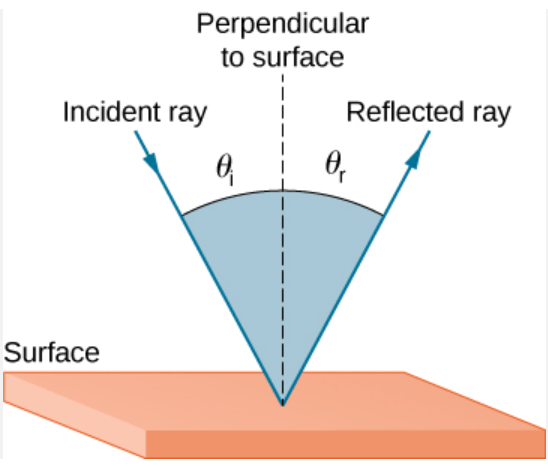
If the angle of incidence is 20 degrees, what will be the value of the angle of reflection?
(Si el ángulo de incidencia es de 20 grados, ¿cuál será el valor del ángulo de reflexión?)
0
10
20
30
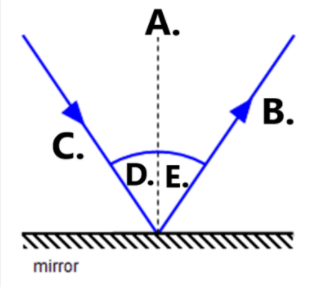
In the diagram, which letter represents the angle of incidence?
(En el diagrama, ¿qué letra representa el ángulo de incidencia?)
B
C
D
E
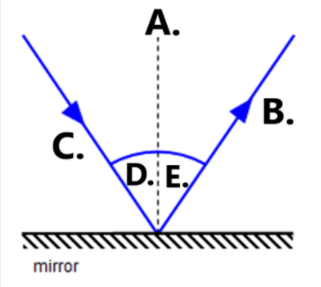
In the diagram, which letter represents the angle of reflection?
(En el diagrama, ¿qué letra representa el ángulo de reflexión?)
B
C
D
E
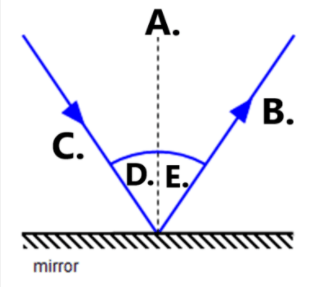
In the diagram, which letter represents the incoming wave?
(En el diagrama, ¿qué letra representa el haz entrante?)
A
B
C
D
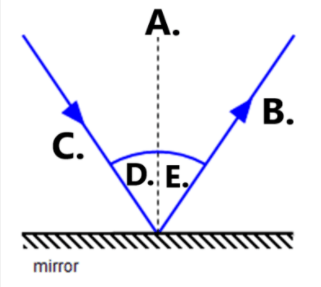
In the diagram, which letter represents the reflected wave?
(En el diagrama, ¿qué letra representa el rayo reflejado?)
A
B
C
D
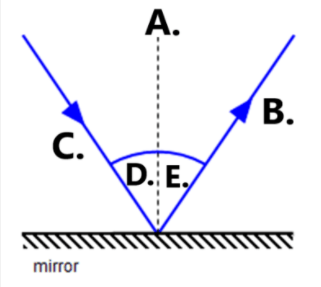
In the diagram, which letter represents the normal line?
(En el diagrama, ¿qué letra representa la línea normal?)
A
B
D
E
The bending of waves due to a change in speed is called...
(a)
When a wave bounces straight off a surface is called...
(a)
When a wave moves around a barrier or through an opening in a barrier...
(a)
(a) is when waves meet
(a) interference is when waves meet and form a wave with a smaller amplitude.
(a) interference is when waves meet and form a wave with a larger amplitude.

What type of interference is represented in this diagram?
Constructive
Destructive

What type of interference is represented in the diagram?
Constructive
Destructive

What's happening at A?
Two crests are combining to create constructive interference.
A crest and a trough are combining to create destructive interference.
Two crests are combining to create destructive interference.
A crest and trough are combining to create constructive interference.

What is happening at B?
Two crests are combining to create constructive interference.
A crest and a trough are combining to create destructive interference.
Two crests are combining to create destructive interference.
A crest and a trough are combining to create constructive interference.

What type of interference do noise cancelling headphones use?
Constructive Interference
Destructive Interference

Which type of interference occurs when sound waves produced by wind instruments become louder?
Constructive
Destructive

When a compression interferes with another compression, what occurs?
They counteract and the wave stops.
They combine to create a larger compression.
They combine to create a rarefaction.
None of the above.
When a crest and a trough interfere, what occurs?
They combine to create a higher amplitude wave.
They counteract and the wave either lessens or stops completely.
The wave changes into a longitudinal wave.
When 2 waves meet on the same medium, how do they interact?
They bounce off one another
They travel through one another
They refract off one another

What type of interference is being shown in the picture?
Constructive
Destructive

What type of interference is occurring in the picture?
Constructive
Destructive

Standing waves are created by
Two identical waves reflecting off each other
Two identical waves being diffracted together
Two identical waves move through each other in opposite directions
Two identical waves are diffracted from two identical sources
In the diagram which letters represent the nodes
A B C
A C E
B D
B D E
A C D


How many antinodes does this standing wave have?
5
6
7
8
Definition: When one object vibrating at the same natural frequency of a second object forces that second object into vibrational motion.
Reflection
Refraction
Diffraction
Resonance



