
 Worksheets
General physics
Total questions: 100
Worksheet time: 1hrs 29mins

A student wishes to find the volume of a small, irregularly-shaped stone.
A ruler and a measuring cylinder containing some water are available.
Which apparatus is needed?
neither the ruler nor the measuring cylinder
the measuring cylinder only
the ruler and the measuring cylinder
the ruler only
A measuring cylinder is used to measure the volume of a quantity of water.
Which measuring technique would not improve the accuracy of the measurement?
making sure that the measuring cylinder is vertical
making sure that the water surface is at eye level
reading the top of the water meniscus
using the smallest measuring cylinder available that will contain all the water

The diagram shows four identical spheres placed between two wooden blocks on a ruler.
What is the diameter of one sphere?
1.0 cm
2.0 cm
3.0 cm
4.0 cm
A cook wants to prepare some food to be cooked by 1.15 p.m. He uses an oven with an automatic timer that can be set to switch on and off at certain times. The oven needs to be switched on for 2 hours 10 minutes.
At which time does the oven need to switch on?
11.05 a.m
11.25 a.m
3.05 p.m
3.25 p.m
Which option contains only apparatus that could be used to determine the volume of a small block of unknown material?
measuring cylinder, metre rule
measuring cylinder, stopwatch
metre rule, balance
metre rule, stopwatch
A student uses a measuring cylinder to measure the volume of a quantity of water.
Which action would make her result less accurate?
making sure her eye is level with the water surface
making sure the cylinder is vertical
reading the bottom of the meniscus
using the largest measuring cylinder possible

A student uses a measuring cylinder to measure the volume of some water. The diagram shows part of the measuring cylinder. The top and bottom of the meniscus are labelled.
What is the volume of the water?
47.0 cm3
47.5 cm3
49.0 cm3
47.5 cm3

The diagram shows part of a ruler. The ruler is used to find the length of a nail.
What is the length of the nail?
2.2 cm
2.7 cm
3.2 cm
3.7 cm

A stopwatch is used to time a runner in a race. The diagrams show the stopwatch at the start and at the end of a lap of the race.
How long did the runner take to finish the lap of the race?
50.00 seconds
50.10 seconds
90.00 seconds
100.10 seconds
How many seconds are in a minute?
10
30
60
25
How many minutes are in an hour?
10
60
25
30
How many hours are in a day?
24
30
6
10
How many months are in a year?
24
36
52
12
How many eggs make a dozen?
3
6
9
12
How many days make a year?
250
1,000
180
365
How many days make a full week?
7
5
14
10

The diagram shows an enlarged drawing of the end of a metre rule. It is being used to measure the length of a small feather.
What is the length of the feather?
19 mm
29 mm
19 cm
29 cm

A student wishes to find the volume of a small, irregularly-shaped stone.
A ruler and a measuring cylinder containing some water are available.
Which apparatus is needed?
neither the ruler nor the measuring cylinder
the measuring cylinder only
the ruler and the measuring cylinder
the ruler only

The diagram shows a ball hanging on a string. The ball swings from point W to point Z and back to point W.
Which statement about the ball is correct?
The kinetic energy of the ball is greatest at point W.
The kinetic energy of the ball is greatest at point X
The kinetic energy of the ball is greatest at point Y.
The kinetic energy of the ball is the same at all points of the swing.

The diagram shows a measuring instrument.
Which quantity is this instrument used to measure?
area
density
mass
volume

The diagram shows a measuring cylinder used to measure the volume of a small stone.
What is the volume of the stone?
8 cm3
9 cm3
14 cm3
26 cm3

A student uses a measuring cylinder to measure the volume of some water. The diagram shows part of the measuring cylinder. The top and bottom of the meniscus are labelled.
What is the volume of the water?
47.0cm3
47.5cm3
49.0cm3
49.5 cm3

Diagram 1 shows a measuring cylinder containing water.
Five identical steel balls are now lowered into the measuring cylinder. Diagram 2 shows the new water level in the cylinder.
What is the volume of each steel ball?
6 cm3
14 cm3
30 cm3
70 cm3

The diagrams show the readings on a measuring cylinder before and after a small metal cube is added.
How many more identical cubes can be added to the cylinder, without causing the water to overflow?
Do not include the cube already in the cylinder.
1
2
3
4

A student measures the length of a rod XY by holding it next to a metre rule.
The student writes down the length as 94.8cm.
Which statement is correct?
The value is correct.
The value is incorrect because it should be 95.2cm.
The value is incorrect because it should be in millimetres.
The value is incorrect because the student should subtract the reading for end Y from the reading for end X.

A student uses a ruler to measure the length and the width of a small rectangular metal plate.
What is the area of the plate?
14.0 cm2
14.7 cm2
16.0 cm2
16.8 cm2

A cyclist rides round a track three times.
er friend uses a stopwatch to record the time at the start of the ride, after one circuit, and at the end of the three circuits. The readings from the stopwatch are shown.
What is the average time for one circuit of the track?
174 s
180 s
198 s
200 s

A cylindrical can is rolled along the ruler shown in the diagram. The can rolls over twice.
What is the circumference (distance all round) of the can?
13 cm
14 cm
26 cm
28 cm

Drops of water are dripping steadily from a tap. The diagram shows a measuring cylinder which has collected 120 drops of water.
How many drops in total will have been collected when the measuring cylinder reads 10 cm3?
48
60
180
300

An elastic material can change shape when ________ is exerted on it.
a force
a moment
an acceleration

If tension is applied, the object may be stretched.
We say the object has been __________.
compressed
extended
twisted

A deformation is a change in _________.
speed
shape
direction

If a compression force is applied, the object may be squashed. We say the object has been __________.
compressed
extended
twisted

Which equation could be used to calculate the extension of an object?
extension = stretched length × original length
extension = stretched length ÷ original length
extension = stretched length + original length
extension = stretched length – original length

What is the extension of the spring?
6 cm
9 cm
3 cm
2 cm
Which materials do not break easily and return to their original shape when forces acting on them are removed?
Elastic
Strong
Plastic
Brittle
Robert Hooke investigates springs by seeing how a load affected their.....
extension
correlation
temperature
energy
Hooke's Law does not apply if....
the spring is stretched too far
the spring is compressed
the spring is not made of steel
masses are used instead of weights
The elastic limit is the point at which ..
the spring does not return to its original size
the spring snaps
there is no more room to attach masses
the spring unravels

A car moves along a level road.
The diagram shows all of the horizontal forces acting on the car.
Which statement is correct?
The car is slowing down.
The car is speeding up.
The car is moving at a constant speed.
The car is moving backwards.
Which force and distance produce the smallest moment about a pivot?
a 6.0 N force at a perpendicular distance of 4.0m from the pivot
a 7.0 N force at a perpendicular distance of 6.0 m from the pivot.
a 10 N force at a perpendicular distance of 4.0 m from the pivot
a 12 N force at a perpendicular distance of 3.0 m from the pivot.
A resultant force of 4.0N acts on an object of mass 0.50 kg for 3.0 seconds.
What is the change in velocity caused by this force?
4.0 m / s
6.0 m / s
12 m / s
24 m / s

The diagram shows a tug-of-war between team X and team Y. The arrows show the forces exerted by the teams on the rope.
What is the size of the resultant force on the rope and in which direction does the resultant force act?
size of resultant force = 75 N; direction of resultant force = to the left
size of resultant force = 75 N; direction of resultant force = to the right.
size of resultant force = 725 N; direction of resultant force = to the left
size of resultant force = 725 N; direction of resultant force = to the right.
Which property of an object cannot be changed by a force?
mass
motion
shape
size

An unstretched spring obeys Hooke’s law and has a length of 10 cm. A load with a mass of 2.0 kg is hung from it, and its length becomes 14 cm.
The load is now increased to 6.0 kg, and the new length of the spring is Y. The limit of proportionality is not reached.
What is Y?
22 cm
26 cm
30 cm
42 cm

A spring is suspended from a stand. Loads are added and the extensions are measured.
Which graph shows the result of plotting extension against load?


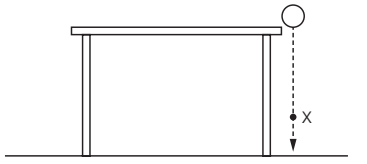
A ball is dropped from a table-top. Air resistance may be ignored.
Which row describes the velocity and the acceleration of the ball at point X
acceleration = constant; velocity = constant
acceleration = constant; velocity = increasing
acceleration = increasing; velocity = constant
acceleration = increasing; velocity = increasing
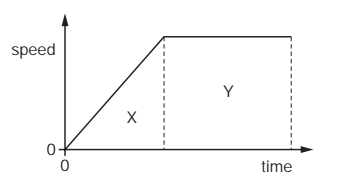
The diagram shows the speed-time graph for a car.
Which area represents the distance travelled while the car is accelerating?
X
X + Y
Y
Y - X

A wooden bar is pivoted at its centre so that it can rotate freely. Two equal forces F are applied to the bar.
In which diagram is the turning effect greatest?


A hole is drilled in a square tile. The diagram shows the tile hanging freely on a nail.
Where is the centre of mass of the tile?
A
B
C
D

A balloon and a mass are attached to a rod that is pivoted at P.
The balloon is filled with helium, a gas less dense than air, so that it applies an upward force on the rod.
The rod is horizontal and stationary.
Which action causes the rod to rotate clockwise?
Move both the balloon and mass 10 cm to the left.
Move both the balloon and mass 10 cm to the right.
Move both the balloon and mass to the 25 cm mark
Move the balloon to the 20 cm mark and the mass to the 30 cm mark.

A ball of mass 0.50 kg falls and hits the floor at 10 m / s.
It rebounds at speed 8.0 m / s, as shown.
The collision between the ball and the floor lasts for 0.50 s.
What is the average force acting on the ball during the collision?
2.0 N upwards
2.0 N downwards
18 N upwards
18 N downwards

A gas molecule strikes the wall of a container. The molecule rebounds with the same speed.
What happens to the kinetic energy and what happens to the momentum of the molecule?
Kinetic energy changes; momentum changes
Kinetic energy changes; momentum stays the same.
Kinetic energy stays the same; momentum changes
Kinetic energy stays the same; momentum stays the same.

A tennis ball of mass 0.060 kg travels horizontally at a speed of 25 m/s. The ball hits a tennis racket and rebounds
horizontally at a speed of 40 m/s.
The ball is in contact with the racket for 50 ms.
What force does the racket exert on the ball?
0.018 N
0.078 N
18 N
78 N
Momentum is a ____________________ quantity
science
scalar
vector
energy
Momentum is the product of mass and velocity
TRUE
FALSE
The momentum of an object depends upon the object's ___________&_____________.
size and shape
mass and speed
mass and veloctiy
mass and energy
A car is of mass 15kg is travelling east at a velocity of 3m/s. the value of its momentum is:
30kg.m.s-1
45kg.m.s-1
18kg.m.s-1
5kg.m.s-1
If you double the velocity of an object, then its momentum will ______________.
will double
will half
will quadruple (x4)
will be quartered (x 1/4)
An impulse depends on
weight and force
force and time
electric charge and time
none of these
An object having a pi of 30kg m/s has ended with a pf of 40 kg m/s. What impulse caused this?
2kg m/s
10kg m/s
70kg m/s
5kg m/s
If the change of momentum of an object is 50kg m/s, we can say the impulse is equal to:
0 kg m/s
25 kg m/s
50 kg m/s
100 kg m/s
An object has pi of 20 kgm/s and then pf of 30 kgm/s. If it took 2s, what is the force?
10N
4N
5N
50N
An object has Pi of 20 kgm/s ends with a Pf of 40 kgm/s. How long would a 5N force need to act?
3s
8s
7s
4s
An object with 20kgm/s is stopped by a force of -20N, how long does it take to do this?
2s
1s
4s
5s
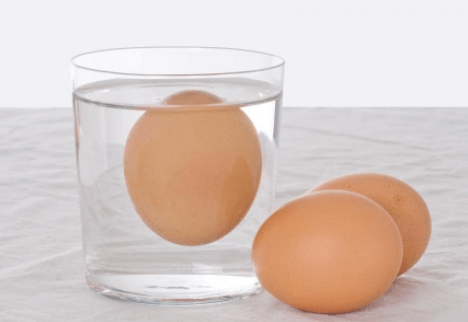
An egg gets dropped from a height of 0.1 meters and cracks. A second egg gets dropped from the same height but this time it lands on a glass of water and does not break. In terms of impulse.
1st egg experienced more impulse
2nd egg experienced more impulse
both experienced the same impulse
The air bag on a car reduces the force experienced by the driver, by extending the time of impact.
True
False

Impulse is equal to the variables shown in the equation below.
True
False
You find that an objects final momentum is 45kg m/s, and the impulse that caused this was 45kg m/s, what must have been the objects initial momentum?
45kg m/s
0 kg m/s
22.5kg m/s
need more information




meausuring cylinder

