
 Worksheets
Volcanic and Seismic Concepts
Total questions: 70
Worksheet time: 1hrs 21mins


This famous fault in California has a lot of earthquakes!
New Madrid
Denali Fault
Ramapo Seismic Zone
San Andreas Fault

What type of boundary is shown in the diagram?
Divergent
Convergent
Transform

What type of boundary is shown in the diagram?
Divergent
Convergent
Slide/Transform

What type of boundary is shown in the diagram?
Divergent
Convergent
Slide/Transform


Hot liquids _____ and cold liquids _____.
sink, sink
rise, rise
sink, rise
rise, sink

Convention currents are powered by:
Motion
Pressure
Heat
Density

When two plates that differ in _______ collide, volcanoes often form nearby.
Speed
Density
Thickness
Temperature
Identify the African Plate
Identify the Eurasian Plate
Identify the North American Plate
Identify the Pacific Plate
Identify the Indian Plate
A water harbor or killer wave caused by an earthquake is called a __________________.
tsunami
seismic wave
electromagnetic wave
surfing wave

The point on earth's surface, directly above the focus (or hypocenter) is called the __________________.
epicenter
fault
seismic wave
earthquake place
In an earthquake, the point underground where the rock first begins to move is called the _________________.
focus or hypocenter
epicenter

What is the instrument used to measure earthquakes?
Seismograph
Sling Psychrometer
Spring Scale
Balance
Anemometer
The epicenter is located directly above the (a) , where all of the (b) is released.
Movement within the (a) causes rocks to bend and break due to (b) resulting in (c) that cause earthquakes.
Vibrations that cause earthquakes are called
seismic waves
radio waves
s-waves
The fastest of all 3 wave types and can travel through solids and liquids.
s-waves
p-waves
seismic wave
Surface waves
What are the most destructive waves?
seismic waves
p-waves
s-waves
Surface waves

Seismology (think about what -ology means...)
Branch of science that studies earthquakes
Earthquakes
The sudden return to elastically deformed rock to its original shape.
Focus
The lithosphere includes the crust and the upper area of the
mantle
inner core
plates
outer core

A _______ is a bowl shaped area that may form near a vent at the top of a volcano.
basin
crater
vent
dike



Oceanic & continental are two types of __________.
mantles
crust
lithospheres
cores
Which of these is NOT a layer of the Earth?
Crust
Mantle
Core
Cradle

Put the layers of the Earth in order from outside to inside.
Crust
Mantle
Outer Core
Inner Core

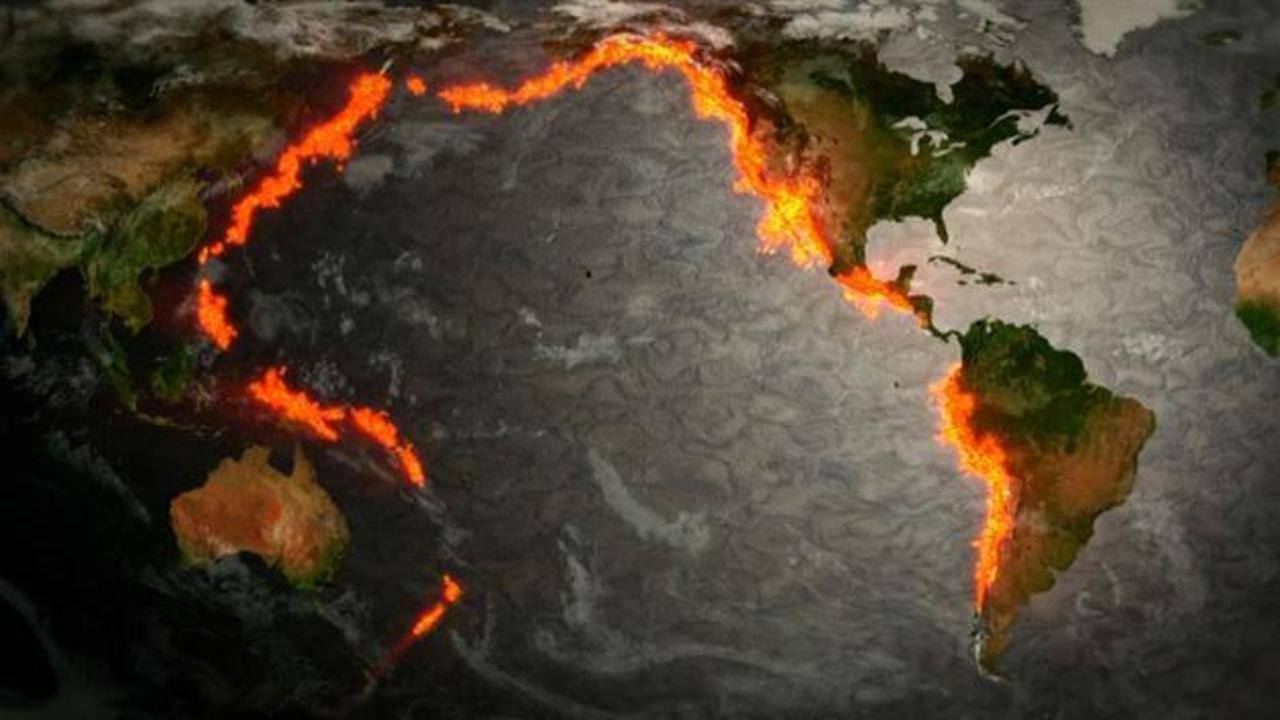
Is there a pattern to the locations of earthquakes and volcanoes around the globe?
No, earthquakes and volcanoes are random.
Yes, earthquakes and volcanoes usually occur near the boundaries of tectonic plates.
yes, earthquakes and volcanoes usually occur in the middle of tectonic plates.
No, earthquakes and volcanoes usually occur under water.
The vibrations flowing out of an earthquake's focus is called a
seismogram
surface wave
seismic wave
seismology
What is a scientist who studies the movement of the earth called?
chemist
biologist
seismologist
astrologist
The strength of an earthquake's seismic waves...
epicenter
magnitude
tsunami
focus
Moves in a straight path with a push-and-pull motion are what type of earthquake wave?
rayleigh wave
S wave
P wave
love wave
Moves in an up-and-down pattern is what type of earthquake wave?
P wave
S wave
rayleigh wave
love wave
Each whole number on a Richter Scale is _______ times greater than the previous one
1000
10
2
100
What does the Richter scale measure?
the strength of earthquakes
the amount of magma released
the time plates will move
all of the above
Which of the following states a fact?
Earthquakes aren't dangerous.
Earthquakes are easy to predict.
Volcanoes are less damaging than earthquakes.
The Earth is constantly changing.
What is magma?
giant pieces of rock and soil that make up the surface of the Earth
cracks in the surface of the earth
melted, liquid rock beneath Earth's crust
enormous ocean waves
How are earthquakes, volcanoes, and tsunamis alike?
All are caused by activity deep in the Earth.
All cause a drop in the Earth's temperature.
All give off poisonous gases.
All of the above.
Which word means cracks in the surface of the Earth usually around the edges of plates.
plates
faults
mudslides
earthquakes
What part of the diagram is magma?
What happens to lava once it reaches the Earth's surface?
It turns into magma.
silica combines with oxygen to make silica oxid
It combines with water to make a base
It becomes gas.
Explain why shield volcanoes have gentle slopes.
They erupt with thick, sticky lava.
They erupt with thin, runny lava.
They are formed by explosive eruptions.
They are formed by ash and cinders.
The amount of ______ determines the the thickness of magma.
oxygen
zinc
silica
sulfur
Which of the following is not a product of an eruption?
water vapor
silica
carbon dioxide
sulfuric acid (sulfur dioxide)
What balloon like plume concentration of hot magma is the creator of the magma chamber?
crater
conduit
sill
hot spot

