wayground logo

Free Printable Worksheets

Font size

S
M
L
XL
Worksheets

Test - Scientific Measurement

Total questions: 99

Worksheet time: 1hrs 19mins

Name
Class
Date
1.
Jack has a rock. The rock has a mass of 14g and a volume of 2cm3. What is the density of the rock?
a)
7 mL
b)
7 g/cm3
c)
28 g/cm3
d)
1/7 g/cm3
2.
Which box has a higher density?  
a)
Box A
b)
Box B
c)
cannot be determined
d)
they are the same
3.
What is the formula for density?
a)
density = mass x volume
b)
density = mass / volume
c)
density = mass + volume
d)
density = mass - volume
4.
Frank has an eraser. It has a mass of 4g, and a volume of 2cm3. What is its density?
a)
8 g/cm3
b)
2 g/cm3
c)
1/2 g/cm3
d)
24 g/cm3
5.
What is the density of water?
a)
0 g/ml
b)
1 g/ml
c)
10 g/ml
d)
100 g/ml
6.
Helium balloons rise on earth because
a)
helium is less dense than air
b)
helium is more dense than air
c)
helium is cooler than air
d)
helium is warmer than air
7.
What is the measuring unit for mass?
a)
centimeter 
b)
millimeter 
c)
grams 
d)
pounds
8.

Which of the following units of measurement are used for volume?

a)

grams

b)

centimeters

c)

grams/milliliter

d)

milliliter

9.
Which liquid is the least dense?
a)
oil
b)
water
c)
syrup 
d)
plastic bottle
10.
Why do objects sink or float in H2O
a)
Because their densities are higher or lower than compared to water
b)
Because their densities are using gravity to pull down
c)
Because their densities are heavier or lighter
d)
Because their mass and volumes are equal 
11.
Define the term "mass".
a)
Mass/Volume
b)
Anything that has mass and takes up space 
c)
The amount of space an object occupies.
d)
The amount of matter in an object.
12.
Volume is ...
a)
Mass/Volume
b)
The amount of matter in an object.
c)
The amount of space an object occupies.
d)
Anything that has mass and occupies space.
13.
Which will float in water (density= 1 g/mL)?
Corn syrup  1.37 g/mL
Vegetable oil  0.91 g/mL
Honey  1.42 g/mL
Lamp oil  0.81 g/mL
a)
Corn syrup and Honey
b)
Vegetable oil and Lamp oil
c)
Corn syrup and vegetable oil
d)
Honey and Lamp oil
14.
A student knows the mass of an object. What other variable does the student need to know to calculate the object's density?
a)
Color
b)
Weight
c)
Volume
d)
Length
15.
Is a measure of heat. 
a)
Temperature
b)
Thermometer
c)
Heat
d)
All of them
16.
Device/Object that measures temperature. 
a)
Thermal energy
b)
Temperature
c)
Thermometer
d)
Heat
17.
A possible explanation to a problem that has not yet been tested. 
a)
data
b)
theory
c)
hypothesis
d)
fact
18.
This variable in an experiment is the one being deliberately changed by the scientist. 
a)
dependent variable
b)
independent variable
c)
data
d)
control group
19.
Should experiments be repeated over and over to see if the results are the same each time?
a)
yes
b)
no
20.
There are two types of data. Which type of data involves numbers that are obtained by counting or measuring?
a)
quantitative
b)
qualitative
21.
The summary at the end of an experiment that explains the results. 
a)
conclusion
b)
procedures
c)
materials
d)
responding variable
22.
There are two types of data. Which type of data involves descriptions/photographs/illustrations that cannot be counted or measured?
a)
qualitative
b)
quantitative
23.
A series of steps used by scientists to solve a problem or answer a question. 
a)
scientific method
b)
recipe
c)
data collection
d)
metric system
24.
In a controlled experiment, how many independent variables can be worked with at a time? 
a)
one
b)
none
c)
two or more
d)
how ever many makes sense.
25.
A list of the steps anyone could follow to conduct an experiment. 
a)
obervations
b)
question/problem
c)
materials
d)
procedures
26.
Which statement is an inference about this picture?
a)
The van is tan.
b)
The  van ran into KFC. 
c)
The driver was hungry. 
d)
Red and white are part of the KFC building. 
27.
Two types of data scientists collect are...
a)
hypothesis and theory
b)
qualitative and quantitative
c)
myths and fables
d)
metric and standard measurements
28.
Jane Goodall video recorded chimpanzees hunting pigs, this type of data is called ___
a)
qualitative
b)
quantitative
c)
field study
d)
observation
29.
Measuring the number of times a person breathes after exercise involves ____ data. 
a)
quantitative
b)
qualitative
30.
A student is planning an experiment to find out how the height from which he drops a ball affects how high the ball bounces. The dependent variable is the _____.
a)
Diameter of the ball
b)
Force acting on the ball
c)
Height that the ball bounces
d)
Height from which the ball is dropped
31.
If I study for my scientific method quiz, then I will have a better test score. What is the dependent variable?
a)
Scientific Method
b)
Studying
c)
Independent variable
d)
Test score
32.
Which is NOT a step in the scientific method?
a)
Make observation
b)
Form a theory
c)
Collect data
d)
Form a hypothesis
33.
Which of these contains steps in the right order?
a)
Ask a question, state your hypothesis, research, experiment, analyze, make a conclusion
b)
State your hypothesis, ask a question, research, experiment, analyze, make a conclusion
c)
Ask a question, research, state your hypothesis, experiment, analyze, make a conclusion
d)
State your hypothesis, ask a question, research, make a conclusion, experiment, analyze
34.
Why do we want to test only one independent variable at a time?
a)
Because it is hard to setup a data table with more than one variable
b)
To better identify what is causing the changes
c)
It is what has always been done
d)
It's easier to perform the experiment
35.
Convert 8 kilometers to meters
a)
800 m
b)
80,000 m
c)
8,000 m
d)
.008 m
36.

How many Hectoliters are in 7 liters?

a)

700

b)

.7

c)

.07

d)

.0070

37.

0.25cm = ? mm

a)

2

b)

2.5

c)

25

d)

2,500

38.

If you study for the test, then you will pass.

a)

Theory

b)

Law

c)

Hypothesis

39.

The universe began 14 billion years ago with a massive expansion event.

a)

Theory

b)

Law

c)

Hypothesis

40.

Earth's average temperature is rising due to greenhouse gases.

a)

Theory

b)

Law

c)

Hypothesis

41.

The planets orbit the sun.

a)

Theory

b)

Law

c)

Hypothesis

42.
A well-substantiated explanation of some aspect of the natural world that can incorporate facts, laws, inferences, and tested hypotheses.
a)
Fact
b)
Theory
c)
Law
d)
Conclusion
43.
Scientific theories are based on
a)
general assumptions of how systems work.
b)
mathematical principles that can be proven true.
c)
large amounts of data collected over time.
d)
observations from within only one scientific discipline.
44.
A scientific ____________ is a statement that describes what always happens under certain conditions in nature.
a)
law
b)
theory
c)
method
d)
variable
45.

The melting point of water is 0 °C (273 K).

The freezing point of water is the same as the melting point which is 0 °C (273 K).

a)

Fact

b)

Theory

c)

Law

46.
Laws tells us that it happens but doesn’t describe how or why.
a)
True
b)
False
47.
A possible explanation to a problem that has not yet been tested. 
a)
data
b)
theory
c)
hypothesis
d)
fact
48.
What do you call the part of the investigation that IS manipulated?
a)
control
b)
independent variable
c)
dependent variable
d)
constant
49.
What do you call the part of the investigation that the scientist is measuring?
a)
control
b)
independent variable
c)
dependent variable
d)
constant
50.

What do you call the part of the investigation that is NOT manipulated?

a)

control

b)

independent variable

c)

dependent variable

d)

constant

51.
Scientists all over the world are sure that all matter is made of atoms.  All of their investigations point to the fact that this is true.  Unfortunately, there is no way to know 100% for sure if atoms are real.  This means that the idea of atoms is a _________.
a)
question
b)
hypothesis
c)
theory
d)
law
52.
An explanation a scientist makes that IS 100% proven based off multiple investigations is called a ___________.
a)
hypothesis
b)
theory
c)
law
d)
question
53.
In 1897, Joseph Thomson discovered that atoms contained electrons.  He proposed a change in the atomic theory of that time, and the theory was modified because of his discovery.  Since Thomson’s discovery, atomic theory has been further modified.  What is the best explanation for why scientific theories are modified?
a)
Theories more than ten years old are usually out of date.
b)
Scientists want to prove that the work of other scientists is wrong.
c)
New evidence that supports a revision prompts scientists to modify earlier theories.
d)
So much information is available today that it is harder to focus research and disprove theories.
54.

When scientists study the natural world, they may form scientific theories and scientific laws. How does a scientific theory differ from a scientific law?

a)

Unlike a theory, a law is not universal.

b)

Unlike a theory, a law describes how the natural world operates.

c)

Unlike a law, a theory is based on observations and experiments.

d)

Unlike a law, a theory can be modified as new evidence is obtained.

55.
Energy is transferred as heat between two objects of ___________ temperatures. 
a)
differing
b)
same
56.

The temperature at which an object's energy is zero is called ____________.

a)

absolute zero

b)

minimum temperature

c)

zero celsius

57.
Absolute zero is...
a)
-273º C
b)
0º C
c)
-373º C
d)
273º C
58.

Absolute zero is...

a)

0º C

b)

0º F

c)

0 K

d)

-0 K

59.
Take your time!
Convert to Kelvins
oC + 273 = Kelvins
Convert 200 oC to Kelvins
a)
73 K
b)
473 K
c)
-73 K
60.
What happens when an object reaches absolute zero?
a)
The molecules stop moving
b)
The molecules move faster
c)
Water freezes
61.
Take your time!
Kelvins - 273 = oC
Convert 400K to Celsius
a)
673 oC
b)
-127 oC
c)
127 oC
62.

Which is the largest unit measure listed

a)

Decimeter

b)

Decameter

c)

Hectometer

d)

Meter

63.

Which two of the following are the same? (2 answers)

a)

1 kilometer

b)

10 meters

c)

100000 millimeter

d)

1 decameter

64.

If there are 10 centimeters in a decimeter, how many decimeters in 1 centimeter?

a)

1 centimeter = 1 decimeter

b)

1 centimeter = 10 decimeter

c)

1 centimeter = 0.01 decimeter

d)

1 centimeter = 0.1 decimeter

65.

What are the Basic Units?

a)

Meter, Liter, Gram

b)

milligram, millimeter, milliliter

66.

2000mg= __________g

a)

2.000 g

b)

20.00 g

c)

200.0 g

67.

480cm=____ m

a)

4.80 m

b)

4.8 m

c)

.480 m

d)

48.0 m

68.

How close a measurement is to the true value is called..

a)

Accuracy

b)

Precision

c)

Significant

d)

Estimate

69.
A set of data are all close to each other, and they are close to the actual value.  This set of data can be described as...
a)
accurate
b)
precise
c)
both precise and accurate
70.
When a measurement is repeatable and consistent it is said to have...
a)
High precision
b)
Low precision
c)
High accuracy
d)
Low accuracy
71.
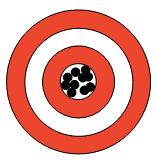
?
a)
High Accuracy & High Precision
b)
High Accuracy & Low Precision
c)
Low Accuracy & High Precision
d)
Low Accuracy & Low Precision
72.
Accuracy is defined as
a)
close repeated measurements
b)
awesome measurements
c)
really good guessing
d)
measurement near the true value
73.
Romy's measurements: 6.02 m, 6. 04 m, 6.03 m
Actual Value: 6.02 m
How would you define her measurements?
a)
accurate and precise
b)
accurate 
c)
precise
d)
neither
74.
What are the units for measuring density of a liquid?
a)
grams
b)
m/s2
c)
g/mL
d)
newtons
75.
If an object has a density of 3.6 g/mL and you put it into water, will it sink or float?  
a)
sink
b)
float
76.
An empty beaker has a mass of 60 grams.  When mercury is added to the graduated cylinder, it has a mass of 200 grams. What is the mass of the mercury?
a)
140 grams
b)
200 grams
c)
140 mL
d)
260 g
77.
Three different people weigh a standard mass of 2.00 g on the same balance.  Each person obtains a reading of 7.32 g for the mass of the standard.  These results imply that the balance that was used is ____.
a)
accurate
b)
precise
c)
accurate and precise
d)
neither accurate nor precise
78.
490,000 g =____ kg
a)
490
b)
49
c)
4,900
d)
0.49
79.
Is 20 g greater than, less than, or equal to 2 kg?
a)
greater than
b)
less than
c)
equal to
80.

When measuring the mass of an apple, I would use...

a)

grams

b)

kilograms

c)

milliliters

d)

liters

81.
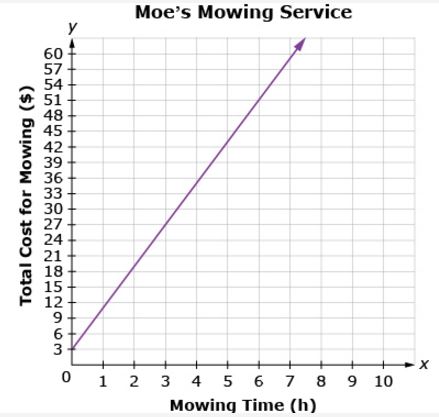
What is the general trend of this line graph?
a)
The more you mow, the less money you make.
b)
You make the same amount of money regardless of how long you mow.
c)
The more you mow, the more money you make.
d)
Mowing is dangerous.
82.
I have two objects with the same volume but different masses.  Which object will be more dense?
a)
The object with less weight.
b)
The object with more weight.
c)
The object with more mass.
d)
The object with less mass.
83.
An object with which of the following densities will float on water?
a)
0.7 g/cm3
b)
1.2 g/cm3
c)
3.5 g/cm3
d)
11.4 g/cm3
84.

A can of Coke will sink in a bowl of water. A can of Diet Coke will float in a bowl of water. What does this tell you about the density of the regular Coke?

a)

it is bigger than 1

b)

it is smaller than 1

c)

it is equal to 1

d)

it is equal to -1

85.
Mercury is a metal that is liquid at room temperature and has a density of 13.5 g/cm3.  Which of these metals would sink below the mercury if dropped into a container of mercury?
a)
gold (density=19.3 g/cm3)
b)
lead (density=11.4 g/cm3)
c)
iron (density=7.9g/cm3)
d)
aluminum (density=2.7g/cm3)
86.
The base unit for length is the
a)
second
b)
gram
c)
meter
d)
liter
87.
The base unit for volume is the
a)
second
b)
gram
c)
meter
d)
liter
88.

Which lists metric units, in order, from smallest to largest?

a)

milligram, centigram, gram

b)

kilogram, gram, centigram

c)

decagram, hectogram, milligram

d)

kilogram, hectogram, decagram

89.
The metric system is based on multiples of:
a)
100
b)
20
c)
10
d)
1
90.
Water freezes at __ degrees Celsius
a)
0 degrees
b)
32 degress
c)
100 degrees
d)
212 degrees
91.
Water boils at __ degrees Celsius
a)
0 degrees
b)
32 degress
c)
100 degrees
d)
212 degrees
92.
To go from kilograms to grams, move the decimal point to the__
a)
left
b)
right
93.
To go from milliliters to liters, move the decimal point to the__
a)
left
b)
right
94.
The base for mass is the
a)
meter
b)
gram
c)
massoliter
d)
liter
95.
You would use Newtons to measure weight because weight is a measure of the ____.
a)
Sun
b)
force of gravity
c)
mass of an object
d)
number of cookies you can eat
96.
The correct abbreviation for milliliter is..
a)
ML
b)
Ml
c)
mL
d)
ml
97.
The abbreviation for gram is...
a)
G
b)
gg
c)
g
98.
Density is...
a)
the amount of mass in an object
b)
the amount of space an object takes up
c)
the amount of mass in a given space
d)
the weight of an object
99.
convert 93.2 dg to dag
a)
0.00932 dag
b)
0.0932dag
c)
0.932 dag
d)
0.000 932dag