wayground logo

Free Printable Worksheets

Font size

S
M
L
XL
Worksheets

waves physics review

Total questions: 100

Worksheet time: 2hrs 20mins
Name
Class
Date
1.
Waves that require a medium are called 
a)
mechanical waves
b)
transverse waves
c)
light waves
d)
gamma rays
2.
What happens when you increase the amplitude of a sound?
a)
it makes the sound louder
b)
it makes the sound travel faster
c)
it increases the wavelength of the sound
d)
it increases the frequency of the sound
3.
What can electromagnetic waves travel through?
a)
mediums
b)
empty space
c)
solely solids
d)
both mediums and empty space
4.
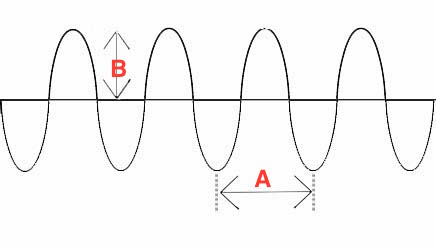
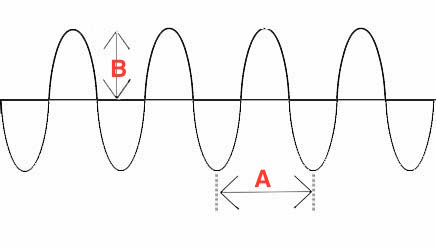
What property of this wave is represented by the letter "A"
a)
amplitude
b)
crest
c)
trough
d)
wavelength
5.
What property of the wave is represented by the letter "B"?
a)
amplitude
b)
crest
c)
trough
d)
wavelength
6.
What do waves carry from place to place?
a)
Energy, but not matter or particles
b)
Energy and matter or particles
c)
Matter or particles but not energy
d)
Neither energy nor matter or particles
7.
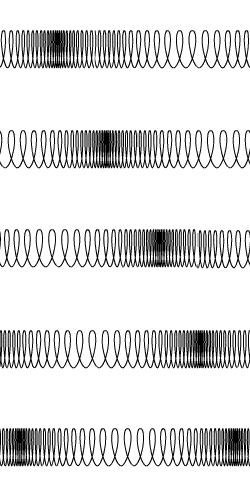
Which wave is pictured?
a)
Transverse
b)
Longitudinal
c)
Both
d)
Neither
8.
A wave carries...?
a)
energy only
b)
matter only
c)
energy and matter
d)
neither
9.
What type of wave move a slinky back and forth?
a)
longitudinal
b)
transverse
10.
What type of wave is this?
a)
Longitudinal
b)
Transverse
11.
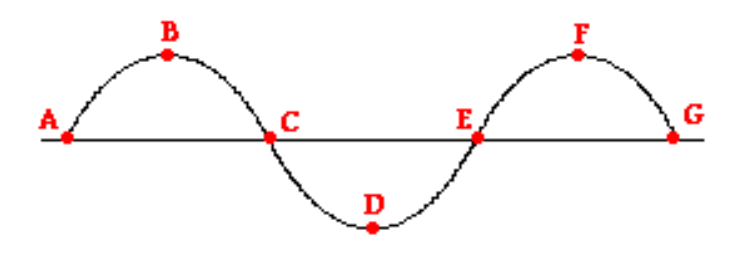
What part of the wave is shown at letter A?
a)
crest
b)
trough
c)
wavelength
d)
frequency
12.
Which part of the wave is shown at letter B?
a)
crest
b)
trough
c)
wavelength resting point
13.
Which part of the wave is shown at letter C?
a)
crest
b)
wavelength
c)
resting point
d)
amplitude
14.
Which part of the wave is shown at letter D?
a)
trough
b)
resting point
c)
wavelength
d)
frequency
15.
Which part of the wave is shown at letter E?
a)
trough
b)
crest
c)
resting point
d)
amplitude
16.
What does a wave carry?
a)
boats
b)
matter
c)
energy
d)
water
17.
What is the frequency of this wave?
a)
3 Hertz
b)
4 Hertz
c)
5 Hertz
d)
6 Hertz
18.
If there is no wave, the particles would be at the _____________________.
a)
wavelength
b)
resting point
c)
trough
d)
beach
19.
When wavelength increases, what happens to the frequency?
a)
it increases
b)
it decreases
c)
it stays the same
20.
What is the speed of a wave that has a wavelength of 2 and a frequency of 2.5?
a)
2.5 m/s
b)
5 m/s
c)
4.5 m/s
d)
6 m/s
21.
Which wave has a longer wavelength?
a)
wave C
b)
wave D
22.
Which wave has a greater frequency?
a)
wave B
b)
wave C
23.
Which wave has the most energy?
a)
top wave
b)
bottom wave
24.

You can't hear sounds in outer space because there is no

a)

medium

b)

light

c)

energy

d)

heat

25.

All waves carry ________ as they travel from one place to another.

a)

matter

b)

space

c)

energy

d)

water

26.

Which letter(s) represent the crest of the wave?

a)

A

b)

B & D

c)

B & F

d)

F

27.
Longitudinal waves are ______.
a)
Parallel
b)
Perpendicular
c)
Crazy
28.
Transverse waves are ___.
a)
Parallel
b)
Perpendicular
c)
Weird
29.
What is the wavelength?
a)
Length
b)
Height
c)
# of waves
30.
What is the amplitude?
a)
length
b)
height
c)
# of waves
31.
If the frequency gets higher, the wavelength gets 
a)
longer
b)
shorter
32.
If the wavelength gets longer, the frequency gets 
a)
higher
b)
lower
33.
The pitch of the sound depends on
a)
frequency
b)
amplitude
c)
wavelength
34.
The loudness of the sound depends on
a)
wavelength
b)
amplitude
c)
frequency
35.
Which electromagnetic wave is responsible for cell phones?
a)
gamma
b)
xray
c)
microwaves
d)
radio
36.
Which EM wave is used to treat cancer?
a)
gamma
b)
radio
c)
xray
d)
infrared
37.
Which EM wave has the lowest frequency?
a)
radio
b)
xray
c)
gamma
d)
infrared
38.
Which EM wave has the longest wavelength?
a)
light
b)
radio
c)
ultraviolet
d)
red
39.
Is refracting light bending or bouncing?
a)
bending
b)
bouncing
40.
A blue tshirt looks blue because of ___.
a)
reflection
b)
refraction
c)
diffraction
41.
Rainbows are ______ light.
a)
Refracting
b)
Reflecting
c)
Diffracting
d)
Absorbing
42.
Which color has the highest frequency?
a)
blue
b)
yellow
c)
orange
d)
violet
43.
When light hits a black object, like the one in the picture, what will happen to the different colors?
a)
All colors of light will bounce off
b)
All colors of light pass through it
c)
All colors of light will be absorbed
d)
None of the above
44.
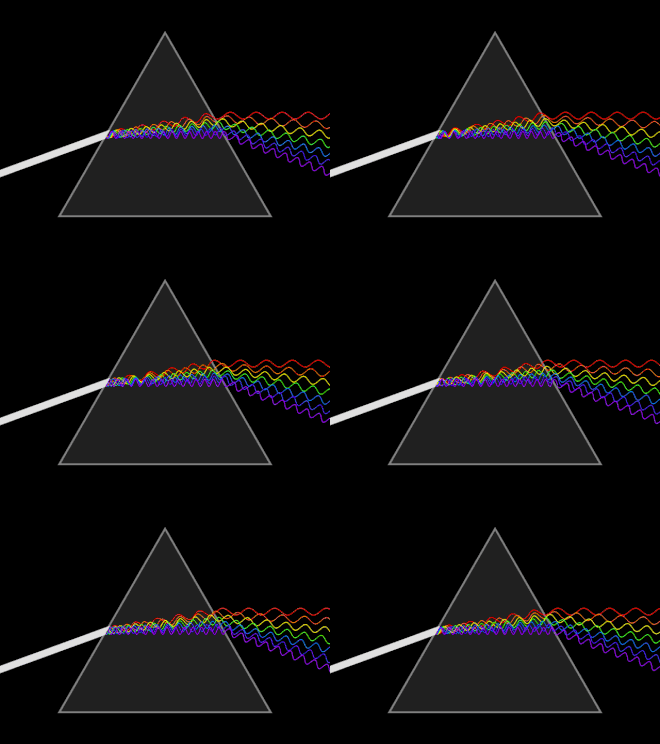
When light hits something like a raindrop or a prism, it will...
a)
Be absorbed
b)
Refract, or bend
c)
Neither 
45.

An airplane that goes slower than the speed of sound

a)

subsonic

b)

supersonic

c)

hypersonic

46.

An airplane that goes so fast that heat starts to become a critical factor

a)

subsonic

b)

transonic

c)

supersonic

d)

hypersonic

47.

How is wavelength measured?

a)

From trough to crest (B to D)

b)

From the center line to the crest (B to C)

c)

From the crest of one wave to the crest of the next (B to F)

d)

From one end of the wave to the far end of the wave (A to H)

48.
True or False: 
Frequency is how many waves pass per second. 
a)
True
b)
False
49.
If you increase frequency what happens to the wavelength?
a)
Wavelength increases
b)
Wavelength decreases
c)
Wavelength remains the same
50.
When amplitude is increased how will it effect a light wave?
a)
Increase fequency
b)
Increased brightness
c)
Increases volume
d)
Decreases brightness 
51.

Why are oranges orange...?

a)

Because they emit orange light from their cells

b)

Because they absorb all visible wavelengths except orange (630-605 nm) which is reflected back into your eyes

c)

Because they are actually a combination of some green and a little more red light

d)

Because orange is the yummiest color

52.
What do we call the section of the EM spectrum that humans can perceive? 
a)
Ultraviolet
b)
The rainbow
c)
The visible spectrum
d)
Black and white
53.
What is really happening when you see white light?
a)
You are seeing white light
b)
You are seeing a rainbow that's been combined
c)
You are seeing equal parts red, green, and blue light
d)
You are only seeing florescent light
54.

This picture is an example of what kind of wave?

a)

Particle wave

b)

Sound wave

c)

Light wave

d)

Snow wave

55.
Which wave has the largest frequency?
a)
A
b)
B
c)
C
d)
None (same frequency)
56.
If all three are waves of light, which wave has the largest speed?
a)
A
b)
B
c)
C
d)
None (same speed)
57.

The highest point on a transverse wave is the

a)

compression

b)

crest

c)

rest position

d)

trough

58.

Mechanical waves usually travels fastest as the temperature of the medium:

a)

increases

b)

decreases

c)

stays the same

59.

Mechanical waves usually travel fastest through:

a)

solids

b)

liquids

c)

gases

60.

Which are properties of a mechanical wave?

a)

can be longitudinal or transverse

b)

can move through space

c)

must have matter to move

d)

carries energy

61.

What are properties of electromagnetic waves?

a)

carry energy

b)

can move through space

c)

can move through matter

d)

include x-rays

62.

Water waves are unique because they:

a)

are transverse waves

b)

are longitudinal waves

c)

carry energy

d)

move matter from place to place

63.

What is the speed of sound?

a)

760 miles per hour

b)

1220 miles per hour

c)

1337 miles per hour

64.

The first airplane to fly faster than sound.

a)

Bell X-1

b)

Concorde

c)

Space Shuttle

65.

In the diagram, which letter represents the angle of incidence?

a)

A

b)

B

c)

C

d)

D

66.

Which diagram represents specular reflection?

a)

A

b)

B

67.
Law of reflection state that - The angle of incidence is .................. to the angle of reflection.
a)
equal
b)
double
c)
half
68.
........... – the angle between the normal and the reflected ray.
a)
Angle of incidence
b)
Angle of reflection
c)
Angle of coincidence
d)
Angle of direction
69.
What is reflection?
a)
Reflection is the bouncing  of light off the surface that it strikes on.
b)
Reflection is the absorbing of light off the surface that it strikes on.
c)
Reflection is the bending of light off the surface that it strikes on.
d)
Reflection is the scattering of light off the surface that it strikes on.
70.
........... – the angle between the normal and the incident ray.
a)
Angle of incidence
b)
Angle of reflection
c)
Angle of coincidence
d)
Angle of direction
71.
How does light travel
a)
It curves around corners
b)
Really slow
c)
In a straight line
d)
In circles
72.
Which term describes when light bounces off of a smooth surface?  
a)
Refraction
b)
Transmission
c)
Absorption
d)
Reflection
73.

Which diagram represents diffuse reflection?

a)

A

b)

B

c)

C

d)

D

74.
The ray of light that strikes a reflecting surface is called ________.
a)
incident ray
b)
reflected ray
c)
normal ray
d)
none of the above
75.
The imaginary line perpendicular to a reflecting surface is called _____.
a)
crooked line
b)
parallel line
c)
angular line
d)
normal line
76.
straight lines that represent light waves 
a)
Rays
b)
image
c)
lines
d)
visible light
77.
If the angle of incidence is 45 degree, what is the angle between the incident ray and reflecting surface
a)
45
b)
90
c)
180
d)
none of the above
78.
What does incidence angle equal?
a)
reflection angle
b)
∠C
c)
∠D
d)
all of these
79.
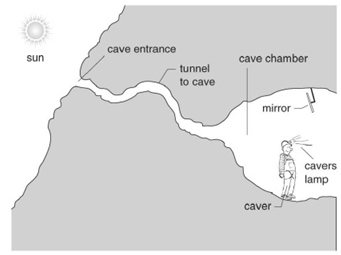
Which of the following is not a source of light? 
a)
A. candle
b)
B. caver’s lamp
c)
C. mirror
d)
D. sun
80.
If his lamp stopped working, what would the caver be able to see? 
a)
A. the tunnel to the cave
b)
B. a mirror
c)
C. nothing
d)
D. the walls of the cave
81.

What type of interference is represented in this diagram?

a)

Constructive

b)

Destructive

82.

What type of interference is represented in the diagram?

a)

Constructive

b)

Destructive

83.

What type of interference do noise cancelling headphones use?

a)

Constructive Interference

b)

Destructive Interference

84.

Sound waves in musical instruments or tubes create standing waves that enhance which type of interference to make louder sounds?

a)

Constructive

b)

Destructive

85.

Through which material does sound travel slowest?

a)

Water

b)

Paper

c)

Aluminum

d)

Air

e)

None of the above

86.

When a crest and a trough interfere, what occurs?

a)

They combine to create a higher amplitude wave.

b)

They counteract and the wave stops.

c)

The wave changes into a longitudinal wave.

d)

They combine to create a low amplitude wave.

87.

What creates the Doppler Effect?

a)

The bunching of waves, then the spreading out of waves creating a change in pitch.

b)

The spreading of sound waves, then the bunching up of sound waves creating a change in pitch.

c)

A consistent frequency that creates the same pitch.

88.
Which of the following will increase the spacing of Young's double slit fringes
a)
A blue light is used instead of a red light
b)
the screen is moved closer to the slits
c)
the slits are moved closer together
d)
Each slit is made wider
89.
Which of the following will decrease the spacing of Young's double slit fringes
a)
Increasing the frequency of the waves
b)
moving the screen further away
c)
decreasing the distance between the slits
d)
Using narrower slits
90.
Which of the following has no effect on the spacing of Young's double slit fringes
a)
Changing the wavelength 
b)
Changing the frequency
c)
Moving the screen further away
d)
Changing the size of each slit
91.

Two waves E and G are shown. The waves have the same speed.

Which statement is correct?

a)

Wave E has a greater amplitude than wave G.

b)

Wave E has a greater intensity than wave G.

c)

Wave E has a smaller frequency than wave G.

d)

Wave E has a smaller wavelength than wave G.

92.

Constructive interference happens when two waves are:

a)

out of phase.

b)

zero amplitude.

c)

in phase.

93.

What principle is responsible for light spreading as it passes through a narrow slit?

a)

refraction

b)

polarization

c)

diffraction

d)

interference

94.

does a constructive interference have a higher or lower amplitude

a)

higher

b)

lower

c)

middle

95.

are destructive and constructive the same

a)

no

b)

yes

96.

what are the different types of interference?

a)

destructive and constructive

b)

good and bad

c)

zach and cody

d)

refraction and reflection

97.

What type of inference is this picture showing

a)

Moksha

b)

Destructive

c)

Restructive

d)

Constructive

e)

Kappa

98.

What causes this result

a)

Hic haec hoc

b)

destructive interference

c)

free gift card giveaway

d)

Constructive interference

99.

What type of interference causes the trough and crest to decrease

a)

Constructive interference

b)

reconstructive interference

c)

Operational definitions

d)

Destructive interference

100.
Two transverse waves overlap.  Crests overlap with troughs.  Troughs overlap with crests.  The waves are
a)
In-phase
b)
Out-of-phase
c)
In-synchronicity
d)
Out-of-synchronicity