
 Worksheets
Physical Science Packet 5 Review
Total questions: 104
Worksheet time: 3hrs 28mins
Joey drives his Skidoo 7 kilometers North. He stops for lunch and then drives 5 kilometers East. What distance did he cover?
Include units in your answer.
(a)
Anthony walks to the pizza place for lunch. He walks 1 km East, then 1 km South, and then 1 km East again. What distance did he cover?
Include units in your answer.
(a)
Joey drives his Skidoo 7 kilometers North. He stops for lunch and then drives 5 kilometers East. What was his displacement?
Include units and direction in your answer using the symbols for North, South, East, and/or West. Round to one place after the decimal.
(a)
Anthony walks to the pizza place for lunch. He walks 1 km East, then 1 km South, and then 1 km East again. What was his displacement?
Include units and direction in your answer. Use the symbols for North, South, East, and/or West. Round your answer to one place after the decimal.
(a)
On his fishing trip, Justin takes the boat 12 km South. The fish aren't biting so he goes 4 km West. He follows a school of fish 1 km North. What distance did he cover?
Include units in your answer.
(a)
On his fishing trip, Justin takes the boat 12 km South. The fish aren't biting so he goes 4 km West. He follows a school of fish 1 km North. What was his displacement?
Include units and direction in your answer. Use the symbols for North, South, East, and/or West. Round your answer to one place after the decimal.
(a)
Preston goes on a camel safari in Africa. Then he travels 5 km North, 3 km East, and then 1 km North again. What distance did he cover?
Include units in your answer.
(a)
Preston goes on a camel safari in Africa. He travels 5 km North, then 3 km East, and then 1 km North again. What was his displacement?
Include units and direction in your answer. Use the symbols for North, South, East, and/or West. Round your answer to one place after the decimal.
(a)



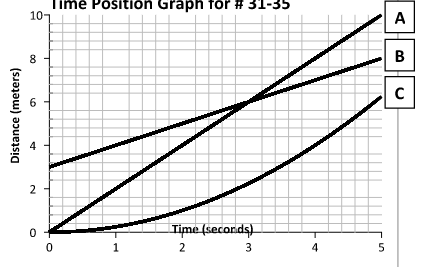
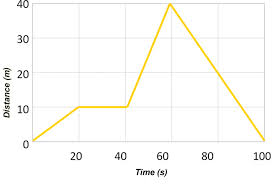

What is happening at E?
Stationary
Accelerating
Fast steady speed; moving away from the starting position
Steady speed; returning to start position

from 3rd second to 5th second, the object is
moving at a constant speed
speeding up
not moving
slowing down
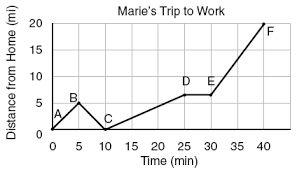
When was Marie driving the fastest?
C to D
D to E
E to F
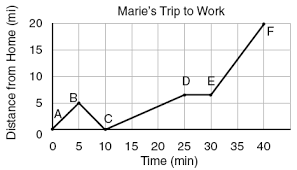
What could account for Marie’s motion at 27 minutes?
She was late so she broke the speed limit
She forgot something at home and ran back to get it
She was stopped at a red light
She was driving across the top of a hill
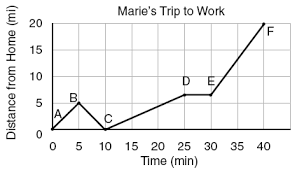
How does her speed at 3 minutes compare with her speed at 7 minutes?
She is driving faster at 3 minutes.
She is driving faster at 7 minutes
She is driving forward at 3 minutes and back at 7.
She is moving up at 3 minutes and down at 7 minutes
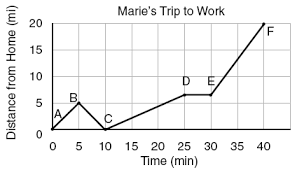
It usually takes Marie 30 minutes to get to work. Did her trip take...
The average amount of time.
Longer then average amount of time.
Shorter then average amount of time.
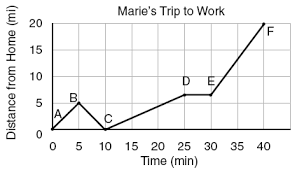
How far away is Marie's work from her house?
40 mi
25 mi
20 mi
5 mi
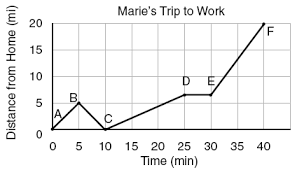
What could be a possible explanation for why Marie turned around at point B.
She arrived at work.
She forgot her lunch
She was waiting at a stop light.
She was sick and went home to sleep.
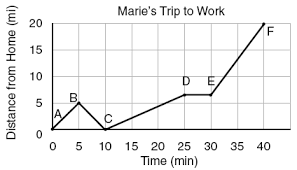
How far did Marie go before she turned around?
20 mi
5 mi
10 mi
25 mi
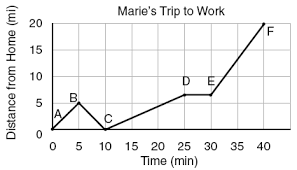
During what period of time was Marie stopped?
0-5 minutes
5-10 minutes
10-25 minutes
25-30 minutes

In Segment DE Marie was stopped at a red light. How long was she stopped for?
1 min.
10 min.
30 min.
5 min.
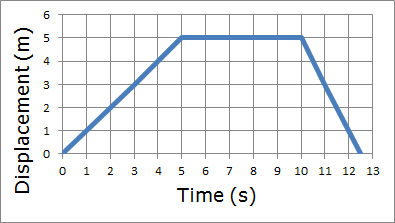
According to the graph, what was the Speed for the first 5 seconds?
1 m/s
0.5 m/s
5 m/s
2 m/s
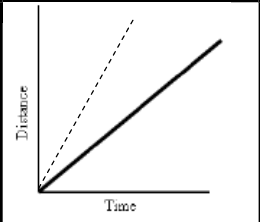
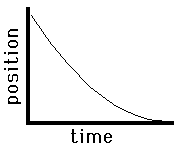
Which of these position vs. time graphs shows an object changing direction?


This position vs. time graph shows an object...
not moving
moving with constant velocity
moving with changing velocity

This position vs. time graph shows an object...
not moving
moving with constant velocity
moving with changing velocity

This position vs. time graph shows an object...
not moving
moving with constant velocity
moving with changing velocity
The location of an object related to a zero point.
position
speed
distance
displacement
Which of these position vs. time graphs shows an object changing direction?
Which of these velocity vs. time graphs shows an object changing direction?


This motion map shows an object...
not moving
moving with constant velocity
moving with changing velocity

This motion map shows an object...
not moving
moving with constant velocity
moving with changing velocity

This velocity vs. time graph shows an object...
(Hint: For this graph, the velocity is 0 m/s!)
not moving
moving with constant velocity
moving with changing velocity

This velocity vs. time graph shows an object...
not moving
moving with constant velocity
moving with changing velocity

This velocity vs. time graph shows an object...
not moving
moving with constant velocity
moving with changing velocity

This position vs. time graph shows an object...
not moving
moving with constant velocity
moving with changing velocity

This position vs. time graph shows an object...
not moving
moving with constant velocity
moving with changing velocity

This velocity vs. time graph shows an object...
not moving
moving with constant velocity
moving with changing velocity
This position vs. time graph shows an object...
not moving
moving with constant velocity
moving with changing velocity
This position vs. time graph shows an object...
not moving
moving with constant velocity
moving with changing velocity
This position vs. time graph shows an object...
not moving
moving with constant velocity
moving with changing velocity

This position vs. time graph shows an object...
speeding up
slowing down

This position vs. time graph shows an object...
speeding up
slowing down

One this graph what is the distance traveled by the object between 0 seconds and 5 seconds of time.
20 m
25 m
22.5 m
-20 m

According to this graph did the object ever have a constant velocity?
Yes, from 1 second to 5 seconds.
Yes, from 8 seconds to 10 seconds
No the object never had a constant velocity.
Yes, from 1-5 seconds and 8-10 seconds

One this graph what is the distance traveled by the object between 5 seconds and 8 seconds of time. Area of a rectangle: A =l ×w
Area of a triangle: A=21 b ×h
55 m
52.5 m
-52.5 m
-55 m

On this graph, what is the change in velocity between 5 seconds and 8 seconds of time.
25 m/s Right
-25 m/s Left
25 m/s/s Right
30 m/s/s Right

On this graph, what is the acceleration between 5 seconds and 8 seconds of time.
8.3 m/s/s Right
-8.3 m/s/s Left
-8.3 m/s Left
8.3 m/s Right

One this graph what is the total displacement the object between 0 seconds and 14 seconds of time.
215 m
215 m Left
215 m Right
215 m Down

According to the data in the graph. What is the average speed of the objects motion between 0 seconds and 14 seconds of time.
15.4 m/s
15.4 m/s Right
15.4 m/s Left
15.4 up

According to the data in the graph. What is the average velocity of the objects motion between 0 seconds and 14 seconds of time.
15.4 m/s Right
15.4 m/s
15.4 m/s Left
15.4 m/s Down

According to the data in the graph, when is the object moving to the right with increasing velocity.
a
b
c
d

According to the data in the graph, when is the object moving to the left with increasing velocity.
c
d
f
a
b

Which x-t graph matches this v-t graph?


Which x-t graph matches the v-t graph shown?


On a velocity-time graph, which variable goes on the y-axis?
velocity
time
acceleration
displacement
On a velocity-time graph, what does the slope represent?
velocity
time
acceleration
displacement
On a velocity-time graph, how is acceleration calculated?
change in x divided by the change in y
change in time divided by the change in velocity
change in velocity divided by the change in time
acceleration cannot be calculated from a v-t graph
A sheepdog starts from rest and accelerates uniformly to a speed of 5.0 m/s in 6 seconds. What is the magnitude of the sheepdog's acceleration?
.80 m/s/s
32 m/s^2
1 m/s^2
1.01543 m/s/s
Flash went from 100 m/s to 180 m/s in 4 seconds. What was her acceleration?
25.25 m/s/s
15 m/s^2
20 m/s/s
1430 m/s^2
Shelvin's Dodge Charger traveled 300 meters in 20 seconds. What was the magnitude of his Charger's average velocity of the car in that 20 second time period?
111.467 m/s
30 m/s
20 m/s
15 m/s
The velocity of Hayling's dog, Charles reaches 6 m/s from rest. Charles moves to the right in 4 seconds to reach that top velocity. What is the acceleration of Hayling's dog?
1 m/s/s to the left
1.5 m/s^2 to the right
13 m/s^2 to the right
22.4683 m/s/s to the left
The speed of little Justin, Jr's red wagon is 2 meters per second. Justin Jr. begins running faster pulling the wagon up to a speed of 4 meters per second in one second. What is the magnitude of the acceleration of Justin Jr's little red wagon in the period of time given?
0.5 m/s/s
3 m/s^2
1 m/s^2
2 m/s/s
A lab experiment was performed and a student got the following speeds at the associated times listed below:
Time (s) / Speed (m/s)
2.0 / 4.0
4.0 / 2.0
6.0 / 0.0
What was the magnitude of the acceleration of the car?
-4 m/s^2
-1 m/s/s
4 m/s^2
1 m/s/s
Which of the following scenarios describes a car which is NOT accelerating?
A car begins to move shortly after a stop light turns green.
A car coming to a stop because a dog runs into the road.
A car turning in a curve as they maintain a constant speed.
A car traveling in a straight line with cruise control set at 50 MPH.

Calculate the average acceleration of the object represented in the graph during segment C only.
-5 m/s/s
5 m/s/s
-3 m/s/s
3 m/s/s
A deer is calmly trotting through the forest at a leisurely pace of 3 m/s when it is startled by a hunter's dog. The deer accelerates to a speed of 21 m/s in 3 seconds. Calculate the deer's acceleration in that 3-second interval.
1 m/s/s
-1 m/s/s
6 m/s/s
-6 m/s/s
On this graph, what is the acceleration between 5 seconds and 8 seconds of time. (Where, V=5m/s @ 5 seconds, and V=30m/s @ 8 seconds)
8.3 m/s/s Right
-8.3 m/s/s Left
8.3 m/s Left
-8.3 m/s Right
5.) An object accelerates 50 m/s2 when a force of 45,000 newtons is applied to it. What is the mass of the object?
(a)

If the mass of the car/man/parachute is 150 kg, what is their acceleration?
0.02 m/s2
50 m/s2
0.11 m/s2
8.82 m/s2
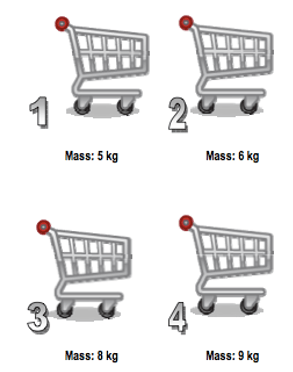
If a force of 90N is applied to each cart below, which one will accelerate the fastest?
Cart 1
Cart 2
Cart 3
Cart 4
Your 2500 kg car experiences a net force of 5000 N. How fast will it accelerate?
20 m/s2
0.5 m/s2
2 m/s2
120 N
True or False. Acceleration of an object is directly proportional to the net force acting on it
True
False

If the man pushes with an equal amount of force, which object will accelerate more?
Car because it has more mass
Lawnmower because it has less mass
Car because it has less mass
Lawnmower because it has more mass

Which of the following has the greatest momentum?
a scurrying cockroach
a parked semi-truck
more information is needed

Which of the following is NOT a unit of momentum?
kg*m/s
N*s
kg*mph
kg*m/s2




Two skaters begin at rest. Skater 1 has a smaller mass than Skater 2. After they push off each other,...
Skater 1 experiences a greater change in momentum
Skater 2 experiences a greater change in momentum
Skater 1 has a greater speed than Skater 2
Skater 1 experiences a greater force


Why does a semi truck have more momentum than a car if they are both traveling at 60kph?
Truck is more massive
Truck is less massive
Car is moving faster
Car is more massive
Which would have more momentum between a train moving at 0 kph and a bug flying at 0.5 kph?
Bug
Train
They are the same
Determine the momentum of 1000-kg car moving northward at 20 m/s.........
20,000 N
20,000 Joules
20,000 Kg * m/s
20,000 kg * m/s north

In any collision (crash) the ______ is ALWAYS constant
total momentum
total speed
total Velocity
Energy

