wayground logo

Free Printable Worksheets

Font size

S
M
L
XL
Worksheets

IIT-JEE & NEET FOUNDATION EXAM LEVEL - 15 (9-T)

Total questions: 100

Worksheet time: 2hrs 40mins

Name
Class
Date
1.

Which do you want the most of in your diet?

a)

Protein

b)

Sugar

c)

Trans Fat

d)

Saturated Fat

2.
The purpose of carbohydrates is:
a)
to provide a layer of insulation for protection.
b)
to boost the immune system and fight off infection.
c)
to provide the body with energy.
d)
to help us get a good night's rest.
3.

Promotes repairing and rebuilding of muscle tissue

a)

Protein

b)

vitamins

c)

minerals

d)

fats

4.

The body's main source of energy

a)

Protein

b)

Vitamins

c)

minerals

d)

Carbohydrates

5.

This nutrient helps keep your bones and teeth strong

a)

vitamins

b)

carbohydrates

c)

Minerals

d)

Fats

6.
Which nutrient carries nutrients to cells and waste from the body?
a)
carbohydrates
b)
proteins
c)
fats
d)
water
7.
Which of the following foods is NOT a carbohydrate?
a)
rice
b)
bread
c)
fruit 
d)
fish
8.
Which of the following foods is NOT a carbohydrate?
a)
rice
b)
bread
c)
fruit 
d)
fish
9.
Which of the following foods is NOT a protein?
a)
Orange
b)
Steak
c)
Eggs
d)
Chicken
10.
True or False:  Water is essential to every body function you have.  
a)
True
b)
False
11.

These help your body fight diseases

a)

protein

b)

carbohydrates

c)

vitamins

d)

minerals

12.

This nutrient helps in digestion, removes waste, and regulates body temperature.

a)

Fats

b)

Water

c)

Carbohydrates

d)

Saturated fats

13.
Grains are a good source of...
a)
Protein
b)
Carbohydrates
c)
Sugar
d)
Water
14.
Grains are a good source of...
a)
Protein
b)
Carbohydrates
c)
Sugar
d)
Water
15.
How does calcium help our body?
a)
Builds muscle
b)
Helps eyesight
c)
Develops red blood cells
d)
Builds strong bones
16.
How does calcium help our body?
a)
Builds muscle
b)
Helps eyesight
c)
Develops red blood cells
d)
Builds strong bones
17.

The role of fibre is to

a)

Strengthen teeth and bones

b)

Keep the digestive system healthy

c)

Provides the body with energy

d)

Repairs muscle and tissues

18.

Vitamin C is important because...

a)

It keeps the immune system healthy

b)

Provides the body with energy

c)

Improves eye health and vision

d)

Reduces the risk of brittle bones

19.

Which vitamin improves the vision of a bird?

a)

Vitamin A

b)

Vitamin C

c)

Vitamin D

d)

Iron

20.

Which vitamin or mineral allows the blood to hold oxygen?

a)

Calcium

b)

Iron

c)

Vitamin A

d)

Vitamin D

21.

Solve

 x3=2\sqrt{x-3}=2  

a)

4

b)

5

c)

6

d)

7

22.

What should you multiply 615\frac{6}{1-\sqrt{5}}  by to rationalize the denominator?

a)

-4

b)

 151-\sqrt{5}  

c)

 1+51+\sqrt{5}  

d)

 (335)2-\frac{\left(3-3\sqrt{5}\right)}{2}  

23.

 21+6\frac{-2}{1+\sqrt{6}}  Rationalize the following:

a)

 1+62\frac{1+\sqrt{6}}{-2}  

b)

 2+265\frac{-2+2\sqrt{6}}{-5}  

c)

 266-\frac{2\sqrt{6}}{6}  

d)

 26-2\sqrt{6}  

24.

Rationalize the following: 23+5\frac{\sqrt{2}}{\sqrt{3}+\sqrt{5}}  

a)

 6108\frac{\sqrt{6}-\sqrt{10}}{8}  

b)

 6102\frac{\sqrt{6}-\sqrt{10}}{-2}  

c)

 6+108\frac{\sqrt{6}+\sqrt{10}}{8}  

d)

 23+252\frac{2\sqrt{3}+2\sqrt{5}}{-2}  

25.

 3 × 5\sqrt{3}\ \times\ \sqrt{5}  

a)

 8\sqrt{8}  

b)

 1515  

c)

 15\sqrt{15}  

d)

 2\sqrt{2}  

26.

 10×5 \sqrt{10}\times\sqrt{5}\   Simplify your answer!

a)

 50\sqrt{50}  

b)

 15\sqrt{15}  

c)

 252\sqrt{5}  

d)

 525\sqrt{2}  

27.

Simplify

 144\sqrt{144}  

a)

 2362\sqrt{36}  

b)

 646\sqrt{4}  

c)

12

d)

 12\sqrt{12}  

28.

 22×352\sqrt{2}\times3\sqrt{5}  

a)

 6106\sqrt{10}  

b)

 10610\sqrt{6}  

c)

 676\sqrt{7}  

d)

 565\sqrt{6}  

e)

 575\sqrt{7}  

29.

simplify

 8\sqrt{8}  

a)

 242\sqrt{4}  

b)

 424\sqrt{2}  

c)

 222\sqrt{2}  

d)

4

30.

 27 + 372\sqrt{7}\ +\ 3\sqrt{7}  

a)

 676\sqrt{7}  

b)

 575\sqrt{7}  

c)

 6496\sqrt{49}  

d)

42

31.

 5 + 45 \sqrt{5}\ +\ \sqrt{45}\   simplifies to...

a)

 50\sqrt{50}  

b)

 225\sqrt{225}  

c)

 454\sqrt{5}  

d)

 10510\sqrt{5}  

e)

 4104\sqrt{10}  

32.

What is the value of k?  12 = k3\sqrt{12}\ =\ k\sqrt{3}  

a)

2

b)

3

c)

4

d)

5

33.

 5 × 5\sqrt{5}\ \times\ \sqrt{5}  simplify your answer!

a)

 25\sqrt{25}  

b)

5

c)

 10\sqrt{10}  

d)

 5\sqrt{5}  

34.

 2(4 + 5)2\left(\sqrt{4}\ +\ 5\right)  

Expand and simplify

a)

18

b)

 24 + 52\sqrt{4\ +\ 5}  

c)

 24+ 102\sqrt{4}+\ 10  

d)

 292\sqrt{9}  

35.

 3(4 + 23)\sqrt{3}\left(4\ +\ 2\sqrt{3}\right)  

Expand and simplify

a)

 636\sqrt{3}  

b)

 43+ 234\sqrt{3}+\ 2\sqrt{3}  

c)

 43 + 294\sqrt{3}\ +\ 2\sqrt{9}  

d)

 43 + 64\sqrt{3}\ +\ 6  

36.

 (2 + 7)(2+ 3)\left(\sqrt{2}\ +\ 7\right)\left(\sqrt{2}+\ 3\right)  

Expand and simplify fully!

a)

 112+2111\sqrt{2}+21  

b)

 4+ 32+ 72+21\sqrt{4}+\ 3\sqrt{2}+\ 7\sqrt{2}+21  

c)

 23 + 10223\ +\ 10\sqrt{2}  

d)

 210+ 232\sqrt{10}+\ 23  

37.

 (3 + 5)(3  2)\left(\sqrt{3}\ +\ 5\right)\left(\sqrt{3}\ -\ 2\right)  

Expand and simplify fully!!

a)

 923+5310\sqrt{9}-2\sqrt{3}+5\sqrt{3}-10  

b)

 33  73\sqrt{3}\ -\ 7  

c)

 43104\sqrt{3}-10  

d)

 33133\sqrt{3}-13  

38.

 (4  3)2\left(4\ -\ \sqrt{3}\right)^2  

Expand and simplify fully!!!

a)

 16 4343+ 916\ -4\sqrt{3}-4\sqrt{3}+\ \sqrt{9}  

b)

 19  8319\ -\ 8\sqrt{3}  

c)

 16  8316\ -\ 8\sqrt{3}  

d)

 16  83+916\ -\ 8\sqrt{3}+\sqrt{9}  

39.

What is a surd?

a)

A person

b)

A number

c)

A fraction

d)

A planet

40.
Simplify as much as possible:
3√8
a)
6√2
b)
√72
c)
12√2
d)
6√4
41.
What  is the formula to calculate heat energy required to raise the temperature of any substance?
a)
Q = m Cp ∆T
b)
Q = m Cp
c)
Q =  ½ m v
d)
m = Q Cp
42.
There are four cups of hot cocoa. The cup sizes are shown. The temperature of the cocoa in each cup is 25 degrees celsius. Which cup has the MOST thermal energy?
a)
Large cup (Trenta)
b)
Small cup (Tall)
c)
Venti
d)
All three are the same temperature so they have same thermal energy
43.
If the specific heat of water is 4,186 J/kg∙°C, how much heat is required to increase the temperature of 1.2 kg of water from 23 °C to 39 °C? 
a)
-80,371.2 J
b)
44,938.6 J
c)
80,371.2 J
d)
112,575.9 K
44.
What would be the effect on the particles if more heat is supplied to the system?
a)
They would slow down
b)
They would stop moving
c)
They would speed up
d)
There would be no effect
45.
A sample of iron receives 50.J of heat energy that raises the temperature of the iron 25.0°C. If iron has a specific heat of  0.10 J/g°C, what is the mass of the iron sample?
a)
25 g
b)
30 g
c)
20 g
d)
50 g
46.
The specific heat is the amount of energy needed to raise the temperature one degree Celsius of 1 gram of a substance.
a)
True
b)
False
47.
What is the symbol for Thermal Energy?
a)
Q
b)
T
c)
m
d)
Cp
48.
What unit do you use to measure Thermal Energy?
a)
J/Kg ºC
b)
Kg
c)
ºC
d)
J
49.
The symbol for specific heat is .......
a)
Cp
b)
Q
c)
m
d)
T
50.
You have 20 g of water with specific heat of 4.18 J/gŸ°C.  The temperature changes from 25° C to 20° C.  How much heat energy (Q) moves from the water to the surroundings?
a)
418 Joules
b)
209 J
c)
83 J
d)
4.18 J
51.
Heat is a form of _______________.  
a)
movement
b)
energy
c)
melting
52.
Heat makes things _______________________
a)
colder
b)
warmer
c)
faster
53.
What will happen to ice if you leave it out in the room?
a)
it will melt
b)
it will stay the same
c)
it will freeze
54.
Something will melt faster in the _______________.
a)
shade
b)
freezer
c)
sun
55.
Does this give off heat? 
a)
yes 
b)
no
56.
Does this give off heat?
a)
yes
b)
no
57.
Does this give off heat? 
a)
yes 
b)
no
58.
Does this give off heat? 
a)
yes
b)
no 
59.
Does this give off heat? 
a)
yes
b)
no 
60.
Does this give off heat? 
a)
yes 
b)
no
61.

cosec 31°-sec59°=.....

a)

1

b)

2

c)

0

d)

1/2

62.

tan60°•tan30°=.....

a)

0

b)

1

c)

2

d)

1/√2

63.

2cos²45°=.....

a)

0

b)

2

c)

1

d)

√2

64.

Find tan(θ).

a)

tan(θ) = 5/13

b)

tan(θ) = 12/13

c)

tan(θ) = 12/5

d)

tan(θ) = 5/12

65.

Find the value of x.

a)

16.0

b)

20.5

c)

20.3

d)

42.2

66.

What is the SINE ratio of any angle in a right triangle

a)

adjacenthypotenuse\frac{\text{adjacent}}{\text{hypotenuse}}

b)

oppositehypotenuse\frac{\text{opposite}}{hypotenuse}

c)

oppositeadjacent\frac{\text{opposite}}{\text{adjacent}}

d)

hypotenuseopposite\frac{\text{hypotenuse}}{\text{opposite}}

67.

What is the COSINE ratio of any angle in a right triangle

a)

adjacenthypotenuse\frac{\text{adjacent}}{\text{hypotenuse}}

b)

oppositehypotenuse\frac{\text{opposite}}{hypotenuse}

c)

oppositeadjacent\frac{\text{opposite}}{\text{adjacent}}

d)

hypotenuseopposite\frac{\text{hypotenuse}}{\text{opposite}}

68.

What is the TANGENT ratio of any angle in a right triangle

a)

adjacenthypotenuse\frac{\text{adjacent}}{\text{hypotenuse}}

b)

oppositehypotenuse\frac{\text{opposite}}{hypotenuse}

c)

oppositeadjacent\frac{\text{opposite}}{\text{adjacent}}

d)

hypotenuseopposite\frac{\text{hypotenuse}}{\text{opposite}}

69.

"θ" is used to represent an unknown ____________.

a)

angle

b)

side

c)

hypotenuse

70.

For the triangle shown, name the hypotenuse.

a)

AB

b)

AC

c)

BC

71.

For the triangle shown, name the opposite side of θ.

a)

KL

b)

LM

c)

KM

72.

For the triangle shown, name the adjacent side of θ.

a)

SR

b)

RT

c)

ST

73.

For the triangle shown, find sin Φ.

a)

pr\frac{p}{r}

b)

qr\frac{q}{r}

c)

qp\frac{q}{p}

d)

pq\frac{p}{q}

74.

For the triangle shown, find sin Φ.

a)

pr\frac{p}{r}

b)

qr\frac{q}{r}

c)

qp\frac{q}{p}

d)

pq\frac{p}{q}

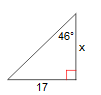
75.
What is the correct equation to solve for x ?
a)
tan( 46 ) = 17/x
b)
sin ( 46 ) = x/17
c)
tan (46 ) = x/17
d)
cos (46) = x/17
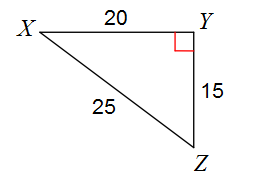
76.
Find the value of tan X.
a)
3/4
b)
4/3
c)
5/3
d)
3/5
77.
What type of triangle is the context of our study of trigonometry?
a)
right triangle
b)
isosceles triangle
c)
scalene triangle
d)
acute triangle
78.

Thinking of equivalent ratios, 1 : 4 is equal to:

a)

2 : 9

b)

4 : 16

c)

6 : 26

d)

8 : 40

79.
What is the length of side x?
a)
6.57 cm
b)
7 cm
c)
7.44 cm
d)
26.33 cm
80.

if sin(x) = 52/65, find cos(x).

a)

cos(x) = 3/5

b)

cos(x) = 5/3

c)

cos(x) = 4/3

d)

cos(x) = 3/4

81.

Find tan(θ).

a)

tan(θ) = 5/13

b)

tan(θ) = 12/13

c)

tan(θ) = 12/5

d)

tan(θ) = 5/12

82.
GOLD
a)
Al
b)
Ag
c)
Ar
d)
Au
83.
CHLORINE
a)
C
b)
Ca
c)
Cl
d)
Cu
84.
CALCIUM
a)
C
b)
Ca
c)
Cu
d)
Cl
85.
CARBON
a)
C
b)
Ca
c)
Cl
d)
Cu
86.
COPPER
a)
C
b)
Ca
c)
Cu
d)
Cl
87.
SILVER
a)
Au
b)
Ag
c)
Al
d)
Ar
88.
SILVER
a)
Au
b)
Ag
c)
Al
d)
Ar
89.
SILICON
a)
S
b)
Si
c)
Su
d)
Sc
90.
SODIUM
a)
S
b)
So
c)
N
d)
Na
91.
HELIUM
a)
H
b)
He
c)
Hl
d)
Hm
92.
HYDROGEN
a)
H
b)
He
c)
Hy
d)
Hd
93.
IRON
a)
I
b)
Ir
c)
F
d)
Fe
94.

ZINC

a)

Zn

b)

Z

c)

Zi

d)

Zc

95.
NICKEL
a)
N
b)
Ni
c)
Nc
d)
Nl
96.
FLUORINE
a)
F
b)
Fl
c)
Fu
d)
Fe
97.
BORON
a)
B
b)
Be
c)
Bo
d)
Br
98.
ALUMINUM
a)
Al
b)
Au
c)
Ag
d)
Am
99.
NEON
a)
N
b)
Ne
c)
No
d)
Nn
100.
NITROGEN
a)
N
b)
Ne
c)
Ni
d)
Nt