
 Worksheets
PRESSURE
Total questions: 96
Worksheet time: 2hrs 36mins


The pressure inside the balloon will:
Decrease
Increase
Remain the same
Not enough information to formulate an answer

The pressure of the gas in the balloon in the ice water will be:
Greater than that of the balloon in the boiling water.
Less than that of the balloon in the boiling water.
The same as that of the balloon in the boiling water.
Not enough information to answer the statement.

This is an example of the everyday application of pressure in:
Solids
Liquids
Gases
Plasma

Weather balloons travel to a great height gathering data before the balloon bursts. This is because the atmospheric pressure (layer of gas surrounding the earth):
Increases the higher you travel.
Decreases the higher you travel.
Remains the same.
Not enough information to answer the question.

The reason gases can be compressed is because:
The particles are very close together.
The particles are merely vibrating.
The particles are unable to move.
The particles are very far apart.
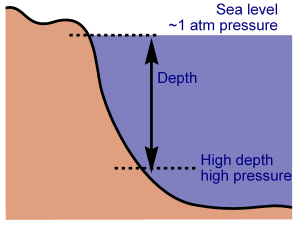
When you increase your depth under water, the water pressure on your body
increases
decreases
stays the same
Why won't you sink in mud if you wear boots?
Because the surface area is larger creating less pressure.
Has air in it to keep you floating.
Because the mud won't want you.

Diagram shows the design of a dam. Why does the thickness of the dam increase with its depth?
The design of this structure is stronger.
Water pressure increases with depth.
The cost of construction is lower.
Water pressure acts uniformly in all directions.
What is pressure?
The amount of force exerted on a surface
The surface area of an object
The weight of an object
An object will float on water if it is
less dense than water.
more dense than water.
the same density as water.


Army tank tracks are useful for travelling through the mud because..
they decrease the force the vehicle exerts on the ground
they increase the force the vehicle exerts on the ground
they decrease the pressure the vehicle exerts on the ground
they increase the pressure the vehicle exerts on the ground
Where would pressure be the greatest
10 m deep in a lake at sea level
5 m deep in a pond on a mountain
top of a mountain 15,000 feet up
on a hill in Oklahoma City (1,200 ft. above sea level)
Choose two correct applications that exert high pressure.
Tractors have big and wide wheels
Press a thumbtack into a plank
Studs on the sole of football boots
Shoulder pad for a school bag
Magdeburg Hemisphere, straw, syphon, and vacuum cleaner are some of the applications of .........
buoyant force
liquid pressure
air pressure
density
Atmospheric pressure depends on .......
mass
density
altitude
magnitude
When a diver dives deeper into the ocean, he will experience ...................... liquid pressure
greater
less
no
The higher the temperature, the .................................. the movement of air particles.
slower
faster
neither
same

If a hairspray can is heated, what can be expected of the pressure of the gas inside the can?
The pressure will increase
The pressure will decrease
The pressure will remain constant
The pressure will equalize

Pressure can be exerted by solids, liquids and gases.
TRUE
FALSE

The pressure inside the syringe will decrease if we move the plunger in:
Direction A
Direction B
We don't have to move the plunger as the pressure will change on its own.
None of the above answers.

We can increase the pressure of a gas by:
Adding more gas.
Reduce the volume of the container.
Increase the temperature of the gas.
None of the above answers.
The reason gases can be compressed is because:
The particles are very close together.
The particles are merely vibrating.
The particles are unable to move.
The particles are very far apart.
In gases, pressure is
directly proportional to volume
inversely proportional to volume
directly proportional to friction
inversely proportional to heat
For a constant temperature, Boyle's law states that
the pressure of a fixed amount of gas is directly proportional to the volume of the gas
the pressure of a fixed amount of gas is inversely proportional to the volume of the gas
the pressure of a fixed amount of gas is independent of the volume of the gas
None of the above
According to Charles Law, if you have a balloon inside a car at noon during a hot summer day the balloon molecules inside will increase in pressure.
True
False
Gas pressure is caused by
Gas molecules heating up
Gas molecules reacting with other gas molecules
Gas molecules hitting the walls of a container
Gas molecules hitting other gas molecules
Cooking gas containers are kept in a lorry moving with uniform speed. The temperature of the gas molecules inside will
Increase
Decrease
Remain the same
Decreases for some, while increase for others
The temperature of gas is held constant, while its volume is decreased. The pressure exerted by the gas on the wall of the container increases, because its molecules
Strike the walls with higher velocities
Strike the walls with large farce
Strike the walls more frequently
Are in contact with the walls for a shorter time
What happens to the volume of the balloon if the temperature increased ?
The volume will increase
The volume will decrease
There will be more energy
There will be less gas pressure
What happen to the pressure if you in a gas if you compressed it in to a volume that was one-third the size ?
The pressure will increase one- third because pressure and volume are inversely proportional
The pressure will decrease by one-third of its original volume
The pressure will increase three times
The pressure will decrease three times
Why the bicycle tyre does not expand like balloon ?
Because the Balloon material is more elastic than bicycle tyre
Because Bicycle tyre is heavier than Balloon
Because the Bicycle tyre have more density than Balloon
Because Bicycle tyre have more are and weight than Balloon


This principle states that the faster a fluid moves, the less pressure the fluid exerts.
Bernoulli's Principle
Newton's Principle
Pascal's Principle
Archimedes' Principle


Where will air move faster - above or below an airplane wing?
above
below
from the image below which represents the correct force of the fluid pressure on solid objects ...


If the density of sea water is 1150 kgm-3 , calculate the pressure at a point 40m below sea level due to the water alone.
using formula; P = ρhg
500kPa
460 kPa
320kPa
20kPa
If the upthrust is more than the weight of the body, then body will (a) .
If a body will be put in water, it will weigh
more than weight in air
less than weight in air
same as weight in air
may be more or less depending on impurities in water
According to Archimedes, loss in weight is equal to
weight of liquid
weight of the body
weight of the liquid displaced by the immersed part of the body
density of liquid
Upthrust is more in sea water than pure water because
sea water is salty
sea water has more density than pure water
sea water has aquatic animals
sea water has waves
One application of Pascal's principle is
a hydraulic car lift
the flight of an airplane
a speedboat's bottom slapping against the waves
the buoyancy shown by ducks and other waterfowl
If an object floats, the volume of displaced water is equal to the volume of
the entire object
the portion of the object that is above water
the portion of the object that is submerged
exactly half of the object
What scientific rule states that the buoyant force on an object is equal to the weight of the fluid displaced by the object?
Archimedes' principle
Pascal's principle
Bernoulli's principle
Newton's third law of motion
A ship stays afloat as long as the buoyant force is
less than the ship's weight
equal to the ship's weight
less than the ship's speed
greater than the ship's speed

This principle says that an increase in pressure on a confined fluid is transmitted equally to all parts of the fluid.
Newton's Principle
Bernoulli's Principle
Archimedes' Principle
Pascal's Principle
Water pressure increases as
depth increases
gravity decreases
force decreases
acceleration increases
What are the states of matter?
solid, liquid, and juice
solid and liquid
solid and gas
solid, liquid, and gas
Pascal states that
Pressure is force per unit area
When velocity is higher, the pressure is lower
When force is applied, the pressure is transmitted equally through the fluid
Pressure transmitted is directly proportional to the force applied
Which object involving pascal principle


Which comparison is correct
F1 = F2
P1 > P2
F1 > F2
P1 = P2
Why oil is the best fluid used in hydraulic system
Oil low density
Oil is incompressible
Oil low specific heat capacity
Oil is opaque

Which statement is correct
P a = P b = P c
A a = A b = A c
F a = F b = F c

What does a hydraulic system do?
decreases surface area
increases velocity
multiplies force
decreases pressure

Which lever configuration is most similar to the hydraulic system pictured?


If a hairdryer blows a stream of air between two soda cans hanging side by side, the soda cans will ____________________.
rise
move away from each other
move toward each other
not move


The correct formula of upthrust is
h ρ
hg
V ρ g
h ρ g

The above diagram shows a vessel called (a) .
What are the 2 things to learn in Archimedes' Principle?
Density&Boyent force
Density & volume
Mass & volume
Time & Velocity

