
 Worksheets
Force and Newton's Laws Review
Total questions: 100
Worksheet time: 3hrs 33mins
What is the unit of force measured in?
Newton
kilograms
meters per second
Joules

Given the FBD, which of the following must be true?
The frictional force must be accelerating the system to the left.
The box must be accelerating to the right.
The box must be moving to the right.
The FBD is incorrectly drawn. This situation isn't possible

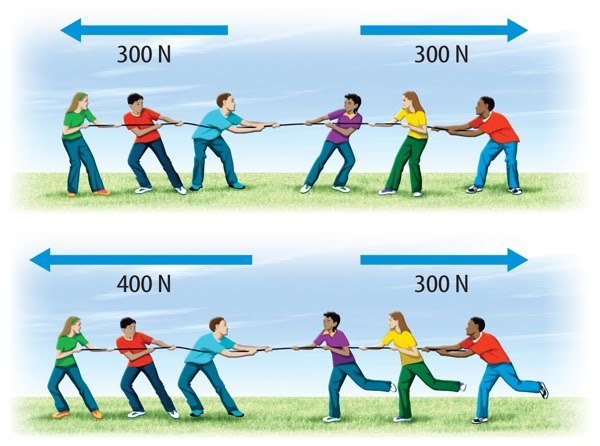
Which of the following statements is true about the image above?
The accelerations of the blocks will vary according to their mass
The net force acting on each block is the same
The blocks will experience the same acceleration
The 3m box will eat the 2m and the m boxes

Sam is hover boarding down they hall at a constant velocity. Assuming there is friction, which of the following must be true?
The force applied by the board must be greater than the frictional force
The frictional force must equal the force applied by the board
The force applied must equal zero
There is not enough information
A man weighing 800 Newtons is standing in an elevator. If the elevator rises with an acceleration of 0.5 meters per second2, the force exerted by the elevator on the man will be
400 N
800 N
1200 N
1000 N

Three forces of equal magnitude act on the box shown. One force is upward, one downward, and one rightward. Which of the following statements must be true based on this information? Select two answers.
The box must have a rightward component of velocity.
The box has no vertical component of velocity.
The acceleration of the box is directed to the right.
The velocity of the box is changing with time.

What is the unit of force measured in?
Newton
kilograms
meters per second
Joules
A net force results in (2 answers needed)
change in velocity
change in direction
both a change in direction and motion
nothing because it is zero
A balanced force results in
a change in velocity
a change in acceleration
a change in direction
nothing - it is zero
Mass is
weight
force
atoms and molecules that make up the object - matter
can change if gravity changes
The more mass an object has the more __________ it has; and the the more it wants to stay as is (rest or motion)
inertia
weight
energy
force

What is the net force of the image? (Measured in Newtons)
30 left
30 right
10 right
-10 left

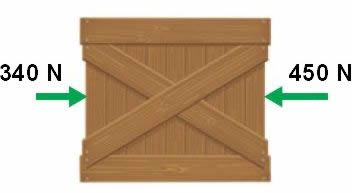
What is the net force of the image (measured in Newtons)
20 right
20 left
40 right
-20 right
If a net force is applied to an object it can (2 answers needed)
change the direction
change the velocity
must change both the direction and velocity
stays at rest

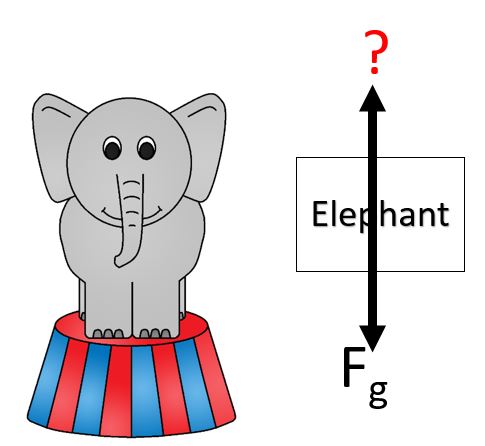
Which statement illustrates Newton's First Law?
A stone will not move unless something pushes or pulls it.
A ball rolling across the floor eventually slows down.
As a car comes to a stop, the passengers continue to move forward.
All of the above
What is the unbalanced force that slows down a ball rolling across the floor?
the force of friction
the force of gravity
the force of inertia
the force of momentum

What type of force is this man using to push his grocery cart?
Normal Force
Gravity
Air Resistance
Applied Force
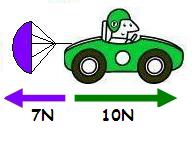
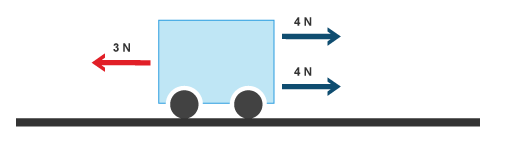
What is the net force?
3 N
3 N, right
17 N, right
3 N, left
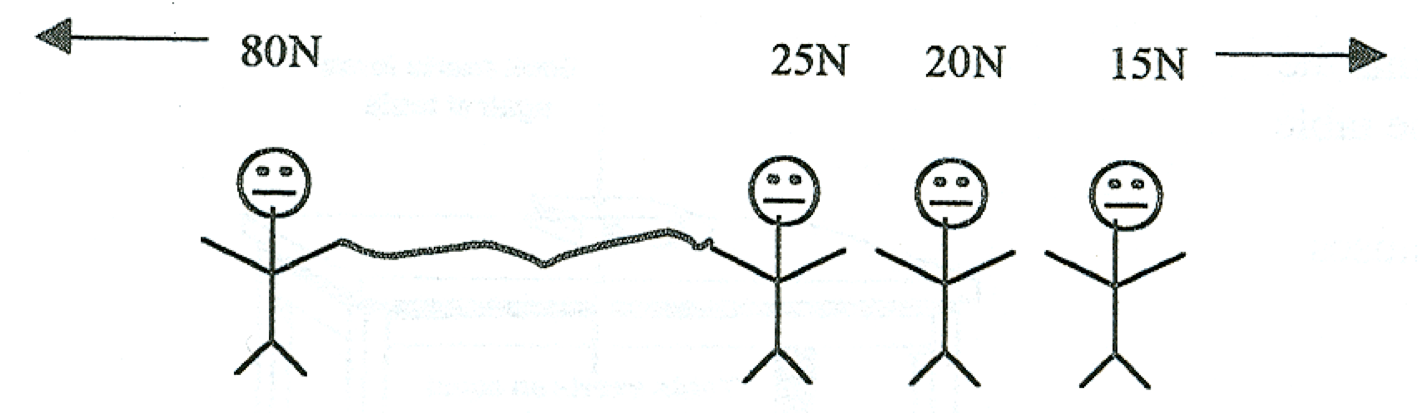
What is the unit to MEASURE force?
Kilogram
Meter
Pounds
Newton

A ____________ is a push or a pull on an object.
friction
force
magnet
gravity

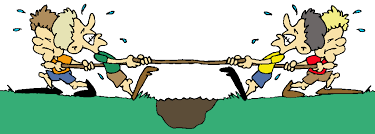


Forces that have a net force of zero Newtons
Balanced force
Unbalanced force
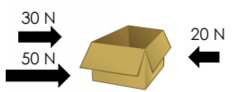


If both forces are going in the same direction you should______ those forces
Add
Subtract
Divide
Multiply
When forces are going in the opposite direction of each other you should do what do find the net force
Subtract
Add
Divide
Multiply
Friction _____________ motion
Works in the same direction as
Opposes
Has not effect on
Pulls against
True or False: objects that are smooth have LESS friction than objects that are rough
TRUE
FALSE
Which type of friction keeps objects from sliding around all over the place
Static Friction
Rolling Friction
Fluid Friction
Sliding Friction
TRUE or FALSE if you push a box across a surface like Ice with no friction, it will NEVER stop
TRUE, as long as it doesn't run into something it will keep going and going and going
FALSE, it will stop very quickly
TRUE or FALSE if you push a box across a surface like rough wood with a lot friction, it will NEVER stop
TRUE, as long as it doesn't run into something it will keep going and going and going
FALSE, it will stop very quickly
An object of mass 10 kg is accelerated upward at 2 m/s2. What force is required?

F = ma

According to Newton's second Law, which would take more force to slow down?
The silver car
The green car
They would both take the same force
Which of these best states Newton's Second Law?
The greater the mass of an object the greater the force needed to change its motion.
The greater the mass of an object the less force needed to change its motion.
The mass of an object does not effect the force needed to change its motion
Johnny has a mass of 10 kg. He sits on a desk. He is pushed with a force of 75 N. What is Johnny's acceleration?
0.75 m/s2
2 m/s2
7.5 m/s2
15 m/s2
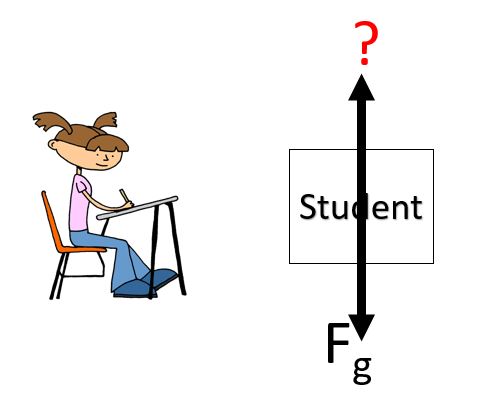
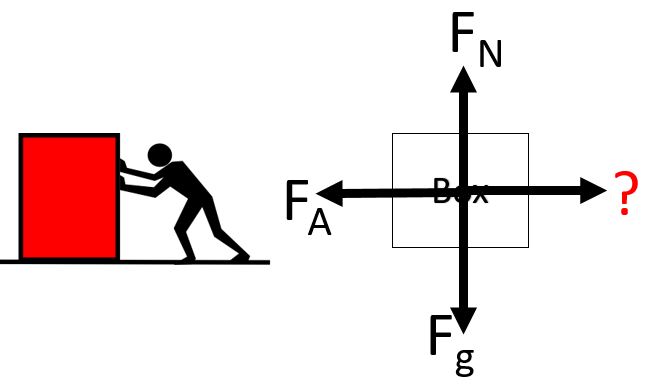
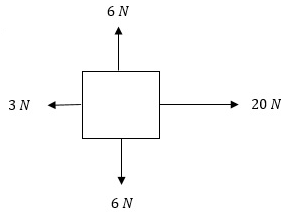
What is the NET FORCE of this diagram?
17 N, right
17 N, left
23 N, right
12 N, up
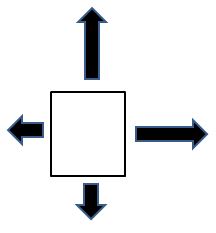
This object would be moving (pick all that are correct):
up
down
left
right
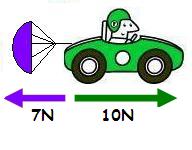


Calculate the net force acting upon the object.
10N, north
20N, south
10N, south
22.4N, north

Determine the net force and direction of motion:
16 N Right
16 N Left
0 N not moving
0 N left

Determine the net force and direction:
11 N Left
11 N Right
0 N Left
5 N Left

If a horse pulls on a wagon at rest, the wagon pulls back equally on the horse. Can the wagon be set into motion?
Yes, because there is a net force acting on the wagon.
Yes, because there is a time delay between action and reaction.
No, because the forces cancel each other.
Yes, because the horse's pull on the wagon is larger than the wagon's pull on the horse.

An unfortunate bug splatters against the windshield of a moving car. Compared to the force of the car on the bug, the force of the bug on the car is
larger.
the same.
smaller
need more information to say.
Inertia is a force
True
False
Suppose that an astronaut throws a baseball in outer space at a location far from significant influences of gravity and air resistance. One would expect that the baseball would ____.
eventually stop since all objects ultimately "lose their steam"
eventually stop as its inertia slowly becomes used up
continue in motion with the same speed and direction
either a, b, or c -- depending on whether the astronaut continues to push it
Inertia is a force that keeps stationary objects at rest and moving objects in motion at a constant velocity.
True
False
The law of inertia (Newton's first law) applies _____.
to moving objects only
only to objects that are not moving
to both moving and nonmoving objects
Inertia refers to _____
the tendency of moving objects to remain in motion
the force which keeps moving objects in motion with a constant velocity
the force that keeps stationary objects at rest
the tendency of stationary objects to remain at rest
A skateboard rolls down a hill, reaches the level surface and eventually comes to a stop. The fact that the skateboard ultimately stops is best explained by ____.
an unbalanced force would be required to keep the sled moving forward at constant speed
the presence of an unbalanced force (e.g., friction) can cause a moving object to stop
the presence of inertia causes it to stop
the natural tendency of any object is to ultimately stop
Inertia depends on ______
Velocity
Speed
Distance
Mass

Mr. S guides a golf ball around the outside rim of the green at the Hole-In-One Putt-Putt Golf Course. When the ball leaves the rim, which path (J, K, or I) will the golf ball follow?
J
K
I
Mac and Tosh are arguing in the cafeteria. Mac says that if he flings the jello with a greater speed it will have a greater inertia. Tosh argues that inertia does NOT depend upon speed, but rather upon mass. Who is correct?
Mac
Tosh
Neither
Both

Rank these objects in order of their inertia, from greatest to least.
ABCD
DABC
DCBA
CBAD

Michael Jordan guides a golf ball around the outside rim of the green at the Hole-In-One Putt-Putt Golf Course. When the ball leaves the rim, which path (A, B, or C) will the golf ball follow?
A
B
C
Two blocks are pushed along a horizontal frictionless surface by a force of 20 N to the right,
as shown above. The force that the 2-kilogram block exerts on the 3-kilogram block is
8 N to the left
8 N to the right
10 N to the left
12 N to the right
20 N to the left
An elevator is pulled up by a cable with a force of 65,000 N. The upward acceleration of the
elevator is 1.8 m/s/s. What is the mass of the elevator?
1.8 kg.
1700 kg.
54880 kg.
5600 kg.
36111 kg.
A 80 N horizontal force is applied to a 20.0 kg block at rest on a horizontal surface where μS =
0.6. What is the magnitude of the force of friction on the block?
118 N.
12 N.
33 N.
100 N.
80 N.

The figure shows two horizontal forces acting on a block along a frictionless floor. Assuming
that a third horizontal force F3 also acts on the block. What are the magnitude and direction of F3 when
the block is moving to the left with a constant velocity of 8 m/s?
8 N to the right.
8 N to the left.
4 N to the right.
4 N to the left.
Need to know blocks mass to answer
A 50-kg student stands on a scale in an elevator. At the instant the elevator has a downward acceleration of 1.0 m/s2 and an upward velocity of 3.0 m/s, the scale reads approximately
350 N
450 N
500 N
550 N

