
 Worksheets
HPS Unit 7 & 8 Review
Total questions: 106
Worksheet time: 4hrs 24mins
_____is the joining of atomic nuclei
Fusion
chain reaction
Photosynthesis
Fission
_______is the splitting of atomic nuclei
Fission
nuclear reaction
Fusion
bayler reaction
Which process occurs naturally in the centre of stars like the Sun
Bi-multiple reaction
Fission
chemical
fusion
How is the alpha particle written in a nuclear equation?
42He
24He
0-1e
00γ
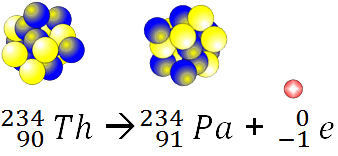
85209At = ___ + 24He
Gamma rays have
no mass
a huge mass
a small mass
an average mass
614C = ___ + -10e
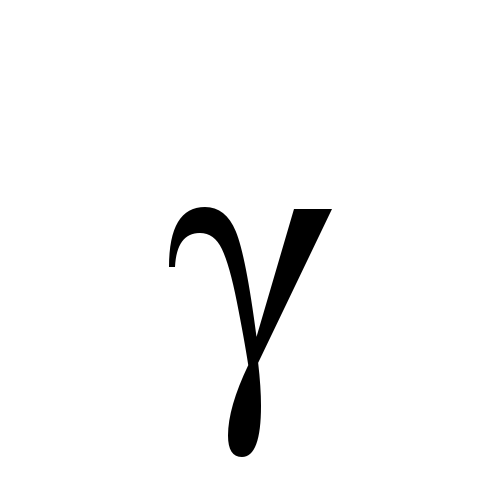
Has the lowest penetrating power. Can only penetrate 0.05 mm into the body and can be stopped by the skin.
Electron capture


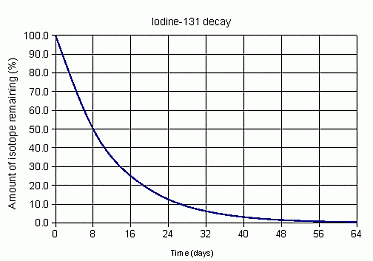
The % of the parent isotope remaining after 2 Half Lives.
50%
25%
12.5%
6.25%

Which type of nuclear radiation is this?
alpha emission
beta emission
gamma emission
electron capture

A radioactive nuclide has a ____ stable nucleus than a non-radioactive nucleus of the same element.
more
less
identical
small
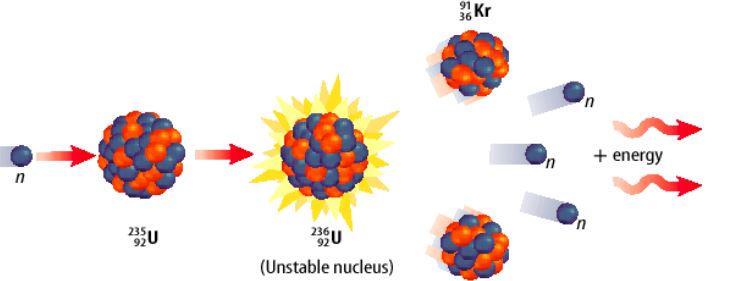
What occurs in both fusion and fission reactions?
Small amounts of energy are converted into large amounts of matter.
Small amounts of matter are converted into large amounts of energy.
Heavy nuclei are split into lighter nuclei.
Light nuclei are combined into heavier nuclei.
Which reaction represents fusion?




Which reaction represents fission?




Identify the type of nuclear decay shown here
21483Bi → 0-1e + 21484Po
alpha
beta
gamma
Solve this equation.
85209At = ___ + 24He
83205Bi
86209Rn
81207Tl
85208At
What type of nuclear decay is shown here
13756Ba →→ 13756Ba + γ rays
alpha
beta
gamma
What type of decay is shown here
23892U ---> 23490Th + 42He.
alpha
beta
gamma
Solve this equation for.
614C = ___ + -10e
410Be
714N
210He
613C
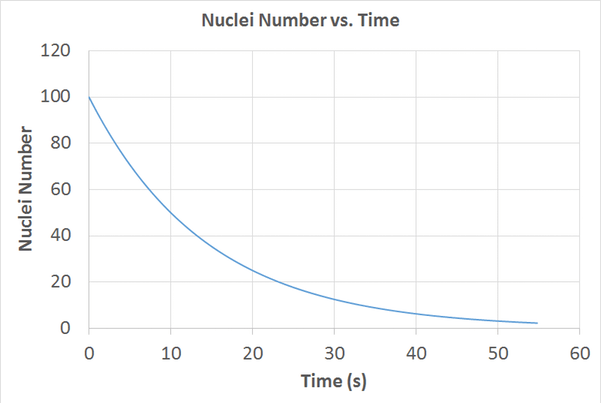
What is the Half life of this isotope?
5 seconds
10 seconds
15 seconds
20 seconds
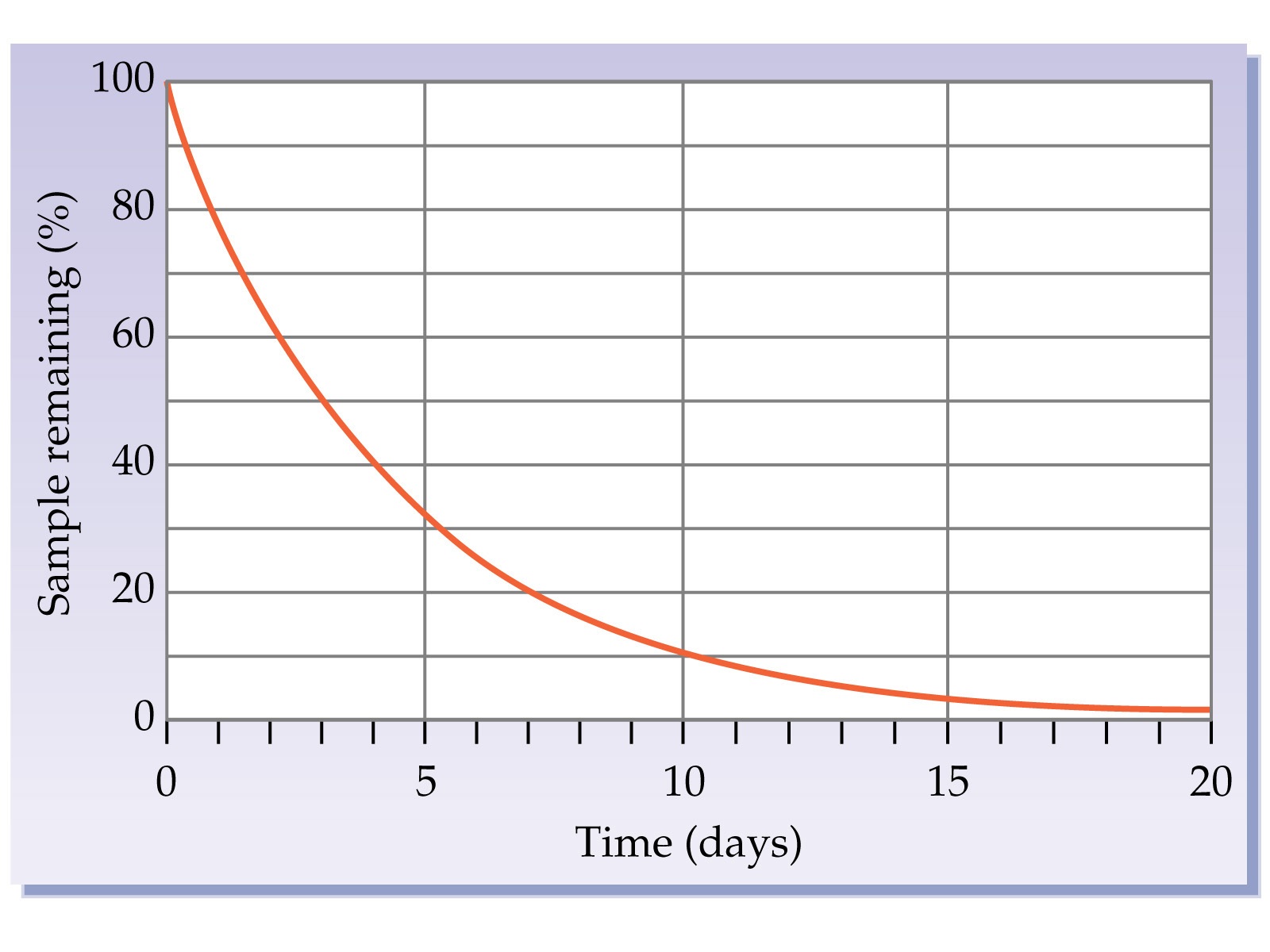
What is the Half Life of this isotope?
3 days
5 days
8 days
10 days

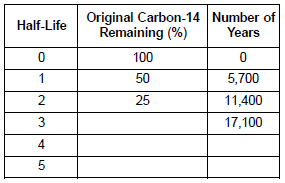
After 22,800 years, approximately what percentage of the original carbon-14 remains?
15%
12.5%
6.25%
3.125%
After 24.0 days, 2.00 milligrams of an original 128.0 milligram sample remain. What is the half-life of the sample?
(a)
100.0 grams of an isotope with a half-life of 36.0 hours is present at time zero. How much time will have elapsed when 6.25 grams remains?
(a)
How much time will be required for a sample of H-3 to lose 75% of its radioactivity? The half-life of tritium is 12.5 years.
(a)
Scott travels north 5 miles and then goes west 3 miles before coming straight back south 2 miles. What is his DISTANCE?
10 mi
7 mi
8 mi
6 mi
Distance and direction of an object's change in position from a starting point (HINT: Direct path from starting point to end point)
displacement
distance
motion
reference point
Jasmine runs exactly 3 laps around a 400 meter track. What is the DISPLACEMENT?
800 m
400 m
0 m
1200 m
David walks 3 km north, and then turns east and walks 4 km. What is the DISTANCE?
7 km
3 km
4 km
1 km
What does magnitude mean?
amount or size
vector
frame of reference
motion
Displacement is a vector because it has magnitude and ______________:
meters
direction
motion
frame of reference
How do scalars and vectors differ?
scalers have units
scalers have direction
vectors have units
vectors have direction
If you walk across town, taking many turns, your displacement is the
total distance that you traveled.
distance and direction of a straight line from your starting point to your ending point.
distance in a straight line from your starting point to your ending point.
direction from your starting point to your ending point.
You travel 30 km West of your home and then turn around and go East for 10 km. What is your displacement from your home.
20 km
20 km, West
40 km
40 km, West

Vocabulary Check:
What is the difference between speed and velocity
Speed is based on time and velocity is not
Velocity has distance and speed does not
Speed has direction
Velocity has direction
Juan ran 72 m across the football field in 8 seconds. What was his speed?
8 m/s
576 m/s
7 m
9 m/s
Steve runs 20 m North in 4 seconds. What is his velocity
5 m/s
4 m/s south
5 m/s south
5 m/s north
If a car is going 125 m/s for 13 seconds, how far does it go?
9.61 meters
1625 meters
1562 seconds
138 m/s
A boat is going 87 m/s. How long will it take him to go 1 km? (Hint: convert km to meters)
.087 seconds
11.49 seconds
.0087 seconds
87,000 seconds

How long does it take a car to travel 40m at 12m/s?
4.8 s
480 s
3.33 s
33.3 s

the unit of acceleration is
(m/s2)
jouls
m
s
A negative acceleration means that your object is
constant
speeding up
at rest
slowing down
A positive acceleration means that your object is
at rest
speeding up
moving
slowing down
When is an object under uniform acceleration?
none of the following
when the direction is straight
when the velocity change is constant per unit time
when the time is constant
A bus starts from rest and accelerates to 14 m/s in 4 s. What is the average acceleration of the bus?
3.5 m/s2
5.9 m/s2
10.5 m/s2
24 m/s2

What is the acceleration during the first 5 seconds?
2 m/s2
4 m/s2
5 m/s2
10 m/s2
A change in speed and/or direction...
Speed
Velocity
Acceleration
Force
Speed in a given direction...
Speed
Velocity
Acceleration
Nebula
At what speed would a car have to move in order to travel 20 kilometers in 2 hours.
5 km/hr
10 km/hr
20 km/hr
40 km/hr

A helicopter flies west 200 miles in 2 hours. What is its velocity?
99 mph
100 mph south
400 mph south
297 mph south

Using the graph, which person finished the race first?
Biker
Runner
Walker
All of these finished at the same time.

Using which point shows the object at speeding UP?
from A to B
from C to D
from D to E
from E to F
As the ball falls towards the ground, its velocity
zero
decreases
at rest
increases
Which of the following objects is accelerating?
A car driving in a northwest at a constant speed of 35 mph.
A car driving southwest at a constant speed of 35 mph.
A car driving in a circle at a constant speed of 35 mph.
Back
A car driving south at a constant speed of 45 mph.
What is Newton's 1st Law?
For every action there is an equal and opposite reaction.
An object at rest will stay at rest, an object in motion will stay in motion, unless an unbalanced force acts upon it.
Which of the following is an example of balancing forces?
A Book resting on the table.
A pencil is knocked off the desk.
What is Newton's 2nd Law?
For every action there is an equal and opposite reaction.
Acceleration depends on two variables, the mass of the object and the amount of force.
What explains why objects resist changes in their state of motion?
gravity
inertia
force
friction
Newton's first law states that an object must travel at a constant speed and in ___________, unless an unbalanced force acts on it.
in a circle
a wave like manner
the same direction

Looking at the image. Decide if this is balanced or unbalanced.
Unbalanced
Balanced

Looking at the image. Decide if this is balanced or unbalanced.
Unbalanced
Balanced
The force that prevents a ball rolling on the ground from continuing on it's path forever is...
Friction
Gravity
Inertia

A ______ is a push or pull on an object.
force
speed
acceleration
velocity
If you are pushing a 1000 kg car at 0.5 m/s2, how many newtons would that be?
Going down a hill a 12 kg sled has a force of 36 N. What is it's acceleration?
An object of mass 300 kg is observed to accelerate at the rate of 4 m/s2. Calculate the force required to produce this acceleration.
A force of 200 N is exerted on an object of mass 40 kg that is located on a sheet of perfectly smooth ice.Calculate the acceleration of the object.


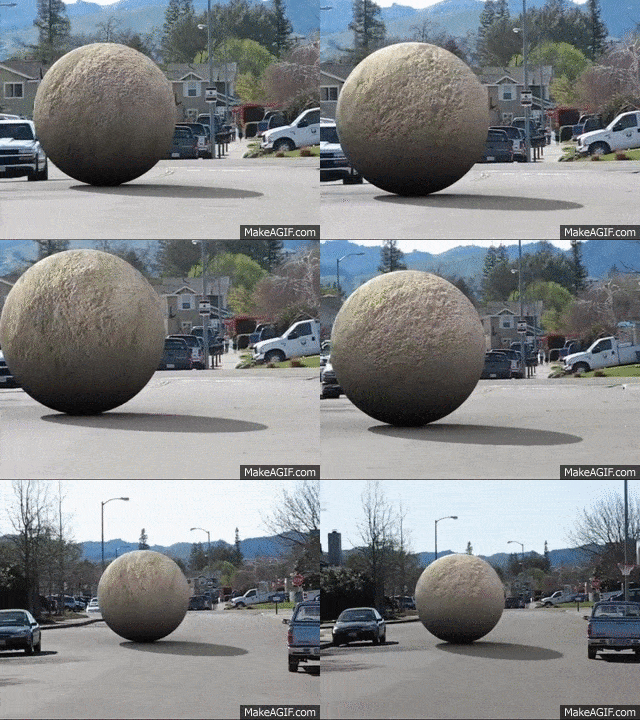
2 m/s
3.4 m/s
4.6 m/s
7.1 m/s

