
 Worksheets
Biology Final Exam 2022-2023
Total questions: 110
Worksheet time: 55mins
Name
Class
Date
1.
What is the shape of RNA?
a)
Double Helix
b)
Single Helix
c)
Triple Hexagon
d)
Quad Bases
2.
1. Bacteria are always harmful.
a)
True
b)
False
3.
Complete this sentence: A cell spends more time _______________ than _______________.
a)
dividing than preparing to divide
b)
preparing to divide than dividing
c)
replicating than preparing to divide
d)
in PMAT than interphase
4.
During which stage of mitosis do the chromosomes line up along the middle of a dividing cell?
a)
Prophase
b)
Telophase
c)
Anaphase
d)
Metaphase
5.
Which of the following has the phases of mitosis in the correct order?
a)
PMTA
b)
IPMAT
c)
PMAT
d)
PMATC
6.
How many total chromosomes do diploid human cells have?
a)
23
b)
26
c)
46
d)
47
7.
How many daughter cells are at the end of Meiosis I?
a)
1
b)
2
c)
3
d)
4
8.
In which stage of meiosis are homologous chromosomes lined up in the middle of the cell?
a)
Anaphase I
b)
Metaphase II
c)
Interphase
d)
Metaphase I
9.
In what stage of meiosis are the sister chromatids pulled apart?
a)
Metaphase II
b)
Anaphase I
c)
Telophase II
d)
Anaphase II
10.
An animal cell that is surrounded by fresh water will burst, what kind of solution is this?
a)
hypotonic
b)
hypertonic
c)
isotonic
11.
A plant cell that has shriveled up and is plasmolyzed is what kind of solution or cell?
a)
hypotonic
b)
hypertonic
c)
isotonic
12.
A cell that has maintained it's normal shape because there are equal amounts of water diffusing in and out of the cell is what kind of solution or cell?
a)
hypotonic
b)
hypertonic
c)
isotonic
13.
For every phosphate head there are ______ fatty acid tails.
a)
1
b)
2
c)
3
d)
4
14.
The phosphate heads are....
a)
Hydrophilic
b)
Hydrophobic
15.
The fatty acid tails are...
a)
Hydrophilic
b)
Hydrophobic
16.
The smallest structural and functional living thing (that makes up your entire body!) is called a....
a)
atom
b)
molecule
c)
cell
d)
protein
17.
3. An example of a bacterial infection is _________.
a)
Influenza
b)
Strep throat
c)
COVID
18.
11. Where are bacteria found?
a)
Only in the body
b)
Only in the environment
c)
Everywhere
19.

13. The bacteria in the picture below are classified as _________________.
a)
cocci
b)
bacilli
c)
spirilla
20.
16. Bacteria that have _________ pore spaces develop more antibiotic resistance.
a)
More
b)
Less
21.
18. Prevention of antibiotic resistance can include many things, one of the most simplest things we can do is:
a)
Use hand sanitizer all the time
b)
Wash our hands frequently
c)
Have poor hygiene habits
22.
19. Bacteria are able to move through the use of their __________________.
a)
Flag
b)
Feet
c)
Flagella
23.
23. If you are prescribed antibiotics, you should __________________.
a)
Take them only for 3 days
b)
Take them for the prescribed amount of days
c)
Take them until you feel better and then save the rest for later
24.
25. Which is smaller?
a)
Bacteria
b)
Virus
25.
30. We should do our best to eliminate ALL bacteria.
a)
True
b)
False
26.
What is the second step in protein synthesis?
a)
Translation
b)
Synthesis
c)
Transcription
d)
Metaphase
27.
What sugar does RNA contain?
a)
phosphate
b)
fatty acid
c)
ribose
d)
sugra
28.
For RNA, what is Thymine replaced with?
a)
Uracil
b)
tRNA
c)
mRNA
d)
Ribo
29.
What are proteins made of?
a)
RIbosomes
b)
Amino Acids
c)
Pedigree
d)
2 Nitrogen Bonds
30.
What does RNA stand for?
a)
Ribosenucleic Acid
b)
Ribnose Acid
c)
Ribonucleic Acid
d)
Riba Nuke Leic Acid
31.
What mRNA code would bond with this DNA code? TAT GGC ATC
a)
UAU CCG AUG
b)
GCG AAU CGU
c)
AUA CCG UAG
32.
Which process is used to make mRNA from DNA in the nucleus?
a)
transcription
b)
replication
c)
translation
33.
One difference between DNA and RNA is....
a)
Only RNA has the base Uracil
b)
Only RNA contains the base Cytosine
c)
Only RNA contains the base Thymine
d)
Only RNA contains the base Guanine
34.
___________ is made during transcription and ___________ is made during translation.
a)
mRNA/a protein
b)
Ribosome/Nucleus
c)
a protein/mRNA
d)
mRNA/tRNA
35.
How many amino acids are coded for by this sequence of bases? ATG GGA ACT CCA
a)
4
b)
6
c)
2
d)
12
36.
What are the 4 nitrogen bases of DNA?
a)
Adenine, Thymine, Cytoplasm, and Guanine
b)
Adenine, Thymine, Cytosine, and Glycerol
c)
Adenine, Thymine, Cytosine, and Guanine
d)
Adenine, Thymine, Cytosine, and Glucose
37.
Nucleotides are made of of a sugar, phosphate, and.....
a)
nitrogenous base
b)
cholesterol
c)
nucleic acid
d)
fatty acid
38.
Which of the following is the sugar found in DNA?
a)
Ribose
b)
Maltose
c)
Deoxyribose
d)
Amylose
39.
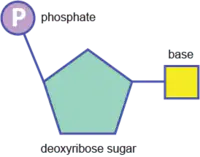
Name this structure
a)
Nucleotide
b)
Nitrogenous Base
c)
Hydrogen Bond
d)
Ribose Sugar
40.
Which enzyme is responsible for making RNA?
a)
RNA polymerase
b)
RNA proliferase
c)
RNA enzymase
d)
DNA polymerase
41.
Codons contain ______ bases
a)
1
b)
3
c)
6
d)
9
42.
The enzyme that replicates DNA is called
a)
RNA Intrase
b)
Transcriptase
c)
RNA Polymerase
d)
DNA Polymerase
43.
Protein Synthesis takes place on the
a)
Nucleus
b)
Ribosome
c)
Cytoplasm
d)
Golgi Apparatus
44.
tRNA molecules match the mRNA condons with an amino acid using:
a)
Methylated Cap
b)
Base Pariring
c)
Transcription
d)
Introns
45.
The codon UAC would have a match of:
a)
AUG
b)
CAU
c)
TAC
46.
DNA has a ___________ structure
a)
Ring
b)
Single Helix
c)
Double Helix
d)
Chain
47.
In DNA, Adenine pairs with _________.
a)
Guanine
b)
Uracil
c)
Thymine
d)
Cytosine
48.
A mutation that involves a change in the entire chromosome
a)
Point Mutation
b)
Gene Mutation
c)
Chromosomal Mutation
d)
Frameshift Mutation
49.
Choose the nucleotide sequence of the replicated DNA strand that would be complementary to the original DNA strand: GTAGTCA
a)
CAUCAGU
b)
ACGACTG
c)
CATCAGT
d)
UATUAGA
50.

What is the correct amino acid sequence for the mRNA code AUGCAAGUGUAA?
a)
Tyr-Gly-His
b)
Met-Glu-Val
c)
Tyr-Gly-Arg-His
d)
Met-Gly-Val
51.
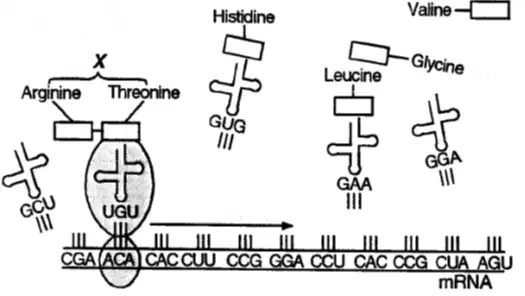
What process is going on in this photo?
a)
Translation
b)
Replication
c)
Transcription
d)
All of the Above
52.
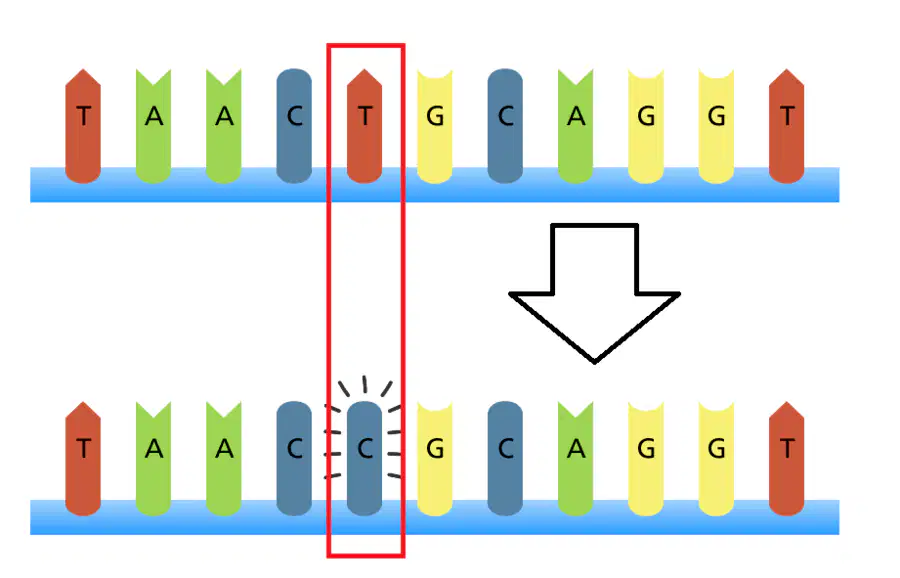
What does this image represent? (Hint: Thymine was accidentally substituted with Cytosine during replication)
a)
Translation
b)
Transcription
c)
tRNA
d)
Mutation
53.
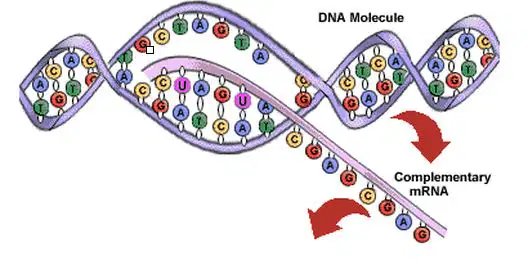
What is occurring in this picture?
a)
Transcription
b)
Translocation
c)
Translation
d)
Replication
54.
Why is DNA important?
a)
It's in everything
b)
It serves as the blueprint for making proteins
c)
It is very small and very complicated
d)
We eat it everyday for energy
55.
Which 2 molecules form the sides (backbone) of the DNA ladder?
a)
Deoxyribose Sugar and Phosphate
b)
Sugar and Nucleus
c)
Deoxyribose and a Hydrogen Bond
d)
Doexyribose and Adenine
56.
What does DNA stand for?
a)
Doexyribonucleic Acid
b)
Diribonucleic Acid
c)
Deribonucleic Acid
d)
Denitrogenous Acid
57.
Mutation that involves a change in a single gene
a)
Frameshift Mutation
b)
Point Mutation
c)
Gene mutation
d)
Chromosomal Mutation
58.
Any change in a sequence of DNA is a......
a)
Transgenic Shift
b)
Mutation
c)
Monohybrid Trait
d)
Single Genotype
59.
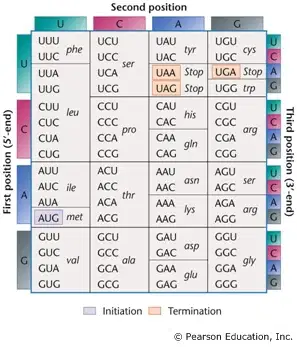
Which change below would result in a different amino acid? Original code: GCU
a)
GCA
b)
GCC
c)
GCG
d)
GAC
60.
What mutation occurred here? TGACCA -> TGAGCA
a)
Substitution
b)
Frameshift
c)
Deletion
d)
Insertion
61.
What mutation is this? Normal: GAG-CTC-GAC-AGA Mutant: GAG-CTC-CAC-AGA
a)
No mutation
b)
Substitution
c)
Insertion
d)
Deletion
62.
What mutation occurred? Normal: AGA-TTC-ATA-GCG Mutant: AGA-TTC-AAT-AGC-G
a)
Deletion
b)
Nonsense
c)
Substitution
d)
Insertion
63.
DNA molecule segment: TTACGCAAG Mutated Segment: TTCGCAAG What mutation is this?
a)
Insertion
b)
Inversion
c)
Deletion
d)
Substitution
64.
What mutation is this? DNA segment: TTACGCAAG Mutated Segment: TTACGCAAC
a)
Inversion
b)
Translocation
c)
Substitution
d)
Insertion
65.
In a molecule of double-stranded DNA, the amount of Adenine present is always equal to the amount of
a)
Thymine
b)
Cytosine
c)
Uracil
d)
Guanine
66.
Mutation that shifts the reading frame of the genetic message
a)
Frameshift Mutation
b)
Chromosomal Mutation
c)
Point Mutation
d)
Gene Mutation
67.
Where is DNA located in a eukaryotic cell?
a)
Cytoplasm
b)
Golgi Apparatus
c)
Ribosome
d)
Nucleus
68.
In garden peas, tallness (T) is dominant to shortness (t) and axillary flowers (A) are dominant to terminal flowers (a). What are the expected phenotypes of the offspring if a heterozygous tall, heterozygous axillary plant is crossed with a heterozygous tall, terminal plant? Give answers in % (round to the nearest whole percent).
a)
Tall/Axillary: 37%, Short/Axillary: 12%, Tall/Terminal: 37%, Short/Terminal: 12%
b)
Tall/Axillary: 38%, Short/Axillary: 12%, Tall/Terminal: 38%, Short/Terminal: 12%
c)
Tall/Axillary: 38%, Short/Axillary: 13%, Tall/Terminal: 38%, Short/Terminal: 13%
d)
Tall/Axillary 37%, Short/Axillary: 13%, Tall Terminal: 37%, Short/Terminal: 13%
69.
What is the term for two traits that "mix" or "blend" when an organism contains heterozygous genes?
a)
Complete Dominance
b)
Incomplete Dominance
c)
Co-Dominance
d)
Polyploidy
70.
What is the term for two traits that both show completely when the organism is heterozygous?
a)
Polyploidy
b)
Incomplete Dominance
c)
Complete Dominance
d)
Co-Dominance
71.
True or False: We can use genetic engineering to re-create dinosaurs as they were millions of year ago
a)
True
b)
False
72.
Organisms produced with incompletely dominant or co-dominant traits are called
a)
Clones
b)
Hybrids
c)
Transgenic
73.
What is the term for a cell taking in external DNA that becomes part of it's own DNA?
a)
Transformation
b)
Inbreeding
c)
Selective Breeding
d)
Genetic Variation
74.
True or False: Scientists have been able to transform bacteria that can create human insulin and human growth hormone.
a)
True
b)
False
75.
What is the term for an organism that contains genetically identical cells produced from a single cell?
a)
Transgenic
b)
Clone
c)
Hybrid
d)
Transformed Organism
76.
In shorthorn cattle, when a red bull (RR) is crossed with a white cow (rr), all the offspring are roan (Rr). What results when you cross a roan bull with a roan cow?
a)
Red: 0%, Roan: 100%, White: 0%
b)
Red: 50%, Roan: 0%, White: 50%
c)
Red: 25%, Roan: 25%, White: 50%
d)
Red 25%, Roan 50%, White: 25%
77.
In some chickens, the gene for feather color is controlled by co-dominance. The allele for black is B and the allele for white is b. The heterozygous phenotype is known as erminette (Bb). What results when you cross a black chicken with a white chicken?
a)
Black: 0%, Erminette: 100%, White: 0%
b)
Black: 50%, Erminette: 0%, White: 50%
c)
Black: 25%, Erminette: 50%, White: 25%
d)
Black: 25%, Erminette: 25%, White: 50%
78.
Which of the following is NOT a principle of the cell theory?
a)
Cells are the basic unit of life
b)
All living things are made of cells
c)
Very few cells reproduce
d)
all cells are produced by pre-existing cells
79.
2. Looking at a cell under a microscope, you note that it is a prokaryotic cell. How do you know?
a)
the cell lacks a cytoplasm
b)
the cell lacks a membrane
c)
the cell lacks a nucleus
d)
the cell lacks DNA
80.
3. Which organelles help provide cells with energy?
a)
mitochondria and chloroplasts
b)
Rough and Smooth ER
c)
Golgi apparatus and ribosomes
d)
None of the above
81.
4. Diffusion is the movement of molecules from
a)
an area of low concentration to an area of high concentration
b)
an area of high concentration to an area of low concentration
c)
an area of equilibrium to an area of high concentration
d)
all of the above
82.
5. The diffusion of water across a selectively permeable membrane is called _________.
a)
pressure
b)
osmosis
c)
facilitated diffusion
d)
active transport
83.
6. During which phase of mitosis do the chromosomes line up along the middle of the dividing cell?
a)
prophase
b)
telophase
c)
metaphase
d)
anaphase
84.
7. The phase of growth and DNA replication is what phase?
a)
Interphase
b)
Prophase
c)
Metaphase
d)
Anaphase
85.
8. Biology is the study of
a)
the land, water and air on Earth
b)
the living world
c)
animals and plants only
d)
None of the above
86.
9. All of the following are characteristics of living things EXCEPT
a)
growth
b)
reproduction
c)
movement
d)
evolution
87.
10. The process by which organisms keep their internal conditions relatively stable is called:
a)
homeostasis
b)
evolution
c)
metabolism
d)
photosynthesis
88.
11. What is the term for a group of organisms one of one type living in the same place?
a)
biosphere
b)
ecosystem
c)
population
d)
environment
89.
12. The branch of biology dealing with interactions among organisms and their environment is called
a)
economy
b)
modeling
c)
anatomy
d)
ecology
90.
13. What is the combined portions of Earth called in which all living things exist?
a)
biome
b)
community
c)
ecosystem
d)
biosphere
91.
14. Which of the following is a good source of carbohydrates?
a)
cheese
b)
potatoes
c)
chicken
d)
seeds
92.
15. What is the monomer of a carbohydrate?
a)
monosaccharide
b)
polysaccharide
c)
amino acid
d)
DNA
93.
16. What is the monomer of a protein?
a)
monosaccharide
b)
amino acid
c)
DNA
d)
triglyceride
94.
19. An organism that cannot make its own food is a called a(an)
a)
heterotroph
b)
chemotroph
c)
autotroph
d)
producer
95.
20. What is an organism that feeds on plants called?
a)
carnivore
b)
herbivore
c)
omnivore
d)
detritivore
96.
22. Each of the following is an abiotic factor in the environment EXCEPT
a)
plant life
b)
soil type
c)
rainfall
d)
temperature
97.
33. What organism is NOT a producer?
a)
grass
b)
oak tree
c)
coral reef
d)
rose bush
98.
34. Which organism is NOT a consumer?
a)
squirrel
b)
grass
c)
whale
d)
coyote
99.
38. Bacilli, Cocci, and Spirilla are
a)
gram stains
b)
shapes of bacteria
c)
methods of bacterial movement
d)
ways in which bacteria obtain energy
100.
39. Bacteria that cause disease are called
a)
viruses
b)
pathogens
c)
endospores
d)
antibiotics
101.
40. Overuse of antibiotics is leading to
a)
more antibiotics being discovered
b)
antibiotic resistant bacteria
c)
easier access to antibiotics
d)
viruses that are being cured
102.
41. Antibiotics are used to treat
a)
bacteria
b)
viruses
c)
both a & b
d)
fungi
103.
42. One of the differences between bacteria and viruses is that
a)
viruses are living and bacteria is non-living
b)
bacteria are living and viruses are non-living
c)
viruses and bacteria are both biotic factors
d)
both are eukaryotic organisms
104.
43. Every year people are hospitalized with simple bacterial infections. These infections can result in amputation of the infected area to save the person from death. The persistent use of modern technology has caused the rise in resistant bacteria. This is due to the overuse of
a)
vaccines
b)
antibiotics
c)
fertilizers
d)
solar panels
105.
44. When during the cell cycle is a cell's DNA replicated?
a)
G1 phase
b)
G2 phase
c)
S phase
d)
M phase
106.
47. What type of cells undergo the process of meiosis?
a)
muscle cells
b)
cheek cells
c)
reproductive cells
d)
somatic cells
107.
48. During _____________, the cell begins to pinch together at the cleavage furrow as it prepares to split.
a)
Prophase
b)
Metaphase
c)
Anaphase
d)
Telophase
108.
49. The end result of mitosis is ____ ____________ cells.
a)
2, diploid
b)
4, diploid
c)
2. haploid
d)
4, haploid
109.
50. The end result of meiosis is ____ ____________ cells.
a)
2, diploid
b)
4, diploid
c)
2, haploid
d)
4, haploid
110.
True or False: Cells are non-living
a)
True
b)
False
100 %

