
 Worksheets
PHYSICS: Final Course Exam Review
Total questions: 110
Worksheet time: 2hrs 53mins

22m
5m
10m
-10m

22m
5m
10m
-10m

4 m/s
3 m/s
0 m/s
-5 m/s

not moving
positive constant velocity
negative constant velocity
changing velocity

not moving
positive constant velocity
negative constant velocity
changing velocity

not moving
positive constant velocity
negative constant velocity
changing velocity

not moving
velocity is increasing
velocity is decreasing
constant velocity
The magnitude of the displacement of an object can never be greater than the distance it travels.
True
False
There must be equal amounts of mass on both sides of the center of mass (or center of gravity) of a system.
True
False
Four objects, each of the same mass and uniform thickness, also have with the mass distributed uniformly. Which one has the greatest moment of inertia when rotated about an axis perpendicular to the plane at a certain point?
a tire with one spoke
a large round solid disk
bicycle wheel with spokes
a small round solid disk
A student sits on a freely spinning lab stool that has no friction in its axle. When this person extends his arms,
moment of inertia increases
angular speed decreases
angular speed remains the same
both the moment of inertia increases and the angular speed decreases
When is the average velocity of an object equal to the instantaneous velocity?
always
never
when the velocity is increasing at a constant rate
when the velocity is constant


If the velocity of an object is zero at some point, then its acceleration must also be zero at that point.
true
false
If the acceleration of an object is zero, then that object cannot be moving.
true
false
If the velocity of an object is zero, then that object cannot be accelerating.
true
false
Suppose a ball is thrown straight up and experiences no appreciable air resistance. What is its ACCELERATION just before it reaches its highest point?
greater than g
zero
exactly g
less than g
If a vector pointing upward has a positive magnitude, a vector pointing downward has a negative magnitude.
true
false
In a collision between a huge van and a small car, .
forces are equal and opposite on the car and the van
the van exerts a larger force on the car
the car exerts a large force on the van

A little boy attaches a rock to a string, then swings it counter-clockwise above his head like a lasso. It breaks on the right. Which path will the rock follow from the circular motion?
a path above it
to the right
straight down
a path in a straight line from where it breaks
A bucket is being lowered into a well with a constant downward velocity. The tension in the rope must be
greater than the weight of the bucket
lower that the weight of the bucket
equal to the weight of the bucket
What is needed to calculate work?
time and distance
speed and distance
force and direction
acceleration and velocity
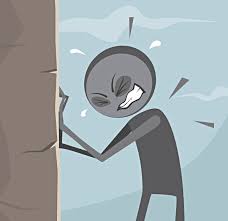
Is this an example of work?
Yes
No

Is this an example of work?
Yes
No!
You have to push with 15 N of force to move it 10 meters. How much work do you do?
15 Joules
150 Joules
1.5 Joules
.67 Joules
For work to be done on an object, the direction and force have to be going the same direction.
True
False
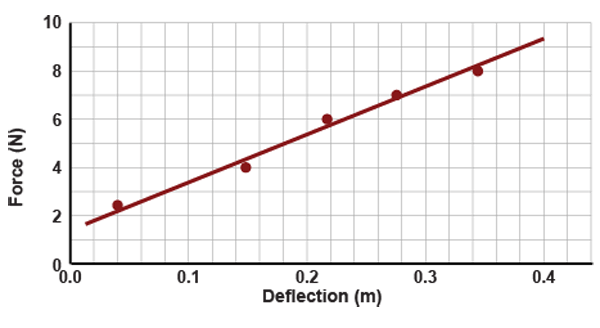
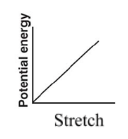
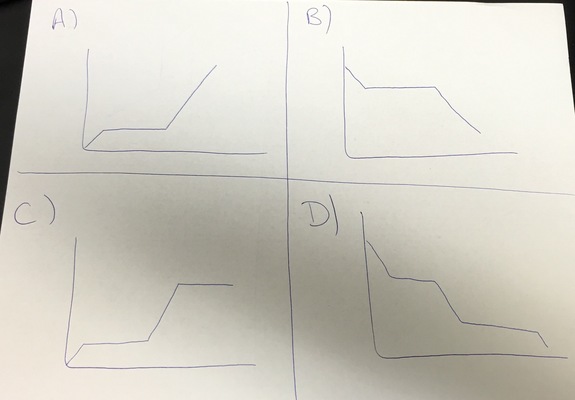
What potential energy is this graph representing?
Electric
Elastic
Magnetic
Gravitational


The momentum of an isolated system is conserved
in elastic collisions only
in inelastic collisions only
in both elastic and inelastic collisions
In a game of pool, the white cue ball hits the #4 ball and stops, while the #4 ball moves away with the same velocity as the cue ball had originally. Both balls have the same mass. This type of collision is
elastic
inelastic
A merry-go-round spins freely and Jack moves quickly to the center along a radius of the merry-go-round. As he does this, it is true to say that
the moment of inertia of the system increases and the angular speed increases.
the moment of inertia of the system increases and the angular speed decreases.
the moment of inertia of the system decreases and the angular speed increases.
the moment of inertia of the system decreases and the angular speed decreases.
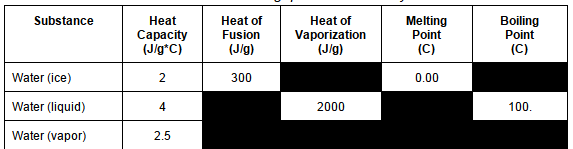
Which of the following is a factor that determines thermal energy?
Mass
Heat
Transfer of thermal energy
Conduction
What is thermal conductivity?
The rate at which particles move in a substance
The ability of a substance to have a large thermal energy
A factor that determines the amount of thermal energy of a substance
The rate at which a substance transfers heat

The diagram shows some rice being boiled in a pan. What is the main methods by which thermal energy is transferred (i) through the metal pan and
(ii) through the water?
(i) conduction (ii) conduction
(i) convection (ii) convection
(i) conduction (ii) convection
(i) convection (ii) conduction
Convection can take place in ____________.
solids only.
liquids only.
liguids and gases only.
solids, liquids and gases.
Which of the following is an application of convection?
The movement of heat through a metal pan to the food.
The use of ice box to keep drinks cool.
The sea breeze that blows from sea to land.
The use of wool blanket to keep the body warm.
In the process of convection, energy is transferred _________.
because of temperature differences in a solid
because of density differences in a liquid
by the diffusion of molecules throughout a fluid
by the vibration of molecules
In an adiabatic process, what is held constant?
Pressure
Volume
Temperature
None of the above
What does "adiabatic" mean literally?
To pass through
To not pass through
To change quickly
To heat or cool
In an adiabatic process, what equals zero?
Q
W
ΔU
T
In an adiabatic process there is no _________ transfer between the gas and the surroundings.
Kinetic Energy
Work
Thermal Energy
Which of the following is a false statement?
Entropy is a quantitative measure of disorder.
The entropy of an isolated system must be conserved (it remains constant).
The total entropy change in one cycle of a Carnot engine is zero.
Entropy can be measured in units of J/K.
A PVC pipe of length L that is open at one end resonates in its third harmonic with a wavelength of 2L/3. Is the other end of the pipe closed or open?
open
closed
When the wavelength increases the frequency will
increase
decrease
remain same
none of these
Which of these lists the EM waves from Highest to lowest frequency?
Radio - Micro - Gamma - Visible light - UV - Xrays - Infrared - Xrays
Radio - Micro - Infrared - Visible light - UV - X - Gamma waves
Gamma - Xray - UV - Visible light - Infrared - Micro - radio
none

Type of mirror found in a bathroom...
Plane
Convex
Concave
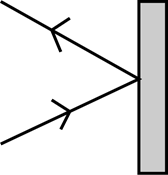
In the illustration, the light ray striking the object is-
When the image of an object is seen in a plane mirror, the image is _____.
real and upright.
real and inverted.
virtual and upright.
virtual and inverted.

The lens pictured is exhibiting _______ behavior and is ______ in shape.
converging, convex
converging, concave
diverging, convex
diverging, concave
Which of the following correctly labels points A, B, and C?
focal point, focal length, principal axis
focal point, principal axis, focal length
principal axis, focal length, focal point
focal length, focal point, principal axis
The focal length of this lens is _______.
negative because it can form real images
positive because it can form real images
negative because it can form virtual images
could be positive or negative depending on the image formed

The focal length of this lens is _______.
negative because it can form real images
positive because it can form real images
negative because it can form virtual images
could be positive or negative depending on the image formed

The lens pictured is exhibiting _______ behavior and is ______ in shape.
converging, convex
converging, concave
diverging, convex
diverging, concave

Classify the image produced by the projector lens. Check two.
real
virtual
larger than original
smaller than original

Classify the image formed in this scenario.
real, inverted, larger than original
real, inverted, smaller than original
virtual, upright, larger than original
virtual, upright, smaller than original
Light enters air from water. The angle of refraction will be
greater than the angle of incidence.
equal to the angle of incidence.
less than the angle of incidence.
A plastic rod is charged up by rubbing a wool cloth, and brought to an initially neutral metallic sphere that is insulated from ground. It is allowed to touch the sphere for a few seconds, and then is separated from the sphere by a small distance. After the rod is separated, the rod
repelled
attracted
no effect
When a current flows through a metal wire, the moving charges are
protons
electrons


Based on the arrangement of the electric field lines in the diagram, what are the charges?
both charges are the same
the charges are opposite
they are neutral; no charge
Coulomb's law also says if distance increases, then force
decreases
disapears
destroyed in a heartbeat
doubles

Solve for total Current in the circuit shown
25 Amps
35 amps
25 milliamps
35 milliamps

Solve for the total resistance of the circuit shown
50 V
1970 ohms
705 K ohms
20 Amps

Solve for the voltage drop at resistor 1
38 volts
60 Kvolts
50 volts
25 volts
When a resistor in a series circuit is replaced by another resistor with an increased resistance value, the total circuit current will __________.
stay the same
decrease
increase
double in value
This circuit has only one path for current to flow
series
parallel
combination
split
__________ remains the same in a series circuit.
Resistance
Voltage
Current
Power
What happens to total current in a series circuit when the total voltage stays the same, circuit resistance decreases, current will ____________.
increase
Stay the same
Decrease
In a standard series circuit, the voltage is the same everywhere in the circuit.
True
False


When more light bulbs are added they all remain bright.

