
 Worksheets
Semester 2 Final Review
Total questions: 108
Worksheet time: 2hrs 6mins

A
B
C
D

A
B
C
D

A
B
C
D

A
B
C
D

A
B
C
D
E

A
B
C
D

A
B
C
D

A
B
C
D
What are the two factors that affect the momentum of an object?
speed and velocity
time and mass
distance and displacement
mass and velocity
Momentum is a ____________________ quantity
science
scalar
vector
energy
T/F: A big truck will always have more momentum than a small car.
True
False
The Law of Conservation of Momentum states:
The total momentum before a collision is equal to the total momentum after a collision.
The total momentum before a collision is greater than the total momentum after a collision.
The total momentum before a collision is less than the total momentum after a collision.
The total momentum before a collision is not related to the total momentum after a collision.
A Russian cosmonaut(87 kg) and USA astronaut(94 kg) are outside the ISS and decide to run a momentum experiment. They are motionless facing each other palm to palm, then push apart from each other. What happens to their momentum?
their total momentum doubles
their total momentum decreases
the guy with the smaller mass has less momentum
their momenta are opposite but equal

A rail car with a nonzero velocity, v, travels on a smooth track while filling with rain. Which statement about its motion is correct?
The speed remains unchanged because the impulse of the rain is on the y-axis but the velocity is on the x-axis.
The speed increases because the impulse the momentum of the rain plus the momentum of the train are summative.
The speed decreases because the mass of the rail car increases so the velocity must decrease for momentum to be conserved.

The two boxes are sliding along a frictionless surface. They collide and stick together. Afterward, the velocity of the
two boxes is
2 m/s to the left
1 m/s to the left
0 m/s, at rest
2 m/s to the right
1 m/s to the right
Which of the Following Statements Is Not True About Applying the Impulse-Momentum Principle to Two-Dimensional Collisions?
If the impulse is zero, the magnitude of the system’s initial momentum equals the magnitude of its final momentum.
If the impulse is zero, the system’s initial momentum along the x-axis equals its final momentum along the x-axis.
If the impulse is zero, the system’s initial momentum along the y-axis equals its final momentum along the y-axis.
Two Carts Travel Toward Each Other on a Frictionless Track at the Same Speed and Collide with Each Other. One of the Carts Has a Mass Five Times That of the Other Cart. Which Cart Experiences the Greater Change in Momentum?
The smaller cart experiences greater change in momentum.
The larger cart experiences greater change in momentum.
They have the same change in momentum.
It depends on the final speed of the carts.
A
B
C
D
A
B
C
D
A
B
C
D
A
B
C
D
E
A
B
C
D
An impulse depends on
weight and force
force and time
electric charge and time
none of these

The unit for energy and work is
J
N
m/s
m/s/s

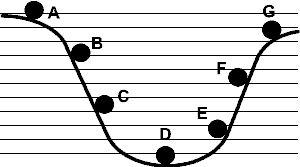

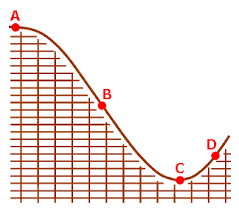
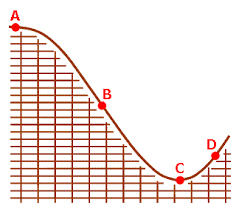
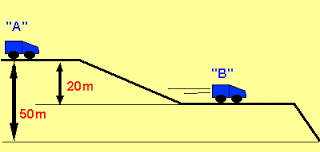
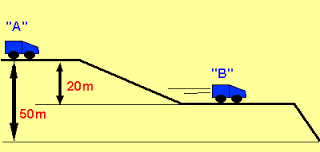
1. A ball has a 17 J of kinetic energy and its mechanical energy is 25 J. If the ball has a mass of 3.2 kg, what is its height above the ground?
0.26 m
0.52 m
5.2 m
25 m
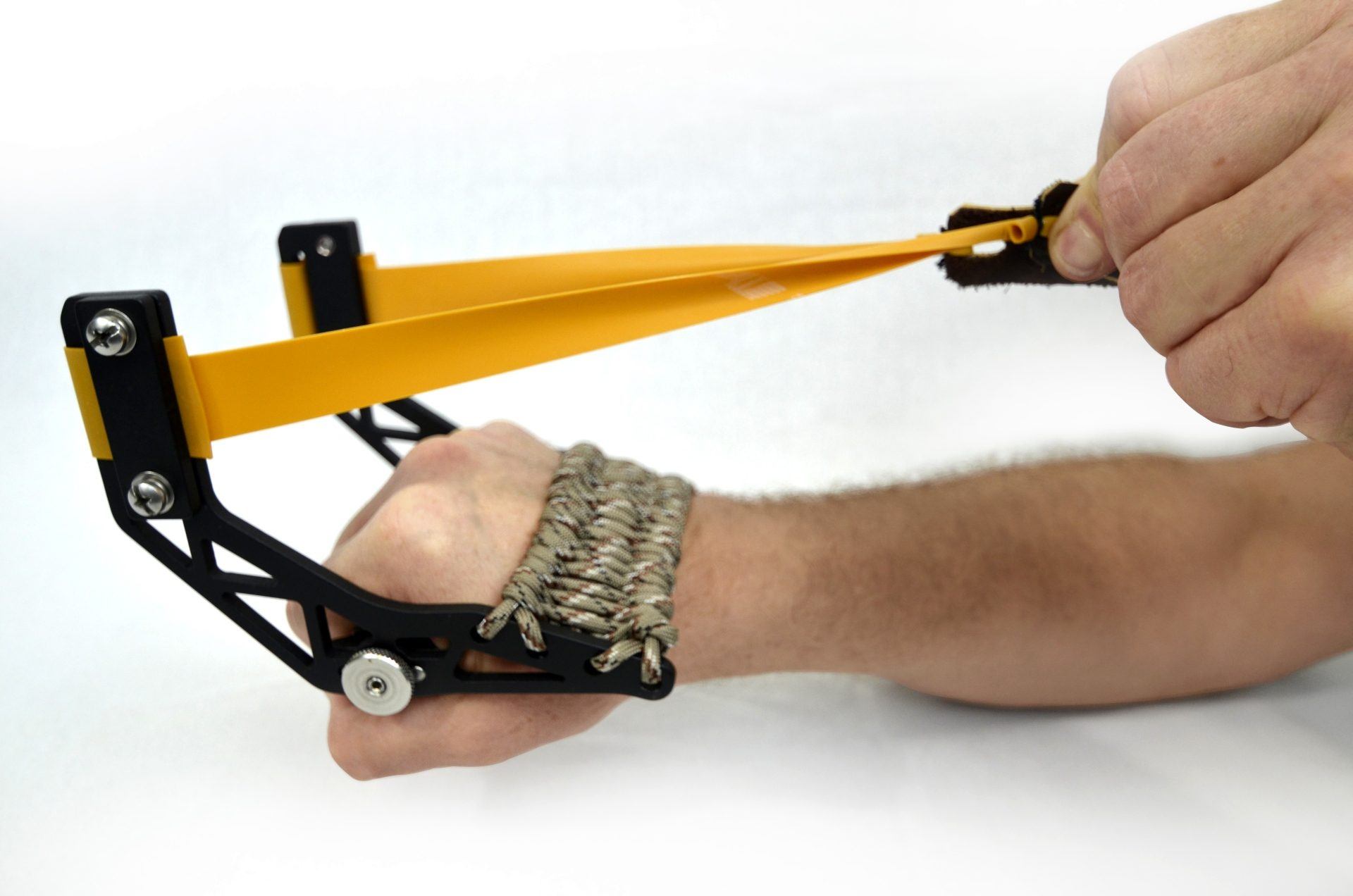

A(n) (a) is a back-and-forth motion of an object between two points of deformation
Periodic motion is repetitious oscillations.
(a)
The period (T) is the time for one oscillation to occur.
(a)
The frequency (f) is the number of oscillations per unit of time. The inverse of the period.
(a)
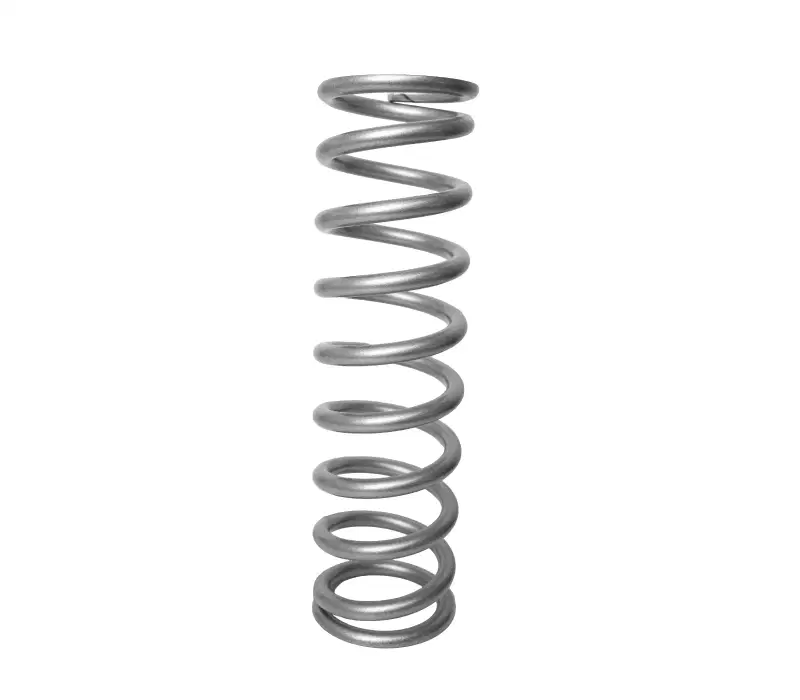
F=−kx
(a)
U=21kx2 . No capital letters
(a)
When we're talking about a pendulum, what does T stand for?
pi
period
length
gravity
What is the unit for the period of a pendulum?
second
meter
m/s/s
Newton
As a pendulum gets longer, what happens to the period?
doesn't change
decreases
increases
At what point in the swing of a pendulum is the bob moving fastest?
at the top of the arc
at the bottom of the arc
Which of these does not affect the period of a pendulum?
length
gravity
mass
Which would have the longest period? Pendulum A: A 200-g mass attached to a 1.0-m length string Pendulum B: A 400-g mass attached to a 0.5-m length string
A
B
Same
When does the mass move at maximum velocity in a mass-spring system?
At equilibrium
At the farthest point from equilibrium
At its highest point
At its lowest point
What are the two requirements for a simple harmonic oscillator?
The object vibrates about the equilibrium point and the restoring force is proportional to the displacement
The object moves left to right and the restoring force is proportional to the displacement
The object vibrates about the equilibrium and the restoring force is greater than the displacement
The object moves left to right and the restoring force is greater than the displacement
When does the mass move at 0 velocity in a mass-spring system?
At equilibrium
At the farthest point from equilibrium
At its highest point
At its lowest point
What factor primarily determines the frequency of a mass-spring system?
The mass of the object
The spring constant
Gravity
The amplitude of oscillation
How does the amplitude of a pendulum's swing affect its period?
The period increases with larger amplitudes
The period decreases with larger amplitudes
The period does not change with amplitude
The period doubles with every increase in amplitude
What is the effect of air resistance on the period of a pendulum?
It increases the period
It decreases the period
It has no effect on the period
It initially decreases then increases the period over time

An ant of mass m clings to the rim of a flywheel of radius r, as shown above. The flywheel rotates clockwise on a horizontal shaft S with constant angular velocity 𝜔 . As the wheel rotates, the ant revolves past the stationary points I, II, III, and IV. The ant can adhere to the wheel with a force much greater than its own weight.
It will be most difficult for the ant to adhere to the wheel as it revolves past which of the four points?
I
II
III
IV
It will be equally difficult for the ant to adhere to the wheel at all points.

Four round objects of equal mass and radius roll without slipping along a horizontal surface that then bends upward and backward into an arc of half a circle. The objects all have the same linear speed initially. The objects are a hollow cylinder, a solid cylinder, a solid sphere, and a hollow sphere. The objects to go up the arc and exit the arc going in the opposite direction they entered without falling off the arc. Now, several trials are run for each object. For each trial, the initial speed of the object is reduced until the object does not make it through the full arc. The speed needed for each object to just make it through the arc is recorded. Which of the following correctly lists the objects in order from fastest to slowest speed needed to make it through the arc?
Hollow cylinder, hollow sphere, solid cylinder, solid sphere
Hollow cylinder, solid sphere, solid cylinder, hollow sphere
Solid sphere, solid cylinder, hollow sphere, hollow cylinder
Solid sphere, hollow sphere, solid cylinder, hollow cylinder
Hollow sphere, solid cylinder, hollow cylinder, solid sphere

A small solid sphere is released from rest at the top of an inclined plane as shown. The sphere rolls down without slipping and reaches the bottom of the plane. How would the angular momentum of the sphere at the bottom of the plane change if the coefficient of static friction between the sphere and the plane were increased?
It would decrease because the force of friction would be greater.
It would decrease because the net torque would be larger.
It would increase because the angular acceleration would increase.
It would increase because the linear acceleration would increase.
It would remain the same because the net torque would remain the same.

A spool is made of two circular disks connected to the ends of a cylinder so that the centers of the disks and the cylinder are aligned. In the figure above, the cylinder is shown as the dashed circle, and the disk on one end of the cylinder is shown as the larger solid circle. The spool is at rest on a level horizontal surface. A string attached to the cylinder is pulled gently so that the spool can rotate without slipping on the surface at point P. A force F
is pulled in the direction of arrow d
, and the spool spins but does not roll across the table. If the string is pulled with a force of 2F
, which of the directions indicated, if any, indicates a pull on the string that will cause the spool to spin but not roll across the table?
a
b
c
d
The spool will roll on the table for all four directions shown

A motor drives a shaft of radius R/8 that is attached to the center of a wheel of radius R. The motor is turned off, and the force that the motor exerts on the shaft, Fmotor, varies with time, as shown. There is also a constant friction force of 0.4N applied to the rim of the wheel in the opposite direction of the motion. During which time interval does the rotational kinetic energy increase and then decrease?
From t = 0 s to t = 1 s
From t = 1 s to t = 3 s
From t = 3 s to t = 5 s
From t = 5 s to t = 7 s
From t = 7 s to t = 8 s

Given the graph above of angular acceleration versus time for a rigid body rotating about a fixed axis, which segment of the graph represents the time interval during which the largest magnitude of net torque is exerted on the rigid body?
Segment A
Segment B
Segment C
Segment D
Segment E

An ant of mass m clings to the rim of a flywheel of radius r, as shown above. The flywheel rotates clockwise on a horizontal shaft S with constant angular velocity 𝜔 . As the wheel rotates, the ant revolves past the stationary points I, II, III, and IV. The ant can adhere to the wheel with a force much greater than its own weight.
What is the magnitude of the minimum adhesion force necessary for the ant to stay on the flywheel at point III?
mg
m𝜔2r2
m𝜔2r2 + mg
m𝜔2r - mg
m𝜔2r + mg

A particle of mass m moves counterclockwise around a horizontal circle of radius r, as shown above. The angular speed of the particle is given as a function of time t by ω (t) = bt , where b is a positive constant and t ≥ 0.
What is the magnitude of the angular momentum of the particle about the center of the circle as a function of time?
mbt/r
mbrt
mbr2t
mbr2rt2
mb2r2t2

A solid disk of mass M and radius R is freely rotating horizontally in a counterclockwise direction with angular speed ω about a vertical axis through its center with negligible friction. The rotational inertia of the disk is MR2/2. A second identical disk is at rest and suspended above the first disk with the centers of the two disks aligned, as shown in the figure above. There is no contact between the disks. The second disk is dropped onto the first disk, and after a short time they rotate counterclockwise with the same angular speed ωf.
The two disks are now shifted so that the axis of rotation goes through a point on the edge of the disks. The rotational inertia of the two-disk system is now
2MR2
3MR2
4MR2
5MR2
10MR2
The rotational inertia of a sphere of mass M and radius R about a diameter is 2/5 MR2. The rotational inertia about an axis tangent to the sphere is
3/2 MR2
7/5 MR2
MR2
1/2 MR2
2/5 MR2
A uniform ladder of weight W leans without slipping against a wall making an angle 𝜽 with a floor as shown above. There is friction between the ladder and the floor, but the friction between the ladder and the wall is negligible.
The magnitude of the friction force exerted on the ladder by the floor is
2W tan𝜽
W
W.cot𝜽
W/2
W/2 cot𝜽

A solid cylinder of mass m and radius R has a string wound around it. A person holding the string pulls it vertically upward, as shown above, such that the cylinder is suspended in midair for a brief time interval Δt and its center of mass does not move. The tension in the string is T, and the rotational inertia of the cylinder about its axis is 1/2 mR2. The linear acceleration of the person's hand during the time interval Δt is
(T - mg)/m
2g
g/2
T/m
zero

A wheel of radius R is fixed to an axle of radius R/3 and rotates at constant angular speed ω , as shown in the figure above. A force of magnitude F1 is applied tangent to the outer edge of the wheel. A second force of magnitude F2 is applied tangent to the edge of the axle to keep the wheel rotating at constant angular speed ω. The magnitude F2 is equal to
F1/9
F1/3
F1
3F1
9F1

A disk-shaped platform has a known rotational inertia ID. The platform is mounted on a fixed axle and rotates in a horizontal plane with an initial angular velocity of ωD in the counterclockwise direction, as shown. After an unknown time interval, the disk comes to rest. A single point on the disk revolves around the center axle hundreds of times before the disk comes to rest. Frictional forces are considered to be constant.
A student must determine the angular impulse that frictional forces exert on the disk from the moment it rotates with angular velocity in the counterclockwise direction until it stops. What additional data, if any, should a student collect to determine the angular impulse on the disk? Justify your selection.
The time interval in which the net torque is applied, because a net torque is not exerted on the disk at a single instant in time.
The net torque exerted on the disk, because a net torque is responsible for an angular impulse.
The force of friction exerted on the disk, because a force component perpendicular to the line connecting the axis of rotation and the point of application of the force results in a torque about that axis.
No additional data are necessary, because the rotational inertia of the disk and its initial angular velocity are known.

A disk-shaped platform has a known rotational inertia ID. The platform is mounted on a fixed axle and rotates in a horizontal plane with an initial angular velocity of ωD in the counterclockwise direction, as shown. After an unknown time interval, the disk comes to rest. A single point on the disk revolves around the center axle hundreds of times before the disk comes to rest. Frictional forces are considered to be constant.
A student must determine the angular impulse that frictional forces exert on the disk from the moment it rotates with angular velocity ωD in the counterclockwise direction until it stops. Which of the following could the student have used in order to approximate the initial angular velocity of the rotating disk?
A motion sensor to collect data about the disk’s linear position as a function of time after the disk was set into motion
A motion sensor to collect data about the disk’s angular position as a function of time after the disk was set into motion
A slow-motion camera that filmed the disk to determine the amount of time it took a particular point on the disk to make its first revolution after the disk was set into motion
A stopwatch to determine the amount of time it took a particular point on the disk to make all of its revolutions from the instant in time when the disk was set into motion to the instant in time when the disk came to rest

A ball of mass M swings in a horizontal circle at the end of a string of radius R at an initial tangential speed v0 as it undergoes uniform centripetal motion. A student gradually pulls the string inward such that the radius of the circle decreases, as shown in the figure.
Which of the following predictions is correct regarding the angular momentum and rotational inertia of the ball about the axis of revolution as the ball is pulled inward?
The angular momentum of the ball increases. The rotational inertia of the ball about the axis of revolution decreases.
The angular momentum of the ball increases. The rotational inertia of the ball about the axis of revolution stays the same.
The angular momentum of the ball remains constant. The rotational inertia of the ball about the axis of revolution decreases.
The angular momentum of the ball remains constant. The rotational inertia of the ball about the axis of revolution stays the same.

A horizontal disk of radius 0.2m and mass 0.3kg is mounted on a central vertical axle so that a student can study the relationship between net torque and change in angular momentum of the disk. In the experiment, the student uses a force probe to collect data pertaining to the net torque exerted on the edge of the disk as a function of time, as shown in the graph. The disk is initially at rest. At what instant in time does the disk have the greatest angular momentum?
0.00 s
1.00 s
1.75 s
2.50 s
The rotational inertia of an object is greater when most of the mass is located
on the rotational axis
near the center
away from the rotational axis
it doesn't matter where the mass is
For round objects rolling on an incline, the faster objects are generally those with the
highest center of gravity
lowest rotational inertia compared with mass
greatest rotational inertia compared with mass
most streamlining
For an object traveling in a circular path, its angular momentum doubles when its linear speed
and its radius remain the same and its mass doubles
doubles and its radius remains the same
remains the same and its radius doubles
all of the above


The figure above shows a uniform meterstick that is set on a fulcrum at its center. A force of magnitude F toward the bottom of the page is exerted on the meterstick at the position shown. At which of the labeled positions must an upward force of magnitude 2F be exerted on the meterstick to keep the meterstick in equilibrium?
A
B
C
D


"A point at which entire weight of object concentrated toward the earth".
Identify the concept explained in the statement above.
Free body diagram
Concurrent forces
Centre of gravity
Rigid body



