
 Worksheets
Massive 9.3 Quizizz with Max and Kai (but no Joe or Florence)
Total questions: 108
Worksheet time: 3hrs 47mins
What does the "I" mean in Ohm's Law, V = IR?
velocity
resistance
current
voltage
What is the current in a circuit with 6 ohms of resistance and a battery containing 24 Volts?
1/4 A
144 A
4 A
0.4 A
What is the resistance of a lightbulb that experiences 9 Volts and 3 amps of current?
1/3 ohms
3 ohms
27 ohms
9 ohms
What is current?
the amount of push the electrical source supplies to the circuit
how much a given device resists the flow of electric current
flow of electric charge
none of the above

What is a circuit with several paths for electricity to flow?
conductor
series circuit
parallel circuit
open circuit

What is a circuit that only has ONE path for electricity to flow?
series circuit
closed circuit
parallel circuit
light bulb
How to you calculate the total resistance in a series circuit?
R1 + R2+ R3
R1 - R2 - R3
1/R1 + 1/R2 + 1/R3
R1 = R2 = R3
How do you calculate total resistance in a parallel circuit?
R1 + R2 + R3
R1 - R2 - R3
1/R1 +1/R2 + 1/R3 = 1/RT
R1 = R2 = R3

What is the equivalent or total resistance (Re) across this circuit?
3 kΩ
10 kΩ
13 kΩ
18 kΩ

How would the equivalent resistance be determined?
1 / Req = (1/5) + (1/8) + (1/3) Ω
120 Ω
1.5189873 Ω
1 / Req = (1/5) * (1/8) * (1/3) Ω


What type of circuit is shown in the image?
Parallel Circuit
Series Circuit
Magnetic Circuit

What happens to the brightness of the light bulbs when you add more bulbs to a series circuit?
The brightness stays the same.
The bulbs get brighter
The bulbs get dimmer

A 6 ohm resistor is powered by a 10 volt battery. How much current is running through the resistor?
0.67 amps
10 volts
1.67 amps
6 ohms
Who would win in a fight between a duck and a squirrel?
Duck
Squirrel
A tie
Hawaiian Pizza

What type of circuit is shown in the image?
Parallel Circuit
Series Circuit
Magnetic Circuit

What happens to the brightness of the light bulbs when you add more bulbs to a parallel circuit?
The brightness stays the same.
The bulbs get brighter
The bulbs get dimmer

What happens to the current when you add more bulbs into a parallel circuit?
The current stays the same.
The current slows down (flows more slowly).
The current speeds up (flows faster).

What happens to the voltage when you add 3 batteries to a circuit?
The voltage increases by adding together
The voltage decreases by 1/3
The voltage stays the same.

In a series circuit, how many amps of current flow through FOUR 3Ω resistors when using TWO 9 volt batteries?
12 amps
18 amps
1.5 amps
0.67 amps

How many ohms of resistance must be in a circuit that has voltage of 220V and current of 20A?
0.09 ohms
11 ohms
200 ohms
240 ohms

As voltage (push) increases, the current (flow of charges) ____________________
Increases
Decreases
Stays the same

As resistance (restricts flow) increases, the current (flow of charges) ____________
Increases
Decreases
Stays the same

What should the voltmeter in the picture read?
1.5 volts
3 volts
4.5 volts
6 volts

What would happen if bulb B were unscrewed?
Both bulbs A and C would remain on.
Bulb A would go out but C would remain on.
Both bulbs A and C would go out.
Bulbs A and B would remain on, C would go out.

Put the circuits in order of total current traveling through the
multimeter from GREATEST to LEAST.
Circuit A, Circuit B, Circuit C
Circuit C, Circuit B, Circuit A
Circuit B, Circuit C, Circuit A
Total current is the same for all

What is the total resistance of the circuit ?
0.109 ohms
9.17 ohms
120 ohms
220 ohms

What is the total resistance of the circuit to below?
Battery = 18V R1 = 9Ω R2 = 2Ω R3 = 5Ω R4 = 6Ω
18 V
0.37 ohms
0.98 ohms
11 ohms
22 ohms
If there is an open circuit path,
electricity will flow.
electricity will not flow.
electricity will flow on and off.
Materials that do not allow electricity to flow
are called blockers.
are called conductors.
are known as insulators.
Choose the conductors
Copper
Aluminum
Glass
Metal
Salt water
How many?
A few
Some
None
All of them
Choose the insulators
Plastic
Concrete
Copper
Rubber
Glass


R= 100 Ω
I-?
Put the answer in SI notation
V=6 V
R-?
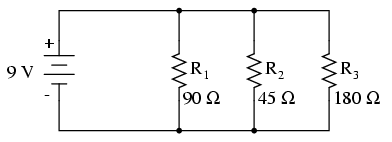
How many chucks would a woodchuck chuck if a woodchuck could chuck wood?
1
2
3
4


Identical charges A, B, and C are located between two oppositely charged parallel plates, as shown in the diagram below. The magnitude of the force exerted on the charges by the electric field between the plates is
least on A and greatest on C
the same on A and C, but less on B
the same for A, B, and C
greatest on A and least on C
What is the magnitude of the electric field intensity at a point where a proton experiences an electrostatic force of magnitude 2.30 x 10⁻²⁵ newton?
1.44 x 10⁻⁶ N/C
1.44 x 1044 N/C
3.68 x 10-44 N/C
3.68 x 10⁶ N/C
An electrostatic force of 20. newtons is exerted on a charge of 8.0 x 10⁻² coulomb at point P in an electric field. What is the magnitude of the electric field intensity at P?
1.6 N/C
20. N/C
2.5 x 10² N/C
4.0 x 10⁻³ N/C
An object with a net charge of 4.80 x 10⁻⁶ coulomb experiences an electrostatic force having a magnitude of 6.00 x 10⁻² newton when placed near a negatively charged metal sphere. What is the electric field strength at this location?
2.88 x 10⁻⁸ N/C directed toward the sphere
1.25 x 10⁴ N/C directed toward the sphere
2.88 x 10⁻⁸ N/C directed away from the sphere
1.25 x 10⁴ N/C directed away from the sphere
Which graph best represents the relationship between the strength of an electric field and distance from a point charge?


The diagram above represents a source of potential difference connected to two large, parallel metal plates separated by a distance of 4.0 x 10⁻³ meter. Which statement best describes the electric field strength between
the plates?
It is the same at points A, B, and C.
It is a maximum at point C.
It is zero at point B.
It is a maximum at point B.

The diagram above shows a point, P, located midway between two oppositely charged parallel plates.
If an electron is introduced at point P, the electron will
accelerate toward the negatively charged plate
travel at constant speed toward the negatively charged plate
travel at constant speed toward the positively charged plate
accelerate toward the positively charged plate

An electron placed between oppositely charged parallel plates A and B moves toward plate A, as represented in the diagram below. What is the direction of the electric field between the plates?
out of the page
toward plate B
into the page
toward plate A

The diagram below shows the arrangement of three charged hollow metal spheres, A, B, and C. The arrows indicate the direction of the electric forces acting between the spheres. At least two of the spheres are positively charged. Which sphere, if any, could be negatively charged?
sphere A
sphere B
sphere C
no sphere
Which diagram best represents the electric field around a negatively charged conducting sphere?


A moving electron is deflected by two oppositely charged parallel plates, as shown in the diagram above.
The electric field between the plates is directed from
C to D
D to C
A to B
B to A

A positive test charge is placed between an electron, e, and a proton, p, as shown in the diagram above.
When the test charge is released, it will move toward
A
B
C
D
In a charged capacitor, the energy resides
The positive charges
Both the positive and negative charges
The field between the plates
Around the edge of the capacitor plates
The capacity of parallel plate condenser depends on
The type of metal used
The thickness of plates
The potential applied across the plates
The separation between the plates

Change Q on a capacitor varies with voltage V . The area of triangle OAB represents
Capacitance
Capacitive reactance
Magnetic field between the plates
Energy stored in the capacitor
During charging a capacitor variation of potential V of the capacitor with time t is shown as


When capacitors is arrange in series (3 capacitors), the equivalent capacitance C is
C = C1 + C2 + C3
1/C = 1/C1 + 1/C2 + 1/C3
C = QV1 + QV2 + QV3
C = CR1 + CR2 + CR3
When capacitors in parallel (3 capacitors), the equivalent capacitance is
C = C1 + C2 + C3
C = 1/C1 + 1/C2 + 1/C3
C = QV1 + QV2 + QV3
C = QV1 + QV2 + QV3
1. A ____________ connection has 2 or more components connected so that there is more than one path for current to flow.
series
parallel
series/parrallel
polarized
6. The total capacitance of two capacitors connected in series is _____________ the lowest value capacitor
equal to
opposite
greater than
less than
If 4μF and 2μF capacitors are conneced in series, the equivalent capacitor is ___________.
1.33μF
0.75μF
6μF
2μF
If capacitors are connected in parallel, then potential difference across each capacitor is
same
zero
different
infinite
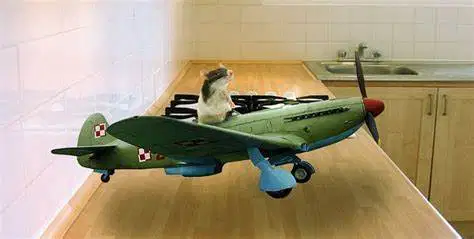
What is wrong with this image?
The kitchen worktop is horrible
Mice can't fly planes
It's the worst photoshop I've ever seen
The mouse has incorrectly calculated the torque required to keep the aircraft in equilibrium
When a 4 V battery is connected to a capacitor, what is the voltage across the capacitor after a long period of time?
0.0 V
2.0 V
4.0 V
3.0 V
Which of the following is symbol of capacitor ?


Capacitance is measured in___________
Coulombs
Farads
Hz
Volts

