
 Worksheets
1D Kinematics and Free Fall
Total questions: 115
Worksheet time: 5hrs 42mins
Acceleration is defined as the CHANGE in
time it takes for one place to move to another place.
velocity of an object.
distance / time
velocity / time
The SI unit for acceleration is
m
m/s
m/s2
s

What is the velocity of an object that has been falling freely in a vacuum for 2 seconds?
9.81 m/s down
10.18 m/s down
19.62 m/s down
39.24 m/s down
What is the acceleration of an object moving at constant velocity?
2 m/s2
1 m/s2
0 m/s2
0.8 m/s2
When velocity is negative and acceleration is negative, what happens to the object’s motion?
The object slows down
The object speeds up
Nothing happens to the objects motion
The object remains at rest
A dolphin swims 1.85 km/hr. How far has the dolphin travelled after 0.6hr?
1.1 km
2.5 km
0.63 km
3.7 km
A coin released from rest from the top of a tower hits the ground after 1.5 seconds. What is the speed of the coin as it hits the ground?
15 m/s
21 m/s
31 m/s
39 m/s
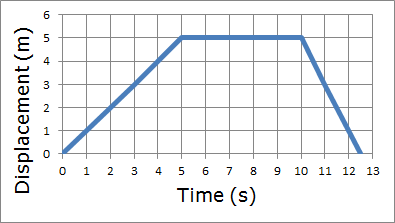
What is the person doing from 5 seconds to 10 seconds?
Walking
Running
Standing Still
Walking Fast

What quantity is equal to the slope of this graph?
Distance
Displacement
Acceleration
Velocity
An object is thrown into the air at 60 m/s, straight up. What is its velocity at the highest point?
0 m/s
-9.8 m/s
60 m/s
-60 m/s
A dog running with an initial speed of 7.5 m/s comes to a stop in 15 seconds. What is the dog's acceleration?
-7.5 m/s
-7.5 m/s2
-0.5 m/s2
7.5 mi//hr
A race car starting from rest accelerates uniformly at a rate of 4.90 m/s2. What is the car's speed after it has traveled 200 meters?
1960 m/s
62.6 m/s
44.3 m/s
31.3 m/a
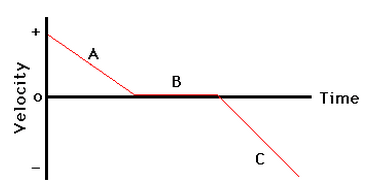
Does upward movement of an object have a negative or positive velocity?
Negative
Positive
If King Kong falls off a roof, which velocity is 0?
Final velocity
Original velocity
If an object comes to a stop in a problem, what is its final velocity?
Depends on the problem
0
Always positive
Always negative
When an object starts from rest, what is its original velocity?
Depends on the problem
0
Always positive
Always negative


The graph above represents the motion of a car during a 6 - second interval. What is the acceleration of the car at t = 5.0 s?
0.0 m/s
2.0 m/s
2.5 m/s
10 m/s

This velocity vs. time graph shows an object...
not moving
moving with constant velocity
moving with changing velocity
"A car traveling from rest has a top speed of 65 m/s. It travels a distance of 550 meters. What is the acceleration?" Which is the best equation to use to solve this problem?


velocity unit
m/s
m/s2
km/s
km/s2
If you throw a ball up, what is its acceleration when it reaches its maximum height?
Depends on the problem
9.8 m/s2
-9.8 m/s2
Positive on the way up and negative on the way down
Does upward movement of an object have a negative or positive velocity?
Negative
Positive
An airplane accelerates down a runway at 3.20 m/s/s
for 8 s until it finally lifts off the ground.
Determine the velocity at take-off.
0.4 m/s
25.6 m/s
2.5 m/s
You toss a ball straight upward, in the positive direction. The ball falls freely under the influence of gravity.
At the highest point in the ball’s motion,
its velocity is zero and its acceleration is zero.
its velocity is zero and its acceleration is positive (upward).
its velocity is zero and its acceleration is negative (downward).
its velocity is positive (upward) and its acceleration is zero.
its velocity is positive (upward) and its acceleration is zero.
A ball is thrown downward from the top of a roof with a speed of 25 m/s. After 2 s, its velocity will be:
(Choose upward as positive)
19.6 m/s
-5.4 m/s
-44.6 m/s
44.6 m/s
An object in free fall is acted on only by the force of gravity
True
False
A very massive object will free fall at the same rate of acceleration as a less massive object
True
False
An automobile with an initial speed of 4.30 m/s accelerates uniformly at the rate of 3.0 m/s2. Find the final speed after 5.0 s.
Δx = v0t + 21 at 2
vf2 = v02 + 2a Δx
vf = v0 + at
v = tΔx
Velocity is the rate of change of ...
Acceleration
Distance
Speed
Position
An airplane accelerates down a runway at 3.20 m/s2 for 32.8 s until it finally lifts off the ground. Determine the distance traveled before takeoff.
1720 m
420 m
5.23 m
79 n
A bike accelerates uniformly from rest to a speed of 7.10 m/s over a distance of 35.4 m. Determine the acceleration of the bike.
0.72 m/s2
0.712 m/s
0.712 m/s2
45.6 m/s2

A rock is thrown in the air as shown in the picture. If it takes 5 seconds to reach point D, how long will take the rock to reach the ground from point D?
2.5 s
5 s
10 s
1 s

19.6 s
9.8 s
An alpaca is traveling at 10 m/s when it speeds up to 30 m/s in a span of 4 s. What distance does it travel?
160 m
120 m
80 m
40 m

An old lady rolls down a hill at 3 meters/second. The hill is 36 meters long. How many seconds does it take the old lady to reach the bottom of the hill?
39 seconds
12 seconds
15 seconds
33 seconds

A textbook is dropped from a second floor window and falls to the ground. What happens to the velocity as the book falls to the ground
the velocity increases
the velocity decreases
the velocity remain constant

A baseball is thrown up into the air. What happens to the velocity as the ball rises in the air?
the velocity increases
the velocity decreases
the velocity remains constant

A baseball is thrown up into the air. What happens to the acceleration as the ball rises in the air?
the acceleration increases
the acceleration decreases
the acceleration remains constant
Which of the following statements applies to the motion of a ball rising and then falling in free fall?
I. The ball has constant acceleration as it moves upward.
II. The ball has constant acceleration at the top of its path.
III. The ball has constant acceleration as it moves downward.
I only
III only
I and III
I, II, and III

A textbook is dropped from a second floor window and falls to the ground. What happens to the acceleration as the book falls to the ground
the acceleration increases
the acceleration decreases
the acceleration remains constant
The state that exists when the only force acting on an object is gravity is called
free fall
inertia
acceleration
momentum
When we throw an object up in the air, its velocity at the peak
cannot be calculated.
is -9.8 m/s
is 0 m/s
is -9.8 m/s/s
A car is traveling to the right with a speed of 29m/s when the rider slams on the accelerator to pass another car. The car passes in 110 m with constant acceleration and reaches a speed of 34m/s. We want to find the acceleration of the car as it sped up. What equation should you choose?
vf=vi+at
x=vit+1/2at2
vf2=vi2+2aX
x=((vf+vi)/2)t

Describe the motion as a ball is moving upwards from A to B
velocity is remaining constant
velocity is slowing down
velocity is speeding up
Describe the motion as a ball is moving upwards from A to B
acceleration is remaining constant
acceleration is slowing down
acceleration is speeding up
Describe the motion as a ball is moving at point B
acceleration due to gravity does not exist
velocity of the ball is 0 m/s
velocity is slowing down
acceleration due to gravity is upwards
Describe the motion as a ball is moving downward from B to C
acceleration is remaining constant
acceleration is slowing down
acceleration is speeding up
Describe the motion as a ball is moving downwards from B to C
velocity is remaining constant
velocity is slowing down
velocity is speeding up
What direction is the acceleration vector if the ball is moving downwards from A to B
acceleration vector is upwards
acceleration vector is downwards
Acceleration due to gravity is constant.
True
False
If you drop an object from rest, the speed of the object will ___ as it falls.
increase
decrease
remain constant
Planet X has an acceleration due to gravity of 8 m/s/s. If you throw a rock upward at 40 m/s, it's velocity will be (a) when it reaches the highest point in (b) .
If an object has an acceleration of 0 m/s2, then one can be sure that the object is not ___.
moving
changing position
changing velocity
What is the acceleration of an object moving at constant velocity?
2 m/s2
1 m/s2
0 m/s2
0.8 m/s2
A baseball catcher throws a ball straight up and catches it in the same spot. A what point in the balls trajectory does it experience a velocity of zero.
Midway on the way up
At its peak height
The instant it leaves the catchers hand
The instant before it arrives in the catchers mitt
Which of the following correctly describes what happens during a free fall?
Kinetic energy is converted to potential energy.
Velocity is constant.
Acceleration is constant.
Acceleration increases with the fall.
A car traveling initially at +7.0 m/s accelerates uniformly at the rate of +0.80 m/s2 for a distance of 245 m. What is its velocity at the end of the acceleration?
Δx = v0t + 21 at2
vf2 = v02 + 2a Δx
vf = v0 + at
a = tΔv
A car accelerates uniformly in a straight line from rest at the rate of 2.3 m/s2. How long does it take the car to travel 55 m?
Δx = v0t + 21 at2
vf2 = v02 + 2a Δx
vf = v0 + at
Δx = vt
Turner’s treadmill runs with a velocity of -1.2 m/s and speeds up at regular intervals during a half-hour workout. After 25 min (1500 s), the treadmill has a velocity of -6.5 m/s. What is the average acceleration of the treadmill during this period?
Δx = v0t + 21 at2
vf2 = v02 + 2a Δx
vf = v0 + at
v = tΔx
The Velocity vs. Time graph for an object experiencing constant (nonzero) acceleration looks like:
A Horizontal Line
A Straight Line with a defined, nonzero slope
A Vertical Line
A Parabolic Curve
A paint brush is dropped from the top of a tall ladder and free falls to the ground. What changes, if any, would be observed of the velocity and the acceleration of the brush as it falls? Pick 2 answers.
The velocity increases.
The velocity decreases.
The velocity remains a constant value.
The acceleration changes (increases or decreases).
The acceleration remains a constant value.
Heavier objects free fall faster than lighter objects.(in the absence of the air resistance)
True
False
Kylie Jenner wanted to prove to her sisters that her diamond earrings can survive a fall off a 300-meter building. What was the final velocity that her earrings reach?
5,886 m/s
76.72 m/s
50 m/s
5,886 m/s2
An object falls freely from rest near the surface of Earth. What is the speed of the object after having fallen a distance at 10 meters?
14 m/s
96.1 m/s
4.90 m/s
24.0 m/s
A brick is dropped from a height of 0 meters. What was the final velocity of the brick right before it hits the ground?
100 m/s
0 m/s
50 m/s
9.81 m/s
A rock that was thrown upwards has a different acceleration than a rock that is thrown downwards.
TRUE
FALSE
A dropped object in free fall...
Fall 9.8 m each second
Falls 9.8 m in the first second
Has an increase in speed of 9.8 m/s each second
Has an increase in acceleration of 9.8 m/s each second
Suppose the child and trampoline are flown in a rocket to the moon where gravity is -1.63 m/s^2. And the child once again jumps upward from the trampoline with a velocity of 9 m/s. At what height above the trampoline will the child reach?
24.8 m
4.1 m
0.46 m
2.8 m
Zach is out in the brush goose hunting one foggy morning in Louisa County. He sees a goose sitting at rest on a lake when suddenly the goose begins to swim away at a velocity of 2.8 m/s. If the goose’s displacement is 2 m when Zach realizes the goose has moved, how fast is the goose accelerating across the water?
1.96 m/s2
0.7 m/s2
3.92 m/s2
2.8 m/s2
Juan is standing on the top observation deck of the Eiffel Tower in Paris at a height of 300 meters. He drops his cell phone. How fast will the phone be traveling when it hits the ground? Ignore the effect of air resistance.
9.8 m/s
76.68 m/s
149.76 m/s
46.99 m/s
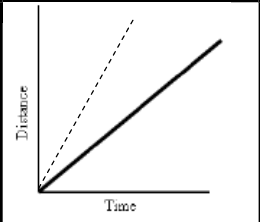
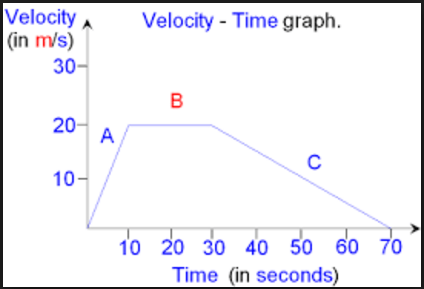

What is the velocity of the object from point A to B?
2 m/s
1 m/s
4 m/s
-4 m/s
Kinematic equation can only be used when you have a constant ....
Position
Velocity
Acceleration
Time

A dog basks in the sun when he sees a squirrel and bolts after it. If the dog accelerates at +1.6 m/s/s, how far does he run in 3 seconds?
4.8 meters
45 meters
1.6 meters
7.2 meters
An object with an initial velocity of 3.50 m/s moves east along a straight and level path. The object then undergoes a constant acceleration of 1.80 m/s2 east for a period of 5.00 s. How far does the object move while it is accelerating?
6.30 m
17.5 m
27.2 m
40.0 m
The speed of an object undergoing constant acceleration increases from 8.0 m/s to 16.0 m/s in 10 s. How far does the object travel during the 10 seconds?
360 m
160 m
120 m
80. m
A car accelerates uniformly from rest at 3.2 m/s2. When the car has traveled a distance of 40. m, its speed will be
8.0 m/s
12.5 m/s
16 m/s
128 m/s
On the moon, a feather dropped from rest from a height of 2 meters reaches the surface in 1.57 seconds. What is the acceleration of gravity on the moon?
0.616 m/s2
1.59 m/s2
1.62 m/s2
2.54 m/s2

What is the acceleration of the car at t = 5.0 seconds?
0.0 m/s2
2.0 m/s2
2.5 m/s2
10. m/s2
A car moving along a level road, increases its speed from 14 m/s to 25 m/s while traveling 500m.
What was the magnitude of the car's acceleration?
20 m/s2
0.4 m/s2
114 m/s2
26 m/s2


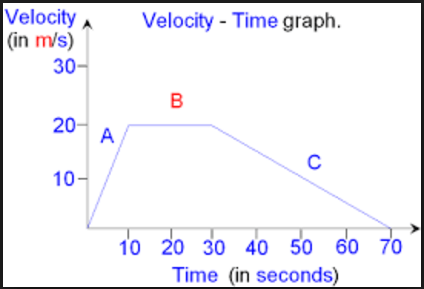

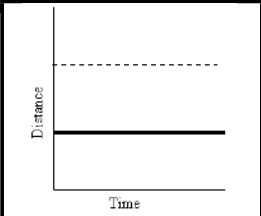
Velocity is always the same as speed?
True
False

If Kath was able to travel 50 km north in 2 hours in her car, what was her average velocity?
100 kph, S
25 kph, S
100 kph, N
25 kph, N
The slope of the velocity vs time graph represents
displacement
acceleration
velocity

Based on the graph above, describe the motion of the object from 0-4 seconds
The object is moving in the positive direction and speeding up.
The object is moving in the positive direction and slowing down.
The object is moving in the negative direction and speeding up.
The object is moving in the negative direction and slowing down.
Based on the graph above, describe the motion of the object from 6-10 seconds
The object is moving in the positive direction and speeding up.
The object is moving in the positive direction and slowing down.
The object is moving in the negative direction and speeding up.
The object is moving in the negative direction and slowing down.
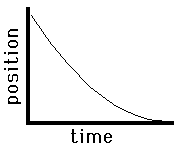
Describe the motion (a)
On a distance vs. time graph, the steeper the slope the (a) the speed.
To determine an object's acceleration using a Velocity-time graph I should...
Look at the vertical axis for that time
Determine the area between the graph & the x axis up to that time
See whether the graph is above or below the x axis at that time
Solve for the slope of the graph at that time

If you throw a baseball straight up, what is its acceleration at the highest point?
-9.8 m/s2
9.8 m/s2
0 m/s2
0 m/s

