wayground logo

Free Printable Worksheets

Font size

S
M
L
XL
Worksheets

3rd Quarter Review Test (a 100 item test challenge)Recorded)

Total questions: 100

Worksheet time: 1hrs 10mins

Name
Class
Date
1.
Softer landings tend to
a)
increase impact force
b)
increase force
c)
increase collision time
d)
increase change in momentum
2.

What is the difference between a car hitting a wall vs. a car hitting a hay stack?

a)

the Impulse on the car hitting the wall is greater

b)

the change in momentum of the car hitting the wall is greater

c)

the force on the car hitting the hay stack is greater

d)

the collision time of the car hitting the hay stack is greater

3.

What is the unit for Impulse?

a)

N/s

b)

N.s

c)

N

d)

m/s

4.
A boy kicks a football with a force of 20 N, the time the force acts for is 0.3 s.
Calculate the impulse on the ball.
a)
1 N.s
b)
6 N.s
c)
66 N.s 
d)
None of these
5.

What is the purpose of crumble zones on a car?

a)

decrease time of impact.

b)

increase force of impact.

c)

increase the time of impact.

d)

decrease the impulse during impact.

6.

In an isolated system, the net ____ on that system is zero.

a)

external force

b)

internal force

c)

time interval

d)

displacement

7.
The impulse-momentum theorem states that
a)
the impulse on an object is equal to the change in momentum it causes 
b)
the force on a moving object is equal to the magnitude of the impulse.
c)
the impulse on an object is greater than the change in momentum it causes 
d)
the impulse on an object is less than the change in momentum it causes
8.

can a bullet have the same momentum as a truck?

a)

yes

b)

no

9.
A biker with a mass of 75 kg moves along the path with a constant velocity of 5 m/s. What is the biker's momentum?
a)
25 m/s
b)
375 m/s
c)
25 kg m/s
d)
375 kg m/s
10.

A 5 N force is applied to a 3 kg ball to change its velocity from +9 m/s to +3 m/s. The impulse on the ball is ______ N s.

a)

-2.5

b)

-10

c)

-18

d)

-45

11.
A 0.250 kg cart moving at 0.400 m/s has how much momentum?
a)
0.1 kg-m/s
b)
1 kg-m/s
c)
10 kg-m/s
d)
100 kg-m/s
12.
A runner has a momentum of 670 kg m/s and is travelling at a velocity of 9 m/s. What is his mass?
a)
6030 kg
b)
0.0134 kg
c)
74.4 kg
d)
80 kg
13.
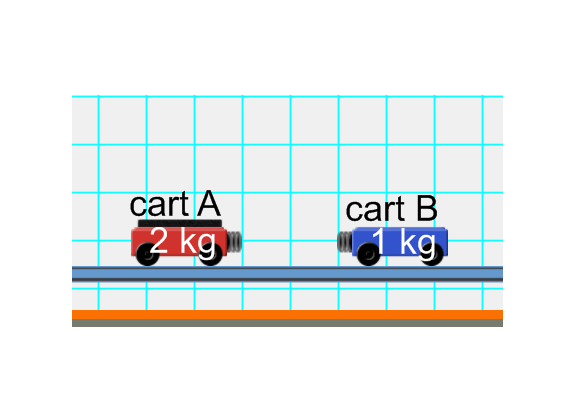
Cart A is pulled with a 2 Newton force for 2 seconds, and Cart B is pulled with a 1 Newton force for 3 seconds.  Which cart experiences the greatest impulse?
a)
Cart B
b)
Cart A
c)
they are the same
14.
A boy kicks a football with a force of 20 N, the time the force acts for is 0.3 s.
Calculate the impulse on the ball.
a)
1 N.s
b)
6 N.s
c)
66 N.s 
d)
None of these
15.
Which takes more force  to catch, a bowling ball or a ping pong ball?
a)
bowling ball because it has more momentum
b)
ping pong ball because it has more momentum
c)
both require the same amount of force when catching
d)
bowling ball because it has less momentum
16.
An object with a mass of 2000 kg at rest has what momentum?
a)
2000 kg m/sec
b)
0 kg m/sec
c)
2000 kg
d)
2000 m/sec
17.
When the speed of an object is doubled, its momentum
a)
remains unchanged in accord with the conservation of momentum.
b)
doubles
c)
quadruples
d)
decreases
18.
How can a tennis ball and a bowling ball have the same momentum?
a)
have the same speed
b)
have different speeds
c)
one is moving backwards
d)
they can't
19.

The momentum of an object depends upon the object's ___________&_____________.

a)

size and shape

b)

mass and speed

c)

mass and veloctiy

d)

mass and energy

20.

_________________ causes and is equal to a change in momentum

a)

Impulse

b)

Force

c)

Joule

d)

Watt

21.

Determine the momentum of 1,000-kg car moving northward at 20 m/s.

a)

20,000 N

b)

20,000 Joules

c)

20,000 Kg * m/s

d)

20,000 kg * m/s north

22.
If two objects have the same mass, then the faster moving object has ____________ momentum.
a)
more 
b)
less
c)
the same
23.
The total momentum before a collision is _________ the total momentum after a collision.
a)
equal to 
b)
less than 
c)
more than
d)
It depends on the type of collision
24.
The law of conservation of momentum states that, 
a)
p before is less than p after
b)
p before is the same as p after
c)
p before is more than p after
25.
A large box slides across a frictionless surface with a velocity of 12 m/s and a mass of 4 kg,  collides with a smaller box with a mass of 2 kg that is stationary.  The boxes stick together. What is the velocity of the two combined masses after collision?
a)
0 m/s
b)
4 m/s
c)
8 m/s
d)
12 m/s
26.

How does velocity of an object affect its momentum?

a)

If velocity increases, momentum decreases.

b)

If velocity decreases, momentum increases.

c)

If velocity increases, momentum also increases.

d)

If velocity increases, momentum doesn't change.

27.

Mona, a skater who is moving at a high speed needs a certain amount of force to stop her. When will more stopping force needed?

a)

if she has more mass

b)

if she has more momentum

c)

if she has more velocity

d)

if she has a less stopping distance

28.

Which of the following statements is true about impulse – momentum theorem?

a)

The impulse on an object is equal to the change in momentum.

b)

The impulse on an object is greater than the change in momentum.

c)

The force on a moving object is equal to the magnitude of the impulse.

d)

The impulse on an object is less than the change in momentum it causes.

29.

Which of the following types of collisions where both momentum and KE is conserved?

a)

elastic collision

b)

inelastic collision

c)

perfectly inelastic

d)

both a and b

30.

How can the stability of an object be decreased?

a)

lower the center of gravity

b)

the LoCOG must pass through the BOS

c)

increase the weight of the object

d)

narrow the base of the object

31.

What provides centripetal force for the vehicles to travel in curve banked road?

a)

centrifugal force

b)

frictional force

c)

x component of normal force

d)

y component of the normal force

32.

Which of the following statements is not true?

a)

All moving bodies have inertia.

b)

All bodies have inertia.

c)

Not all moving bodies have momentum.

d)

Not all bodies have momentum.

33.

Which of the following best describes friction?

a)

It always resists to the motion of a moving body.

b)

It always works opposite to the direction of the moving object.

c)

It is the opposing force that stops or slows down a moving object.

d)

It is generated when two or more bodies are in contact with each other.

34.

When you carry a load with one arm, why do you tend to hold your free arm away from your body?

a)

to change the mass of your body

b)

to change the weight of your body

c)

to shift your body’s center of gravity

d)

to make your body stable as you move

35.
Jorge noticed a collision outside the coffee shop where two cars collided and stuck together.  What type of collision did he observe?
a)
Elastic
b)
Inelastic
c)
Completely inelastic
d)
none
36.
While playing pool, Emma notices that the pool balls bounce apart.  What type of collision is this?
a)
Elastic
b)
Inelastic
c)
Explosive
d)
Force
37.

You do not know an object's velocity until you know it's

a)

Speed

b)

Reference point

c)

Speed and direction

d)

Acceleration

38.

What scientist came up with the 3 laws of motion?

a)

Mr. Willson

b)

Gregor Mendel

c)

Ms. Forbes

d)

Isaac Newton

39.

Force = ma is the formula from

a)

Newton's 1st Law

b)

Newton's 2nd Law

c)

Newton's 3rd Law

40.

The Law of Conservation of Momentum states that the amount of momentum in a system is ___________________ before and after a collision.

a)

greater

b)

decreased

c)

the same

d)

unknown

41.

No collision is either perfectly elastic or perfectly inelastic.

a)

True

b)

False

42.
The faster an object moves, the ________ kinetic energy it has. 
a)
more
b)
less
c)
none of the above
d)
all of the above 
43.

Which of the following is true about what happens to energy when two balls collide?

a)

The total amount of energy between the two balls becomes zero.

b)

The total amount of energy between the two balls stays the same.

c)

The total amount of energy between the two balls increases.

d)

The total amount of energy between the two balls decreases.

44.

What happens when two objects collide?

a)

Energy is changed into force.

b)

Energy is transferred from one object to another.

c)

Energy is created and the objects move faster.

45.

What effects the amount of energy transferred in a collision?

a)

the speed

b)

the weight

c)

the speed AND weight

46.

While playing with toy cars, Kirsten and Luca each push a car toward the center of the room. What happens when the toy cars collide?

a)

Energy is transferred.

b)

Energy is unchanged.

47.

The picture shows what type of collision?

a)

Elastic, Inelastic and Perfectly Inelastic Collision

b)

Inelastic Collision

c)

Perfectly Inelastic Collision

d)

Elastic Collision

48.

In what type of collisions, momentum is conserved?

a)

Inelastic and Perfectly Inelastic Collisions

b)

Elastic, Inelastic and Perfectly Inelastic Collisions

c)

Inelastic and Elastic Collisions

d)

None

49.

In what type of collisions, both momentum, and total kinetic energy is conserved?

a)

Elastic, Inelastic and Perfectly Inelastic Collisions

b)

Perfectly Inelastic Collisions

c)

Elastic Collisions

d)

Inelastic Collisions

50.

The difference between inelastic and perfectly inelastic collisions is that...

a)

In one type of collisions, objects stick after colliding, while the other objects bounce,and move separately.

b)

One type maintains Kinetic Energy, while the other doesn't.

c)

One type maintains velocity, while the other doesn't.

d)

One type maintains momentum, while the other doesn't.

51.
Friction is a force that acts in an ___________ direction of movement.
a)
similar
b)
opposite
c)
parallel
d)
west
52.
The amount of friction depends on the weight of the objects pressing together.
a)
True
b)
False
53.
What type of friction is not moving?
a)
static
b)
sliding
c)
fluid
d)
rolling
54.
How can friction be reduced?
a)
reduce the force acting between the 2 surfaces
b)
reduce the roughness of the 2 surfaces coming in contact
c)
use wax, grease or oil
d)
all of the above are ways of reducing friction
55.
A type of friction that occurs when air pushes against a moving object causing it to decelerate.
a)
surface area
b)
air resistance
c)
velocity
d)
gravity 
56.
Which of the following is an example of friction that is helpful?
a)
Brakes used on a bike
b)
Tires from a car on the road
c)
Tread on the bottom of your shoes
d)
All are examples that are helpful
57.
Which of the following is an example of friction that is harmful?
a)
Pencil marking on paper
b)
Engine parts wearing out
c)
sand placed on ice in the winter
d)
Using an eraser to erase marks
58.
Rougher surfaces have ...
a)
greater friction
b)
less friction
c)
the same level of friction
59.

Center of gravity is usually located where

a)

more weight is concentrated

b)

less weight is concentrated

c)

less mass is concentrated

d)

more mass is concentrated

60.

Center of gravity of an object depends on it's

a)

weight

b)

mass

c)

density

d)

shape

61.

Where the center of gravity of a circle lies?

a)

At its centre

b)

Anywhere on its radius

c)

Anywhere on its circumference

d)

Anywhere on its diameter

62.

What is one way you might increase the stability of an object?

a)

Lower the center of gravity

b)

Raise the center of gravity

c)

Increase the height of the object

d)

Shorten the base of the object

63.
The velocity is always _____ to the line of a circle. 
a)
outwards
b)
towards the center
c)
tangent
d)
faster
64.
Which statement is true about an object that is traveling in uniform circular motion?
a)
The speed of the object varies.
b)
The net force on the object is directed toward the center of the circular path.
c)
The direction of the object's velocity is constant.
d)
The net force on the object is directed away from the center of the circular path.
65.
Centripetal acceleration always points
a)
in the direction of the object's motion
b)
in the opposite direction of the object's motion
c)
towards the center of the circle
d)
towards the outside of the circle
66.
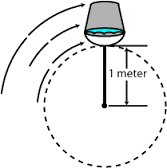
You swing a bucket of water attached to a string in a circle above your head. What keeps the water in the bucket?
a)
Friction
b)
Centripetal Force
c)
Gravity
d)
Inertia
67.
Centrifugal force is a ______
a)
force that pushes you to the outside of a circle during uniform circular motion.
b)
fictitious force that is really just the linear momentum of an object in uniform circular motion.  
c)
The force that keeps the planets in orbit
68.
Which of the following is the unit for centripetal force?
a)
J
b)
m/s2
c)
kg⋅m/s
d)
N
69.
What object experiences uniform circular motion?
a)
A car speeding up as it turns left
b)
A car traveling around a roundabout at a constant speed
c)
A car slowing down as it crests a tall hill
d)
A car traveling down the road at a constant speed
70.

What force keeps an object moving in a circle?

a)

centripetal force (inward)

b)

centrifugal force (outward)

71.
What states that "every object in the universe attracts every other object"?
a)
Law of Universal Gravitation
b)
Newton's First Law of Motion
c)
My mother
d)
Inertia & gravity
72.
Force of gravity is inversely proportional to
a)
Mass
b)
Weight
c)
Distance
d)
Time
73.
If Earth's mass was cut in half, what would happen to your mass?
a)
increase because gravitational force increases
b)
decrease because gravitational force decreases
c)
decrease because gravitational force increases
d)
nothing, mass is not affected by gravitational force
74.
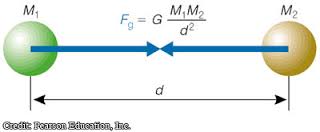
What is the Universal law of gravitation equation? 
a)
G=F ⋅ m⋅m2/r2
b)
F=G ⋅ m⋅m2/(r)2
c)
F=G ⋅ r2/m⋅m2
d)
G=F ⋅ r2/m⋅m2
75.
The law of universal gravitation is credited to whom?
a)
Einstein
b)
Galileo
c)
Darwin
d)
Newton
76.
Two factors effecting the magnitude of the force of gravity between 2 objects are...
a)
mass and distance 
b)
mass and matter
c)
distance and weight 
d)
weight and mass
77.
Gravity attracts all objects towards one another.
a)
False
b)
True
c)
It depends
78.
Complete the following statement: The farther away two planets are the _______ the gravitational force between them.
a)
more
b)
same
c)
dosen't matter
d)
less
79.
Gravity is the force objects put on each other because of their ______.
a)
Mass
b)
Friendliness
c)
Acceleration
d)
Speed
80.
The moon and other satellites rotate around the earth. Identify the force that keeps these satellites in orbit.
a)
gravity
b)
friction
c)
a strong force
d)
electromagnetic force
81.
Force of gravity is inversely proportional to
a)
Mass
b)
Weight
c)
Distance
d)
Time
82.
Force of gravity is directly proportional to
a)
Mass
b)
Weight
c)
Distance
d)
Time
83.
Two factors effecting the magnitude of the force of gravity between 2 objects are...
a)
mass and distance 
b)
mass and matter
c)
distance and weight 
d)
weight and mass
84.

The sun is the anchor point of our solar system because of

a)

the gas Hydrogen

b)

its small density

c)

its huge mass

d)

its location

85.
Ocean tides occur mainly because 
a)
water normally runs to the side of Earth away from the sun
b)
of the gravitational pull of the sun on Earth
c)
of different gravitational pulls of the moon on opposite sides of Earth
d)
as Earth rotates it leaves the ocean water somewhat behind it
86.
How are mass and weight different?
a)
Mass is the amount of matter in an object;Weight is the amount of gravitational force acting on the object
b)
Mass is the amount of gravitational force acting on an object;Weight is the amount of matter in an object
c)
Mass is a thing;Weight is a place
d)
Mass is an animal;weight is a human
87.
The units of velocity are
a)
kg
b)
m
c)
m/s
d)
N
88.
The units of acceleration are
a)
kg
b)
m/s2
c)
m/s
d)
N
89.
What is weight?
a)
The amount of particles in an object
b)
The force applied by gravity on a mass
c)
How much you weigh on Earth
d)
The number of Newton's of force your body applies to the ground. 
90.

Which of the following statements is true?

I.A car turning at a constant speed has a changing momentum.

II.A car turning at a constant velocity has a changing momentum.

III.A car moving at changing direction has a changing momentum.

a)

I

b)

II

c)

I & II

d)

I & III

91.

Which of the following is FALSE when an object is moving with a constant mass but the momentum is changing?

a)

The object is accelerating.

b)

The object’s speed is changing.

c)

The object’s velocity is changing.

d)

There is force acting on the object.

92.

Which of the following statements is FALSE about a perfectly inelastic collision?

a)

The objects involved are deformed to some degree.

b)

The objects involved move together as one mass afterwards.

c)

The objects involved move with a common velocity after collision.

d)

The objects involved stick together after bouncing effect happens.

93.

Which of the following is the symbol for momentum?

a)

m

b)

p

c)

I

d)

v

94.

Which of the following represents the meaning of symbol "p" for momentum?

a)

progress

b)

persevere

c)

protect

d)

presence

95.

Momentum is a ____________________ quantity

a)

science

b)

scalar (without direction)

c)

vector (with direction)

d)

energy

96.

What is the metric SI unit for momentum?

a)

g.m/s

b)

kg.m/s2

c)

kg.m/s

d)

m/s

97.

What happens to the momentum of an object if its velocity is doubled?

a)

remains unchanged

b)

doubles

c)

quadruples

d)

decreases

98.

Which has more momentum: a truck stopped at a red light or a bike moving at 15 mph?

a)

car

b)

bike

c)

they are equal

99.

Which of the two cars has larger momentum?

a)

blue car

b)

yellow car

100.

Which of the following statements is TRUE?

a)

Momentum is inversely proportional to mass and velocity.

b)

Momentum is directly proportional to mass but inversely proportional to velocity.

c)

Momentum is directly proportional to mass and velocity.

d)

Momentum is inversely proportional to mass but directly proportional to velocity.