wayground logo

Free Printable Worksheets

Font size

S
M
L
XL
Worksheets

Physics| Recap

Total questions: 100

Worksheet time: 1hrs 15mins

Name
Class
Date
1.
A car speeding up, a dog slowing down and person turning around the block are examples of..
a)
Balanced Forces
b)
Unbalanced Forces
2.
What is Newton's First Law known as? The Law of
a)
Friction
b)
Mass
c)
Inertia
d)
Gravity
3.

What is Newton's First Law?

a)

F=ma

b)

Every action has an equal and opposite reaction

c)

An object at rest stays at rest, an object in motion stays in motion. 

d)

Friction 

4.
Newton's third law states that any action will have a(n) _______ and ______ reaction
a)
Equal and similar
b)
Equal and opposite
c)
Equal and different
d)
Greater and opposite
5.

This equation goes with which law?

a)

Newton's first law of motion

b)

Newton's second law of motion

c)

Newton's third law of motion

6.

A person is pushed forward into their seat belt when a car stops. Which law is this?

a)

Newton's 1st Law

b)

Newton's 2nd Law

c)

Newton's 3rd Law

7.
Which of Newton's laws are illustrated with a rocket launch?
a)
1st Law, the Law of Inertia. 
b)
2nd Law, the Law of Acceleration.
c)
3rd Law, the Law of Action Reaction
d)
The Law of Conservation of Mass
8.

When the force on a car is doubled, the acceleration is doubled.

a)

Newton's 1st Law

b)

Newton's 2nd Law

c)

Newton's 3rd Law

9.

A skater pushes another skater forward, but the one pushing moves backwards.

a)

Newton's 1st Law

b)

Newton's 2nd Law

c)

Newton's 3rd Law

10.

The harder you hit a baseball, the faster it accelerates.

a)

Newton's 1st Law

b)

Newton's 2nd Law

c)

Newton's 3rd Law

11.

You push against a wall and the wall is pushing back on you.

a)

Newton's 1st Law

b)

Newton's 2nd Law

c)

Newton's 3rd Law

12.

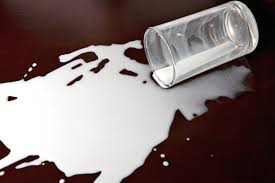
You are carrying a lunch tray when you bump into the edge of a table. Although the tray did not tip, your milk falls off of the front of the tray.

a)

Newton's

1st

Law of Motion

b)

Newton's

2nd

Law of Motion

c)

Newton's

3rd

Law of Motion

13.

Which law best explains why more force must be applied to the bowling ball to make it accelerate at the same rate as the tennis ball.

a)

Newton's 1st Law

b)

Newton's 2nd Law

c)

Newton's 3rd Law

14.
Which one needs a greater net force to move, a kilogram of feathers or a kilogram of iron? 
a)
feathers 
b)
iron
c)
same
d)
depends on their friction
15.
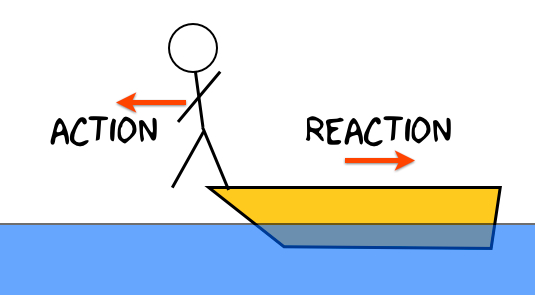
What law of motion does this picture represent?
a)
Newtons 1st law
b)
Newtons 4th law 
c)
Newtons 3rd law 
d)
Newtons 2nd law
16.

A sports car speeds up much faster than a dump truck when a traffic light turns from red to green. Which law is this?

a)

Law 1

b)

Law 2

c)

Law 3

17.

Which of the following has more inertia?

a)

Bowling ball

b)

Tennis ball

18.

Which of the following has less inertia?

a)

Feather

b)

Hammer

19.

Newton's Third Law says that forces must always occur in _____.

a)

pairs

b)

groups of 20 or more

c)

individual circumstances

d)

friction

20.

What measurement is used to measure force?

a)

Newtons

b)

Kelvin

c)

Kilos

d)

Moles

21.
If you double the mass of an object with the same force apply on it, the acceleration will
a)
double
b)
cut in half
c)
the same
d)
zero
22.
What kind(s) of objects have inertia?
a)
all objects with mass
b)
only objects at rest
c)
only objects in motion
d)
only objects whose motion is being changed
23.
Which one needs a greater net force to move, a kilogram of feathers or a kilogram of iron? 
a)
feathers 
b)
iron
c)
same
d)
depends on their friction
24.
After a cannonball is fired into frictionless space, the amount of force needed to keep it going equals
a)
twice the force with which it was fired
b)
the same amount of force with which it was fired
c)
1/2 the force with which it was fired
d)
zero, since no force is required to keep it moving. 
25.
The acceleration produced by a net force on an object is
a)
inversely proportional to the mass of the object.
b)
directly proportional to the magnitude of the net force.
c)
in the same direction as the net force.
d)
 all of the above
26.

A 10-kg brick and a 1-kg book are dropped in a vacuum. The Fg (weight) on the 10-kg brick is

a)

10 times as much as the force on the 1-kg book

b)

zero.

c)

the same as the force on the 1-kg book.

d)

none of the above

27.
A book weighs 4 N. When held at rest in your hands, the net force on the book is
 
a)
0 N.
b)
 0.4 N.
c)
 4 N.
d)
 39 N.
28.
A 20 kg bike accelerates at 10 m/s2.  what was the net force
a)
25 Newtons
b)
20 Newtons
c)
200 Newtons
d)
10 Newtons
29.
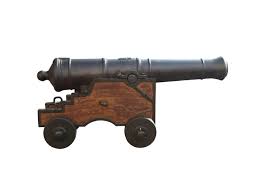
When a cannon fires a cannonball we observe Newton's third law. Which force is the reaction force?
a)
The cannon moving forward
b)
The cannonball moving forward
c)
The cannon moving backward
d)
The cannonball moving backward
30.
Which one of Newton’s Laws of Motion best explains why the dishes do not move when the table cloth is removed?
a)
Newton's 1st Law
b)
Newton's 2nd Law 
c)
Newton's 3rd Law 
d)
Newton's Law of Biology
31.
The tendency of an object to stay in motion or at rest is called 
a)
velocity
b)
acceleration
c)
speed
d)
inertia
32.
What is the difference between mass and weight?
a)
mass is how much matter is in an object, and weight is the gravitational pull on that object
b)
mass and weight are the same
c)
weight affects how much mass is in an object
d)
weight is determined by how many atoms make up an object
33.
What is the net force?
a)
5000 N right
b)
4000 N right
c)
40 N left
d)
4000 N left
34.
What is happening at C?
a)
Stationary
b)
Accelerating
c)
Fast steady speed; moving away from the starting position
d)
Slower steady speed; moving away from the starting position
35.
What is happening at D?
a)
Stationary
b)
Accelerating
c)
Fast steady speed; moving away from the starting position
d)
Slower steady speed; moving away from the starting position
36.
Which of the following shows the direction of the friction force?
a)
A
b)
B
c)
C
d)
D
37.

An old lady rolls down a hill at 3 meters/second. The hill is 36 meters long. How many seconds does it take the old lady to reach the bottom of the hill?

a)

39 seconds

b)

12 seconds

c)

15 seconds

d)

33 seconds

38.

Jose wandered 4 km at 2 km/hr. How long did Jose wander?

a)

2 hours

b)

8 hours

c)

0.5 hours

d)

2 km

39.
Find the distance Sara walks from A to B,  B to C then C to D?
a)
11m
b)
3m
c)
5m
40.

Solve the sum:

a)
b)
c)
d)
41.
In practice A of the figure, What is  the magnitude of the  resultant displacement?
a)
5 km 
b)
8 km
c)
11 km
d)
15 km
42.

A force of 6.0 newtons north and a force of 8.0 newtons east act concurrently on an object. The magnitude of the resultant of the two forces is

a)

1.3 N

b)

2.0 N

c)

10. N

d)

14 N

43.

A 5.0-newton force could have perpendicular components of

a)

1.0 N and 4.0 N

b)

2.0 N and 3.0 N

c)

3.0 N and 4.0 N

d)

5.0 N and 5.0 N

44.

Find the distance a hiker walks if he travels 3.50 mi north, and then turns around and walks 3.00 mi south.

a)

0.50 mi

b)

1.50 mi

c)

3.00 mi

d)

6.50 mi

45.

Find the displacement for a hiker who walks 3.50 mi north, and then turns around and walks 3.00 mi south.

a)

0.50 mi

b)

6.50 mi

c)

0.50 mi north

d)

6.50 mi north

46.

A vector has both magnitude and __________.

a)

mass

b)

time

c)

direction

d)

none of the answers

47.
a)
17
b)
149
c)
3
d)
12.2
48.

Determine the displacement for a car that travels 25 mi east and 25 mi north.

a)

50 mi northeast

b)

35 mi northeast

c)

50 mi north

d)

35 mi east

49.

A toy car rolls 8 meters in 2 seconds. What is the average speed of the toy car?

a)

16 m/s

b)

4 m/s

c)

.25 m/s

d)

10 m/s

50.

A man runs a marathon at 8 mph. The course is 32 miles. How long did it take him?

a)

4 h

b)

128 h

c)

50 h

51.

A mouse traveled 26cm in 4s. What is the average speed of the mouse?

a)

6cm/s

b)

104cm/s

c)

6.5cm/s

52.

Which is true?

a)

Speed is measured in m/s but velocity is measured in s/m

b)

Speed is a vector and velocity is a scalar

c)

Speed and velocity are the same exact thing

d)

Speed is like velocity but without a direction

53.

An astronaut travels at a speed of 400 m/s for 250 seconds, what is the total distance he traveled?

a)

0.625 m

b)

100,000 m

c)

1.6 m

d)

650 m

54.

Which is the length of the path an object has traveled?

a)

displacement

b)

distance

c)

motion

d)

reference point

55.
Velocity is 
a)
speed
b)
direction
c)
speed with a direction
56.

Which of the following has INCORRECT units?

a)

speed = m/s

b)

time = s

c)

displacement = m

d)

velocity = s

57.

Which is a vector?

a)

Displacement

b)

Distance

c)

Speed

58.
What does magnitude mean?
a)
size
b)
unit of measure
c)
level of significance
d)
point of view
59.

Two horses are running in a field. The gray horse runs 12 m/s north. The black horse runs 12 m/s east.

Which is true about their motions?

a)

Equal speeds.

b)

Equal velocities.

c)

Equal displacements.

60.
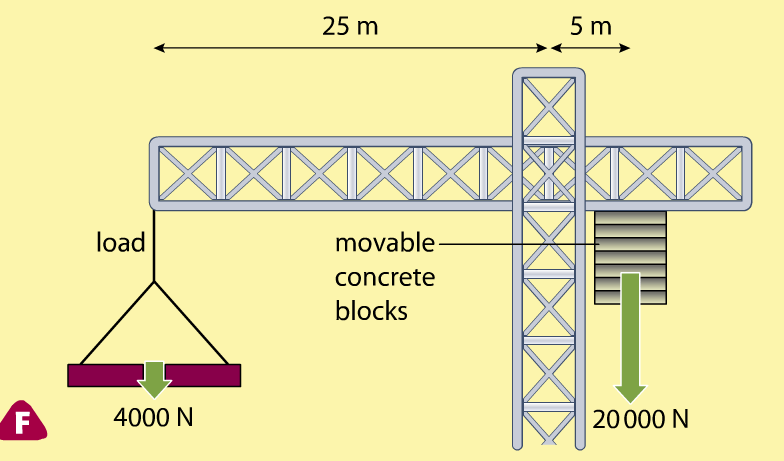
What is the anticlockwise moment acting on this crane?
a)
80,000Nm
b)
100,000Nm
c)
120,000Nm
d)
140,000Nm
61.
A seesaw is unbalanced with two people of different masses sitting equal distances from the center. Which of the following will result in equilibrium?
a)
The larger person moving further away from the center.
b)
Moving the smaller person closer to the center.
c)
Moving the smaller person further from the center.
d)
Making the larger person do nothing.
62.

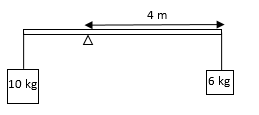
Two masses of mass 10.0 and 6.0 kg are hung from massless strings at the end of a light rod. The rod is virtually weightless. A pivot (fulcrum) is placed off center and the system is free to rotate. If the 6.0 kg mass is 4.0 m away from the pivot, how far away is the 10.0 kg mass if the system is not rotating?

a)

0.42 m

b)

2.4 m

c)

4.8 m

d)

4.2 m

63.
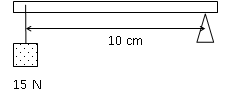
What is the moment produced by the 15 N?
a)
15 Nm (clockwise)
b)
150 Nm (anti - clockwise)
c)
1.5 Nm (anti - clockwise)
d)
0.15 Nm (clockwise)
64.

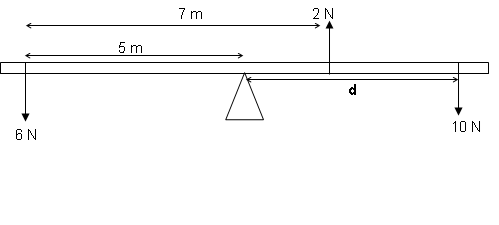
Assuming the system is in equilibrium, calculate the missing distance d

a)

3.4 m

b)

2.8 m

c)

4.4 m

d)

1.6 m

65.

The diagram shows a beam. Without any weights, the beam balances at its centre.

Three weights are hung as shown.

At which point does a load of 2 N balance the beam?

a)

A

b)

B

c)

C

d)

D

66.

The figure below shows a man lifting a heavy rock using a steel bar. He pushes downwards on the end of the bar with a force F.


Which pivot positions allows the force F to be as small as possible?

a)

A

b)

B

c)

C

d)

D

67.

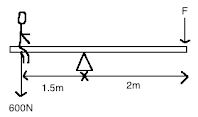
A boy of weight 600N sits on the see-saw as shown at a distance of 1.5m from the pivot. What is the force F required at the other end to balance the see-saw?

a)

450 N

b)

350 N

c)

4.5 N

d)

200 N

68.

What is the unit of moment f force?

a)

N

b)

m

c)

Nm

d)

N/m

69.
Moment is a quantity that tells turning effect of a force about turning point. 
a)
TRUE
b)
FALSE
70.

Calculate the unknown force X!

a)

4.0 N

b)

6.0 N

c)

10 N

d)

12 N

71.

At what distance should a 2N load placed from the pivot so that the see saw won't move?

a)

0.2m

b)

0.5m

c)

0.45m

d)

0.42m

72.

State the principle of moments.

a)

When a system is in equilibrium, the sum of the total clockwise moment is equal to the sum of the total anti-clockwise moment about the same pivot.

b)

When a system is in equilibrium, the sum of the total clockwise moment is greater the sum of the total anti-clockwise moment about the same pivot.

c)

When a system is in equilibrium, the sum of the total clockwise moment is less than the sum of the total anti-clockwise moment about the same pivot.

d)

When a system is in equilibrium, the sum of the total clockwise moment is equal to the sum of the total anti-clockwise moment about the different pivot.

73.
The momentum of an object depends upon the object's ___________&_____________.  
a)
size and shape
b)
mass and speed
c)
mass and veloctiy
d)
mass and energy
74.
The equation to calculate momentum is
a)
p=mv
b)
p=1/2mv2
c)
p=mgh
d)
p=mg
75.
Which has more momentum: a car stopped at a red light or a bike moving at 15 mph?
a)
car
b)
bike
c)
they are equal
d)
cannot determine using the info provided
76.
Momentum is a ____________________ quantity
a)
science
b)
scalar
c)
vector
d)
energy
77.
In any collision (crash) the ______ is ALWAYS constant
a)
Total Momentum
b)
total speed
c)
total Velocity
d)
Energy
78.
When two objects collide, the Pbefore is ____________ the Pafter.
a)
more than 
b)
less than 
c)
equal to
d)
unrelated to
79.
When the speed of an object is doubled, its momentum
a)
remains unchanged in accord with the conservation of momentum.
b)
doubles
c)
quadruples
d)
decreases
80.
What is the unit for momentum?
a)
m/sec
b)
kg/sec
c)
kg/m
d)
kg m/sec
81.
A 50 kg ball rolls down the street at 5 m/s. Calculate the momentum of the ball. 
a)
55 kg*m/s
b)
100 kg*m/s
c)
250 kg*m/s
d)
500 kg*m/s
82.
A 2.5 kg ball moving at 5 m/s collides with a 2.5 kg stationary ball in a perfectly elastic collision.  What is the velocity of the second ball after the collision? 
a)
5 m/s
b)
2.5 m/s
c)
10 m/s
d)
7.5 m/s
83.
A 9300 kg railroad car traveling at a velocity of 5 m/s strikes a second boxcar that weighs 5000 kg at rest. At what speed will the second boxcar move?
a)
18.6 m/s
b)
9.3 m/s
c)
7.5 m/s
d)
1.86 m/s
84.
Which object listed below has the greatest momentum?
a)
A 0.05 kg object rolling at 0.2 m/s.
b)
A 0.15 kg object rolling at 2 m/s.
c)
A 0.15 kg object rolling at 1 m/s
d)
A 0.4 kg object rolling at 2 m/s.
85.
Determine the momentum of 1000-kg car moving northward at 20 m/s......... 
a)
20000 N
b)
20000 Joules
c)
20000 Kg * m/s
d)
20000 kg * m/s north
86.
A 0.250 kg cart moving at 0.400 m/s has how much momentum?
a)
0.1 kg-m/s
b)
1 kg-m/s
c)
10 kg-m/s
d)
100 kg-m/s
87.
A person on a stationary skateboard throws a bowling ball with a velocity of 5.0 m/s. What is a possible speed of the person after the throw? 
a)
0 m/s
b)
1.5 m/s
c)
5.0  m/s
d)
7.5 m/s
88.
Two football players with mass 75 kg and 100 kg run directly toward each other with speeds of 6 m/s and 8 m/s respectively. If they grab each other as they collide, the combined speed of the two players just after the collision would be:
a)
2 m/s 
b)
3.4 m/s 
c)
4.6 m/s 
d)
7.1 m/s
89.
A biker with a mass of 75 kg moves along the path with a constant velocity of 5 m/s. What is the biker's momentum?
a)
25 m/s
b)
375 m/s
c)
25 kg m/s
d)
375 kg m/s
90.

A constant force of 4.5 N acts on a 7.2-kg object for 10.0 s. What is the change in the object's momentum?

a)

45 kg m/s

b)

72 kg m/s

c)

32.4 kg m/s

d)

0.45 kg m/s

91.
In a physics experiment, two carts of mass 1.5 kg each are rolled towards each other.  The orange cart has a velocity of 2 m/s and the blue cart has a velocity of -1m/s.  The carts stick together when they collide.  Calculate their final speed.
a)
0.5 m/s
b)
1.0 m/s
c)
0.33 m/s
d)
0.67 m/s
92.
While playing pool, the white cue ball strikes the 8 ball. Before the collision, the cue ball's velocity was 10 m/s and the 8 ball was at rest. If both ball's have a mass of 0.15 kg and the cue ball's velocity after the collision is 2 m/s, what is the 8 ball's velocity?
a)
2 m/s
b)
8 m/s
c)
-2 m/s
d)
1.5 m/s
93.

What is the SI unit of speed?

a)

m/s

b)

cm/s

c)

km/hour

d)

kg/m

94.

In 2008 Olympic Game, Usain Bolt sets world record at 10 s in Men’s 110 m Final. What is his average speed ?

a)

1100 ms

b)

11 m/s

c)

10 m/s

d)

0.09 m/s

95.
Which of the following quantity is base quantity ?
a)
voltage
b)
electric current
c)
electric energy
d)
electric power
96.
Which of the following pairs of physical quantity and SI unit is correct ?
a)
Mass - SI unit : Gram
b)
Time - SI unit : Hour
c)
Electric current - SI unit : Volt
d)
Temperature - SI unit : Kelvin
97.

What is the couple of quantities have a same unit?

a)

Energy and force

b)

Energy and Work

c)

Energy and power

d)

Work and power

98.

Electric current = 0.25 A


Which one is the magnitude?

a)

Electric current

b)

A

c)

0.25

99.

Fundamental Quantities can also be referred to as Base Quantities.

a)

True

b)

False

100.

Which of the following is a scalar quantity?

a)

time

b)

displacement

c)

acceleration

d)

force