
 Worksheets
Physical Science Final Review
Total questions: 95
Worksheet time: 2hrs 7mins
The one variable in an experiment that is purposely changed or manipulated by the scientist is the________________.
dependent variable
independent variable
control variable
control group
Research question: Does changing the brand of dog food affect how much the dog eats?
Which variable is highlighted in RED?
independent
dependent
control
The details of the experiment that need to remain UNCHANGED throughout the test are called the:
predicted variables
dependent variables
control variables
independent variables
Which of the following is TRUE?
A scientific theory is upgraded into a law once it is fully proven
A scientific law explains why a certain pattern in nature occurs
A commonly observed pattern or principle in nature is a "law"
Most theories in science are not supported by research studies
Scientists create both scientific theories and scientific laws as they make observations and conduct experiments about the natural world. Which of the following statements most accurately compares the difference between scientific theories and scientific laws?
Scientific laws are based on evidence, while scientific theories are not.
Scientific theories involve only biology, while laws involve all types of science.
Scientific theories involve mathematical equations, while scientific laws are based on observations.
Scientific theories are ideas that explain natural events, while scientific laws more reliably predict natural events.
Research Question: Does the type of gasoline put in a car affect how fast the car can drive.
What is the independent variable?
Type of gasoline
Types of cars
How fast the car can drive
Amount of gas put into the car
Who developed the Scientific Method?
Isaac Newton
Sir Francis Bacon
Tycho Brahe
Nicolaus Copernicus

Independent variable is the one controlled by the experimenter ex: time, date, depth, temperature.... and is placed on the _____ axis of a graph
z
y
x
not on a graph

What type of relationship is shown by this graph?
direct relationship
inverse relationship
neither direct nor inverse relationship
continuous

Which of the following choices contain all SI units?
kilograms, Fahrenheit, amperes, seconds
kilograms, meters, amperes, seconds
kilograms, quarts, amperes, minutes
grams, meters, amperes, Inches
64 cm = ____ mm
6,400
0.64
640
6.4
How many significant figures are in 127.500?
(a)
How many significant figures are in 9700?
(a)
Give the answer to the correct number of significant figures to
3.419 + 3.912 + 7.0518 + 0.00013
14.383
14.382
14.3829
14.38293
Give the answer to the correct number of significant figures to
247.89 ÷ 53.2
4.660
4.65
4.6595
4.66
How many significant figures are there in 10090 grams?
1
2
3
4
Solve:
2×1036×106
3 x 10²
3 x 10⁹
1.2 x 10⁴
3 x 10³
The Metric System originated in which country?
England
France
Spain
Germany
How many sig figs are there? 7.000000040
10
Round 1047.78 to three significant figures.
104
105
1050
1050.00
Which Greek letter symbol represents the "change in" a particular value?
Alpha α
Beta β
Delta Δ
Theta θ
Velocity differs from speed because velocity includes:
speed
direction
distance
height
Calculate the velocity of a cyclist traveling 100km south over a period of 5 hours
20km/h south
10km/h south
10mi/h
20km/h
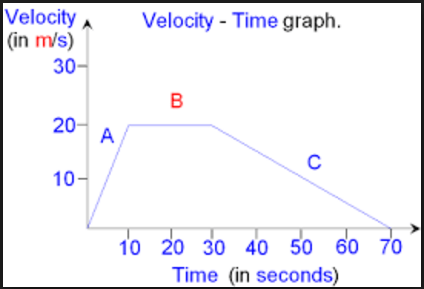
This is a velocity-time graph. What is the object doing in segment A?
Positive acceleration
Negative acceleration
Constant Velocity
Not moving
Acceleration: is the rate change in ______ over time.
speed
distance
velocity
displacement
This is a velocity-time graph. What is the object doing in segment B?
Positive acceleration
Negative acceleration
Constant Velocity
Not moving
33.5 km/s2
0.03 km/s2
-33.5 km/s2
-0.03 m/s2
km/s
m/s2
mi/hr
m/s
What does it mean when a change in velocity is negative?
The object is speeding up.
The object is slowing down.
The object is changing direction.
The object is falling down.
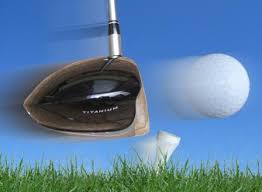


Which law best explains why more force must be applied to the bowling ball to make it accelerate at the same rate as the tennis ball?
Newton's 1st Law
Newton's 2nd Law
Newton's 3rd Law
Law of Universal Gravitation
How do you get the WEIGHT of an object?
Multiply the mass by gravity
The mass is equal to the weight
Divide the mass by gravity
Add the force of gravity to the mass
N(s)
kg/sec
kg/m
kg m/sec
N(s)

A roller coasters accelerates from an initial speed of 6.0 m/s to a final speed of 70 m/s over 4 seconds. What's the acceleration?
24 m/s2
18 m/s2
16 m/s2
16 m/s

The SI unit for WORK is:
Joules
Watts
Newtons
Kilogram
The SI unit for POWER is:
Watts
Joules
Newtons
Meters
A 180 gram softball is thrown into the air using 40 J of work. The ball rises to its maximum height in 1.96 seconds. How much power was exerted throwing the ball?
144 W
20.4 W
3.52 W
2.11W
Newtons (N) are the unit for __________.
Work
Distance
Acceleration
Force

Energy from a compressed spring would be an example of:
kinetic
elastic potential
gravitational potential
chemical potential
Energy that is stored in bonds between atoms in compounds is:
Mechanical energy
Chemical energy
Kinetic energy
Nuclear energy
Energy cannot be created or destroyed. But, it can be _____.
transformed
increased
decreased
evaporated
What is potential energy?
The energy an object has due to its atomic structure.
The energy an object has due to its chemical composition.
The energy an object has due to its motion.
The energy an object has due to its position or condition.
What is the value of the Earth's acceleration due to gravity (g)?
9.8 m/s2
100 m/s2
25 m/s2
3.14 m/s2
A exercise ball is on a table 2.5 m above the ground. What is the mass of the ball if it has a GPE of 56.8 J?
71 kg
22.72 kg
142 kg
2.32 kg
What would 54N be an example of?
work
power
distance
force
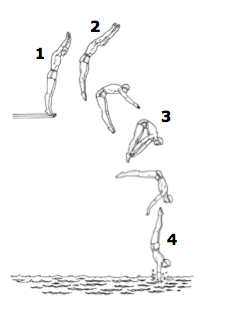
This picture represents a diver’s motion from the top of a high diving board into a pool of water. At what point does the diver have the greatest kinetic energy and the least potential energy?
1
2
3
4
What type of heat transfer is the following?
Solar panels are used to collect sunlight for energy.
Convection
Conduction
Radiation
None of the above
In the following example, identify the type of heat transfer.
You hold an ice cube in your hand and it begins to melt.
Radiation
Convection
Conduction
In terms of Thermal Energy, heat will:
Always flow from the warmer object when its above 50⁰C
Always flow from higher temperatures to lower temperatures
Always flow from lower temperatures to higher temperatures
It depends on the temperature
The specific heat of platinum is 150 J/kg°C. How much heat (Q) is released when a 12 kg piece of platinum cools from 100°C to 50°C?
90000 J
665 J
-90000 J
0.665 J
-7500 J

If 68 W of power is produced in 18 seconds, how much Work is done?
1224 J
0.264 J
3774 J
12.24 J
What is the correct unit for mass in energy equations?
Kilogram (Kg)
Newton (N)
Joule (J)
Watt (W)
Gram (g)

What is the KE half way down the ramp?
50 J
25 J
0 J
100 J
The amount of energy required to raise the temperature 1ºC for every gram or kilogram is called____?
Thermal Energy
Specific Heat
Temperature
Kinetic Energy
Heat Value
What is a Conductor?
a material that slows the transfer of heat
a material that transfers heat easily
a material that is retains and measures heat transfer
a material that is temperature controlled

What is the total Mechanical Energy at point A?
500,000 J
400,000 J
200,000 J
50,000 J

0.125 s
8 s
64800 s
80 s

A cheetah can run briefly with a speed of 31 m/s. Suppose a cheetah with a mass of 47 kg runs at this speed. What is the cheetah’s kinetic energy?
1457 J
728.5 J
45,167 J
22,583.5 J

What type of circuit is this?
Series
Parallel
Simple
None of these
In a series circuit, how is the brightness of a light bulb affected when another bulb is connected?
It gets brighter
It stays the same
It gets dimmer
It goes out
The unit for Current is the:
Volt
Ohm
Joule
Amp

If the light bulb in the middle burned out, what would happen to the other two?
The light bulb to the left would stay lit, but the one to the right would turn off.
They would both stay lit.
The light bulb to the right would stay lit, but the one to the left would turn off.
They would both turn off.
The two main types of electrical circuits are:
parallel and magnetic
electromagnetic and series
series and parallel
series and diagonal
What is the unit for Resistance?
Volts (v)
Amperes (A)
Ohms (Ω)
Joules (J)
If a battery produced 12.6 Volts, what would be the current flow for a 6 Ohm resistor?
2.1 Amps
2.4 Amps
1.71 Amps
15 Amps
0.2 Ω
200 Ω
120 Ω
5 Ω
The rearrangement of electrons on a neutral object caused by a nearby charged object is called:
Induction
Conduction
Friction
Conductor

In a circuit diagram, this symbol represents a
switch
multimeter
battery
globe
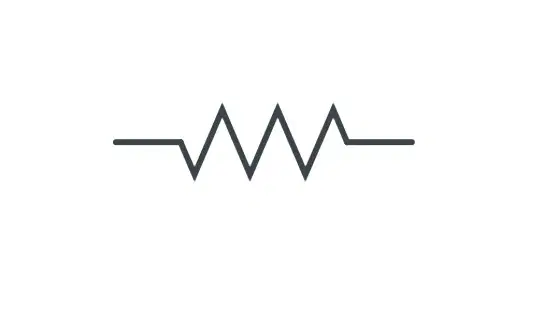
In circuit notation, this is the symbol for:
Light bulb
Resistor
Battery
Switch
Voltmeter
Which of the following best explains an electric current?
An electric current is the flow of positive charges in a circuit.
An electric current is the flow of atoms in a circuit.
An electric current is the flow of electrons in a circuit.
An electric current is the flow of neutrons in a circuit.

All of the following will INCREASE the electrical resistance EXCEPT:
Using insulating materials
Longer wires
Larger diameter wires
Higher temperatures

