wayground logo

Free Printable Worksheets

Font size

S
M
L
XL
Worksheets

Chapter 1, 2, 3 ,4

Total questions: 100

Worksheet time: 2hrs 22mins

Name
Class
Date
1.
A deer running 15 meters per second due west.Vector or scalar?
a)
Scalar
b)
Vector
2.
Scott travels north 5 miles and then goes west 3 miles before coming straight back south 2 miles. What is his distance?
a)
10 miles
b)
7 miles
c)
8 miles
d)
6 miles
3.
 Amy runs 2 miles south, then turns around and runs 3 miles north. What is displacement?
a)
5 miles
b)
1 mile 
c)
2 miles south
d)
1 mile north 
4.
What is magnitude?
a)
The direction that describes a quantity.
b)
A numerical value
c)
A unit of force
5.
A quantity that has both magnitude and direction is called a scalar quantity.
a)
True
b)
False
6.

Weight is a

a)

Vector

b)

Scalar

7.

Acceleration is

a)

Vector

b)

Scalar

8.

Work is

a)

Vector

b)

Scalar

9.

Power is

a)

Vector

b)

Scalar

10.

Kinetic energy is

a)

Vector

b)

Scalar

11.
Which statement describes a vector?
a)
It has magnitude but no direction
b)
It has direction but no magnitude
c)
It has both direction and magnitude
d)
It has constant magnitude but no
 direction
12.
Which of the following quantities are vectors?
a)
speed, velocity, acceleration
b)
velocity, acceleration, force
c)
force, acceleration, mass
d)
length, mass, time
13.
The _______ of two or more vectors is the sum of the vectors.
a)
components
b)
scalar
c)
resultant
d)
magnitude
14.
What is the net force?
100 N        230 N
<------        --------->
a)
30 N to the right
b)
230 N to the right
c)
130 N to the right
d)
This is a balanced force
15.
A vector is a mathematical structure that has both _______ and _______.
a)
direction, magnitude
b)
scope, sequence
c)
meat, potatoes
d)
scalar, vector
16.
If a boomerang is thrown 20 m in a straight line and returns exactly to the spot it was thrown what is its displacement?
a)
20m
b)
40m
c)
0m
d)
-20m
17.
Identify the following quantities as scalar or vector: the mass of an object, the number of hairs on a dog, an airplane's velocity.
a)
Vector, Scalar, Scalar
b)
Scalar, Scalar, Vector
c)
Vector, Scalar, Scalar
d)
Scalar, Vector, Vector
18.

The unit we use to measure acceleration is ___.

a)

ms-1

b)

meters

c)

seconds

d)

ms-2

19.
The SI unit for length or distance is
a)
foot (ft)
b)
inch (in)
c)
mile (mi)
d)
meter (m)
20.

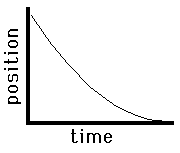
Describe this graph

a)

constant acceleration

b)

constant deceleration

c)

object move to the left

d)

constant velocity

21.
The speedometer on your car tells you
a)
average velocity
b)
instantaneous velocity
c)
average speed
d)
instantaneous speed
22.
The SI unit for time is
a)
second (s)
b)
minute (min)
c)
hour (hr)
d)
year (yr)
23.
A distance vs. time graph shows an object's
a)
frame of reference
b)
speed
c)
acceleration
d)
favorite food
24.

The rate at which velocity changes

a)

speed

b)

positon

c)

distance

d)

acceleration

25.

The length of a path between two points

a)

displacement

b)

distance

c)

inertia

d)

slope

26.

A quantity that is fixed, or unchanging

a)

constant

b)

variable

c)

initial velocity

d)

scalar

27.
During which interval is the object not moving?
a)
B to C
b)
C to D
c)
D to E
d)
only at point A
28.

Changes in our speed, direction or both are called _________.

a)

distance

b)

velocity

c)

acceleration

d)

displacement

29.

Acceleration is defined as the CHANGE in

a)

time of motion to another place.

b)

velocity

c)

distance

d)

speed

30.

Acceleration occurs when an object changes its speed or

a)

direction

b)

inertia

c)

force

d)

mass

31.

If a student rides her skateboard on a straight road and does not speed up or slow down, she is travelling with a

a)

constant acceleration

b)

positive acceleration

c)

constant velocity

d)

negative acceleration

32.

If you travel 7.5 km and walk for 1.5 h, what is your average speed?

a)

5 km/h

b)

0.2 km/h

c)

15 km/h

d)

11.25 km/h

33.

What is occurring on this graph?

a)

A slowing down in the positive direction

b)

A positive change in momentum

c)

An object moving at a constant speed in the positive direction

d)

A positive net force

34.

Based on the graph, how far does the person travel in the first 5 seconds?

a)

2 m

b)

0 m

c)

10 m

d)

5 m

35.
You run from your house to a friend's house that is 3 km away. You then walk home. The distance you traveled is 6 km. What is your displacement? 
a)
6  km
b)
0 km
36.
Speed is a __________ quantity and velocity is a __________ quantity.
a)
scalar, vector
b)
vector, scalar
37.
An object is NOT accelerating if it is moving
a)
in a circle
b)
at constant velocity 
c)
at increasing speed
d)
only as influenced by gravity
38.
What is speed?
a)
how far you go
b)
how much distance is covered over a period of time
c)
how fast you accelerate
d)
the change in the location of a object
39.
What is velocity?
a)
the quickness of an object
b)
the location of an object
c)
acceleration
d)
speed in a specific direction
40.
The unit we use to measure acceleration is ___. 
a)
meters / second 
b)
meters 
c)
seconds 
d)
meters / second / second 
41.
What is this graph representing?
a)
Constant Speed
b)
Acceleration (speeding up)
c)
Deceleration (slowing down)
d)
No motion
42.
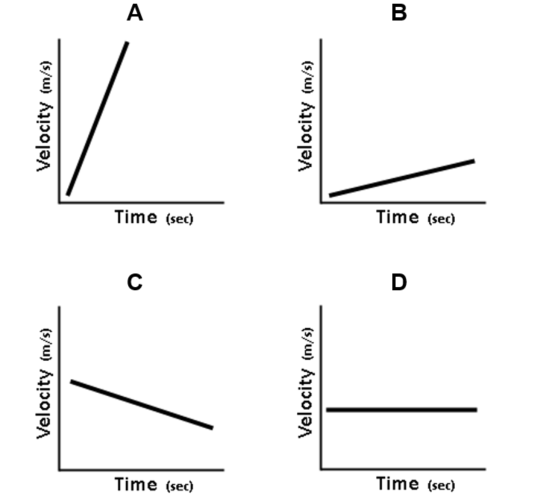
Which graph represents zero acceleration (constant velocity)?
a)
A
b)
B
c)
C
d)
D
43.
What is happening at D?
a)
Stationary
b)
Accelerating
c)
Fast steady speed; moving away from the starting position
d)
Slower steady speed; moving away from the starting position
44.
What is happening at A?
a)
Stationary
b)
Accelerating
c)
Slower steady speed; moving away from the starting position
d)
Steady speed; returning to start position
45.
Which runner won the race?
a)
A
b)
B
c)
C
46.

What is the acceleration at the apex of a y-direction problem?

a)

Depends on the problem

b)

9.8 m/s2

c)

-9.8 m/s2

d)

Positive on the way up and negative on the way down

47.

When an object starts from rest, what is its original velocity?

a)

Depends on the problem

b)

0

c)

Always positive

d)

Always negative

48.
What would the v-t graph look like for an object travelling at a constant velocity? 
a)
Curved line
b)
Straight line
c)
Horizontal line
49.
Describe the motion
a)
Slow to fast;   Negative direction
b)
Fast to slow;   Negative direction
c)
Fast to slow;   Positive direction
d)
Slow to fast;   Positive direction
50.
A golf ball starts with a speed of 2 m/s and slows at a constant rate of 0.5 m/s2, what is its velocity after 2 s?
a)
0 m/s
b)
0.5 m/s
c)
1 m/s
d)
1.5 m/s
51.
Softer landings tend to
a)
increase impact force
b)
increase force
c)
increase collision time
d)
increase change in momentum
52.
The units for Impulse are
a)
N/s
b)
N.s
c)
N
d)
m/s
53.

In an isolated system, the net ____ on that system is zero.

a)

external force

b)

internal force

c)

time interval

d)

displacement

54.
The impulse-momentum theorem states that
a)
the impulse on an object is equal to the change in momentum it causes 
b)
the force on a moving object is equal to the magnitude of the impulse.
c)
the impulse on an object is greater than the change in momentum it causes 
d)
the impulse on an object is less than the change in momentum it causes
55.
Which takes more force  to catch, a bowling ball or a ping pong ball?
a)
bowling ball because it has more momentum
b)
ping pong ball because it has more momentum
c)
both require the same amount of force when catching
d)
bowling ball because it has less momentum
56.
When the speed of an object is doubled, its momentum
a)
remains unchanged in accord with the conservation of momentum.
b)
doubles
c)
quadruples
d)
decreases
57.
How can a tennis ball and a bowling ball have the same momentum?
a)
have the same speed
b)
have different speeds
c)
one is moving backwards
d)
they can't
58.
The law of conservation of momentum states that, 
a)
p before is less than p after
b)
p before is the same as p after
c)
p before is more than p after
59.
A big fish swims upon and swallows a small fish at rest. After lunch, the big fish has less
a)
momentum
b)
velocity
c)
mass
60.
In any collision (crash) the ______ is ALWAYS constant.
a)
Total Momentum
b)
total speed
c)
total Velocity
d)
Energy
61.

The SI unit for momentum is:

a)

N.kg

b)

N.m/s

c)

m/s.N

d)

kg.m/s

62.

Linear momentum is defined as the product of a system’s ______________ multiplied by its _____________:

a)

mass, velocity

b)

acceleration, mass

c)

acceleration, force

d)

force, mass

e)

force, velocity

63.

Two objects, P and Q, have the same momentum. Q can have more kinetic energy than P if it has:

a)

More mass than P

b)

The same mass as P

c)

More speed than P

d)

The same speed as P

64.

Which one of these objects has the greater amount of momentum?

a)

A turtle that slowly crosses a road

b)

A parked car

c)

A stop sign

65.

During a collision. an object experiences an impulse. How can this impulse be calculated?

a)

Multiplying force by time

b)

Multiplying mass by velocity

c)

Dividing velocity by time

d)

Multiplying mass by acceleration

66.

When a cannon fires a cannon ball, it recoils backwards. This occurs because of...

a)

Energy in the system is conserved

b)

Energy in the system is increased

c)

Momentum in the system is conserved

d)

Energy in the system is not conserved

67.

When a cannon fires a cannon ball, it recoils backwards. This occurs because of...

a)

Energy in the system is conserved

b)

Energy in the system is increased

c)

Momentum in the system is conserved

d)

Energy in the system is not conserved

68.

An egg landing on a soft surface will remain intact. The surface increases the _____ and decreases the _____ during the impact

a)

impulse, time

b)

impulse, force

c)

force, time

d)

time, force

69.
When an accident happens, the truck hits the car with a force of 700 N in 0.25 seconds. What is the impulse? What formula do you use:
a)
p=mv
b)
mvf-mvi=/\p
c)
J=Ft
d)
F=(mvf-mvi)/t
70.
The impulse is ______ the change in momentum
a)
greater than
b)
equal to
c)
less than
d)
always double
71.
The momentum of an object depends upon the object's ___________&_____________.  
a)
size and shape
b)
mass and speed
c)
mass and velocity
d)
mass and energy
72.
A 2 kg cart has a momentum of 16 kg m/s. What is its velocity?
a)
8 m/s
b)
32 m/s
c)
0.125 m/s
d)
18 m/s
73.
If two objects have the same mass, then the faster moving object has ____________ momentum.
a)
more 
b)
less
c)
the same
74.

What type of force is this man using to push his grocery cart?

a)

Normal Force

b)

Gravity

c)

Air Resistance

d)

Applied Force

75.

What is the net force?

a)

3 N

b)

3 N, right

c)

17 N, right

d)

3 N, left

76.
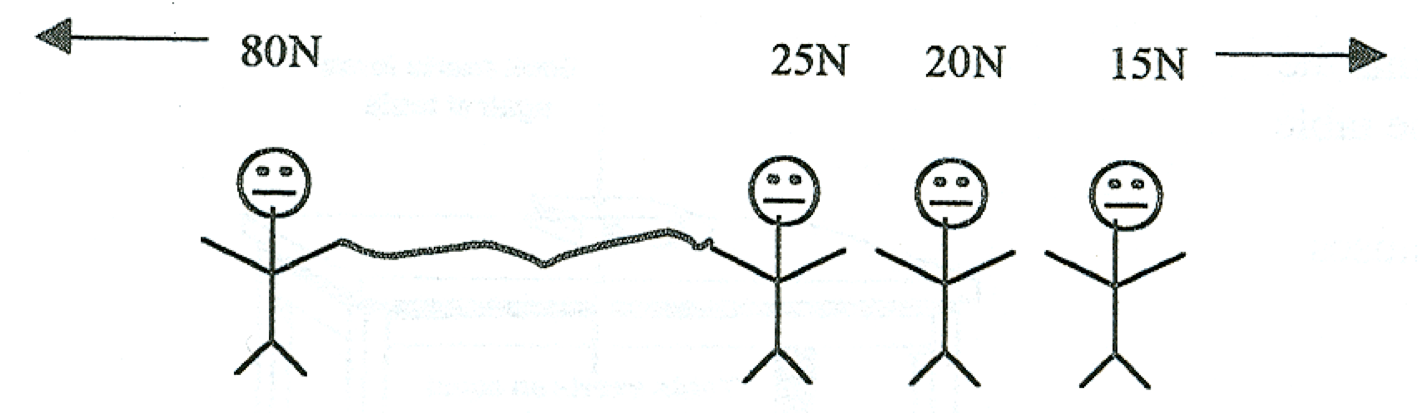
Who wins the tug of war with what net force?
a)
The person on the left with 20 N
b)
The person on the left with 80 N
c)
The people on the right with 20 N
d)
The people on the right with 100 N
77.
What is the net force?
a)
20 N 
b)
0 N 
c)
400 N 
d)
40 N 
78.

What is the unit to MEASURE force?

a)

Kilogram

b)

Meter

c)

Pounds

d)

Newton

79.
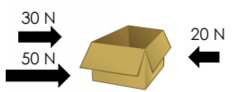
Calculate the Net Force. 
a)
60N, Left 
b)
40N, Right 
c)
0N
d)
60N, Right
80.
This type of force resist motion between two surfaces that are pressed together
a)
contact
b)
gravity
c)
friction
81.

If both forces are going in the same direction you should______ those forces

a)

Add

b)

Subtract

c)

Divide

d)

Multiply

82.

When forces are going in the opposite direction of each other you should do what do find the net force

a)

Subtract

b)

Add

c)

Divide

d)

Multiply

83.
Is this a balanced or unbalance force?
a)
Balanced
b)
Unbalanced
c)
Neither one
d)
Both
84.
Which direction will the object move?
a)
Right
b)
Left
c)
Up
d)
Down
85.
This is an example of what kind of force?
a)
Balanced Force
b)
Pushing Force
c)
Gravity Force
d)
Unbalanced Force
86.

Which of these are examples of motion?

a)

Turning around

b)

Moving side to side

c)

Traveling

d)

All of them

87.
What is the net force?
a)
10 N
b)
0 N
c)
25 N
d)
1 N
88.

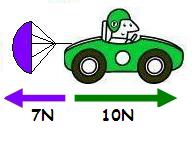
What is true about this picture?

a)

the forces are balanced

b)

the net force is 10N

c)

The net force is 3 N

d)

The net force is 7N

89.

What minimal force must be exerted by a mother to lift her 5kg baby?

a)

0 N

b)

5 N

c)

49 N

d)

10 N

90.
Why is person B having a hard time moving down the hill?
a)
Person B has more friction than person A.
b)
Person B has the same friction as person A.
c)
Person B is out of shape.
d)
Person B has less friction has person A.
91.
A force that slows or stops motion when objects rub together.
a)
Friction
b)
Push
c)
Pull
d)
Magnetism
92.
What pulls a ball back to earth?
a)
Gas
b)
Gravity
c)
Friction
d)
Molecules
93.
Name the missing force...
a)
frictional force
b)
weight force
c)
thrust
d)
buoyant force
94.
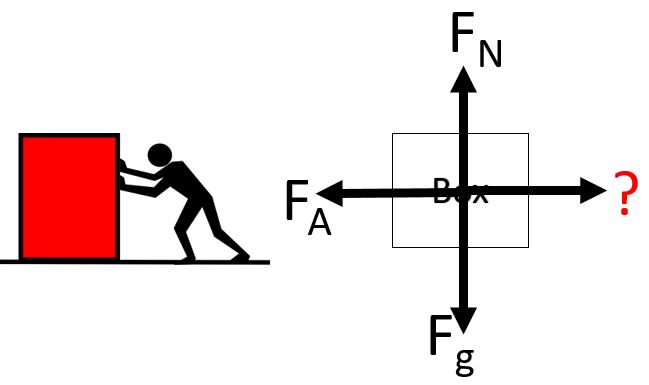
Name the missing force...
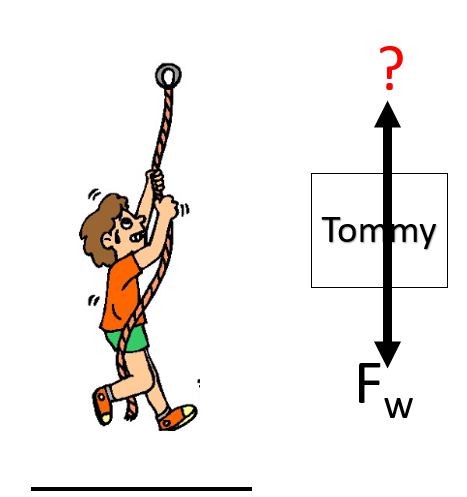
a)
tension force
b)
gravitational force
c)
normal force
d)
applied force
95.
Force depends on
a)
Force
b)
mass
c)
acceleration
d)
mass and acceleration 
96.
8 N to the left , and 4 N to the right. Find the net force. Is this balanced?
a)
12 N Right;  No
b)
4 N Left;  No
c)
12 N Right;  Yes
d)
4 N Left;  Yes
97.
Find the net force: 15 N to the right, and another 15 N to the right.
a)
0 N Right
b)
0 N Left
c)
30 N Left
d)
30 N Right
98.
How is gravity affected by mass?
a)
the larger the mass of the object, the greater the gravity
b)
small objects have no gravity
c)
gravity is not affected by mass of objects, whether large or small
99.
If you pull the cord, what direction will the box move?
a)
Up
b)
Down
c)
Left
d)
Right
100.

A force can____________.

a)

make an object move

b)

make a moving object stop moving

c)

slow an object down

d)

all of the above