
 Worksheets
METHODIST HIGH SCHOOL PRIVATE ARIGBAJO CONTINUOUS ASSESSMENT TES
Total questions: 100
Worksheet time: 2hrs 0mins
Law of reflection state that - The angle of incidence is .................. to the angle of reflection.
(La ley de reflexión establece que - El ángulo de incidencia es .................. al ángulo de reflexión.)
equal (igual)
half (mitad)
double (doble)
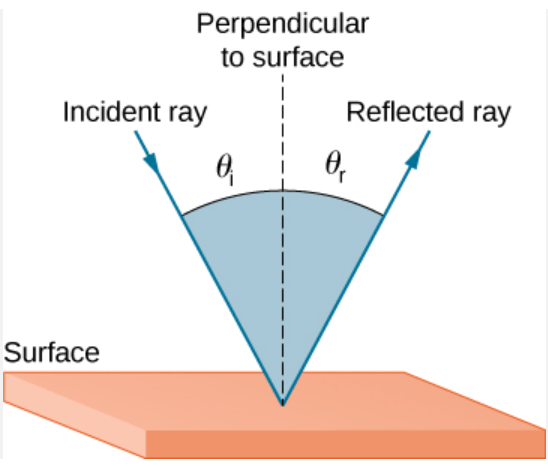
If the angle of incidence is 20 degrees, what will be the value of the angle of reflection?
(Si el ángulo de incidencia es de 20 grados, ¿cuál será el valor del ángulo de reflexión?)
0
10
20
30
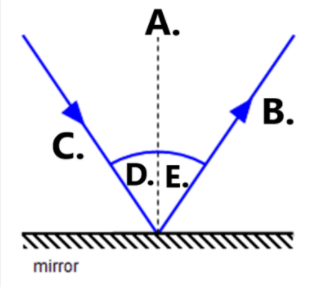
In the diagram, which letter represents the angle of incidence?
(En el diagrama, ¿qué letra representa el ángulo de incidencia?)
B
C
D
E
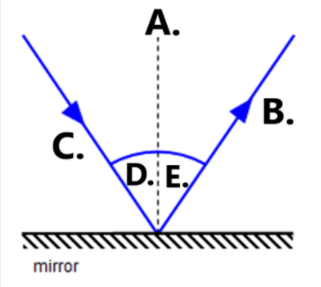
In the diagram, which letter represents the angle of reflection?
(En el diagrama, ¿qué letra representa el ángulo de reflexión?)
B
C
D
E
What is reflection?
(¿Qué es la reflexión?)
Reflection is the absorbing of light off the surface that it strikes on. (La reflexión es la absorción de la luz de la superficie sobre la que incide.)
Reflection is the bouncing of light off the surface that it strikes on.(La reflexión es el rebote de la luz en la superficie sobre la que incide.)
Reflection is the bending of light off the surface that it strikes on.(La reflexión es la desviación de la luz de la superficie sobre la que incide.)
Reflection is the scattering of light off the surface that it strikes on. (La reflexión es la dispersión de la luz de la superficie sobre la que incide.)
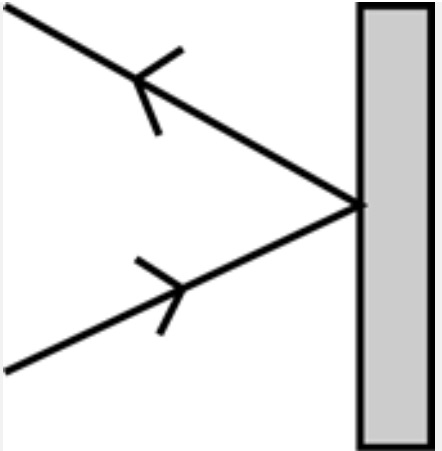
The illustration shows a light ray striking an object.
In the illustration, the light ray striking the object is-
(La ilustración muestra un rayo de luz que golpea un objeto. En la ilustración, el rayo de luz que golpea el objeto es:)
absorbed (absorbido)
stopped (detenido)
reflected (reflejado)
refracted (refractado)
The ray of light that strikes a reflecting surface is called ________.
(El rayo de luz que incide en una superficie reflectante se llama ________.)
incident ray (rayo incidente)
reflected ray (rayo reflejado)
normal line (normal line)
The angle produced as a source of light bounces off a reflecting surface is called ______.
(El ángulo producido cuando una fuente de luz rebota en una superficie reflectante se llama ______.)
angle of incidence (ángulo de incidencia)
angle of reflection (angulo de reflexion)
obtuse angle (angulo obtuso)
straight angle (angulo tecto)
Why can you see most objects?
(¿Por qué puedes ver la mayoría de los objetos?)
They emit light. (Ellos emiten luz.)
Light refracts through them. (La luz se refracta a través de ellos.)
Light reflects off them. (La luz se refleja en ellos)
They absorb light. (Ellos absorben la luz.)
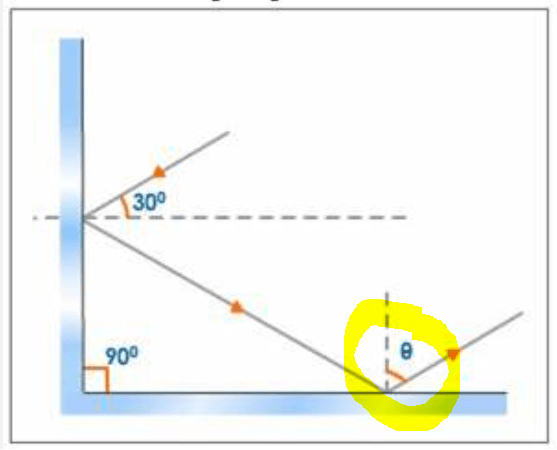
What is the value of the unknown angle (theta) in the following diagram?
(¿Cuál es el valor del ángulo desconocido (theta) en el siguiente diagrama?)
60 degrees
30 degrees
90 degrees
45 degrees

What is the best explanation for Mickey seeing himself in the mirror?
refraction
absorbed
reflection
flipped


In the diagram, which letter represents the angle of incidence?
A
B
C
D
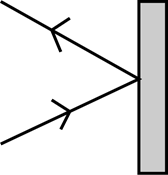
In the illustration, the light ray striking the object is-

If a capital letter R is seen in an ordinary mirror, what does it look like?

Which diagram shows the correct image of the key in a plane mirror?
Characteristics of a image formed by a plane mirror. Check all that applies.
inverted
same size as the object
laterally inverted
real
Magnification produced by a rear view mirror fitted in vehicles
is less than one
is more than one
is equal to one
can be more than or less than one depending upon the position of the object in front of it
Which of the following can make a parallel beam of light when light from a point source is incident on it?
(a) Concave mirror as well as convex lens
(d) Concave mirror as well as concave lens
(b) Convex mirror as well as concave lens
c) Two plane mirrors placed at 90° to each other
A 10 mm long awl pin is placed vertically in front of a concave mirror. A 5 mm long image of the awl pin is formed at 30 cm in front of the mirror. The focal length of this mirror is
30cm
20cm
60cm
40cm
Which of the following statements is true?
A convex lens has 4 dioptre power having a focal length 0.25 m
A convex lens has –4 dioptre power having a focal length 0.25 m
A concave lens has –4 dioptre power having a focal length 0.25 m
A concave lens has 4 dioptre power having a focal length 0.25 m

A beam of light is incident through the holes on side A and emerges out of the holes on the other face of the box as shown in the Figure 10.4. Which of the following could be inside the box?
concave lens
rectangular glass slab
prism
convex lens
You are given water, mustard oil, glycerine and kerosene. In which of these media a ray of light incident obliquely at same angle would bend the most
kerosene
water
mustard
glycerine
The path of a ray of light coming from air
passing through a rectangular glass slab
traced by four students are shown as A,
B, C and D in Figure 10.5. Which one of
them is correct?


shows a ray of light as it travels from medium A to medium B. Refractive index of the medium B relative to medium A is
√3 / √2
√2 / √3
1/ √2
√2
Under which of the following conditions a concave mirror can form an image larger than the actual object?
When object is kept at a distance greater than its radius of
curvature
When object is placed between the focus and centre of curvature
When object is kept at a distance less than its focal length
When the object is kept at a distance equal to its radius of
curvature

Beams of light are incident through the holes
A and B and emerge out of box through the
holes C and D respectively as shown in the Which of the following could be inside the box?
prism
rectangular glass slab
convex lens
concave lens

A light ray enters from medium A to medium
B as shown in The refractive
index of medium B relative to A will be
greater than unity
less than unity
equal to unity
zero

Which of the following ray diagrams is correct for the ray of light incident on a concave mirror as shown in the fig


A child is standing in front of a magic mirror. She finds the imageof her head bigger, the middle portion of her body of the same size and that of the legs smaller. The following is the order of combinations for the magic mirror from the top.
Plane, convex and concave
Convex, concave and plane
Concave, plane and convex
Convex, plane and concave
In which of the following, the image of an object placed at infinity will be highly diminished and point sized?
Concave mirror only
Convex mirror only
Convex lens only
Concave mirror, convex mirror, concave lens and convex lens
A full length image of a distant tall building can definitely be
seen by using
concave mirror
convex mirror
plane mirror
both concave and plane mirror
Total Internal Reflection can only occur when light is traveling from a high index to a low index
True
False
If Total Internal Reflection occurs the light will bounce back at the same angle it came in
True
False
Cubic Zirconia has a lower critical angle than diamonds
True
False
If light hits at an angle larger than the critical angle it will refract and pass through the material
True
False
Light travels from glass (n=1.66) to water, what is the critical angle for these two mediums?
53.2
48.8
37
not possible
Light travels from air to water (n=1.33), what is the critical angle?
48.8
46.4
52.4
not possible
Light travels from oil (n=1.48) to water at an angle of 60 degrees relative to the normal. What will happen to the light?
reflect back at an angle of 60 degrees
refract through at an angle of 74.5 degrees
refract through at an angle of 51.1 degrees
reflect back at angle of 30 degrees
Refraction occurs when light changes mediums, but does not change speeds
True
False
The higher the index of refraction, the faster light travels in that medium
True
False
Light traveling from a higher index of refraction to a lower index of refraction will bend towards the normal (refract at a smaller angle)
True
False
Light traveling from a low index of refraction to a higher index of refraction will get slower and bend away from the normal (refract at an larger angle)
True
False
What is the speed of light in ice (n=1.309)
2.29 * 10^8 m/s
2.43 *10^ 8 m/s
4.36 * 10^-9
4.36 *10^8 m/s
What is the index of refraction for a material that allows light to travel at 2.8 *108 m/s?
1.07
.67
1.5
not possible
Find the angle of refraction for a ray of light that enters water (n=1.33) from glass (n=1.5) at an angle of 25 degrees to the normal.
22
28.5
57.5
32.8
Light traveling from air to some unknown material makes an angle of 40 degrees to the normal and refracts at an angle of 26 degrees, what is the index of refraction of the new material?
1.47
.68
1.2
1.67
A ray of light enters the top of a glass of water at an angle of 36 degrees with the vertical. What is the angle between the refracted ray and the vertical?
2.26 degrees
26.2 degrees
51.4 degrees
36.5 degrees
A person shines a light at a friend who is swimming underwater. If the ray in the water makes an angle of 36.2 with the normal, what is the angle of incidence?
26.4 degrees
2.25 degrees
51.8 degrees
not possible
An object is placed 20 cm in front of a plane mirror. The mirror is moved 2 cm towards the object. The distance between the positions of the original and final images seen in the mirror is:
2 cm
4 cm
10 cm
22 cm
A ray of light that strikes a plane mirror PQ at an angle of incidence of 30o, is reflected from the plane mirror and then strikes a second plane mirror QR placed at right angles to the first mirror. The angle of reflection at the second mirror is:
30°
45°
60°
90°
An object is placed at 100 mm in front of a concave mirror which produces an upright image (erect image). The radius of curvature of the mirror is:
Less than 100 mm
Between 100 mm and 200 mm
Exactly 200 mm
More than 200 mm
Which position of the object will produce a magnified virtual image, if a concave mirror of focal length 15 cm is being used?
10 cm
20 cm
30 cm
35 cm
A concave mirror produces a magnification of +4. The object is placed:
At the focus
Between focus and centre of curvature
Between focus and pole
Beyond the centre of curvature
A ray of light is travelling in a direction perpendicular to the boundary of a parallel glass slab. The ray of light:
Is refracted towards the normal
Is refracted away from the normal
Is reflected along the same path
Does not get refracted
A lens of focal length 12 cm forms an erect image, three times the size of the object. The distance between the object and image is:
8 cm
16 cm
24 cm
36 cm


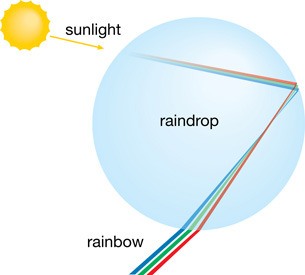

What happens to light passing through a hand lens that makes the image of the penny appear larger? The light is-
In the illustration, the light ray striking the object is-
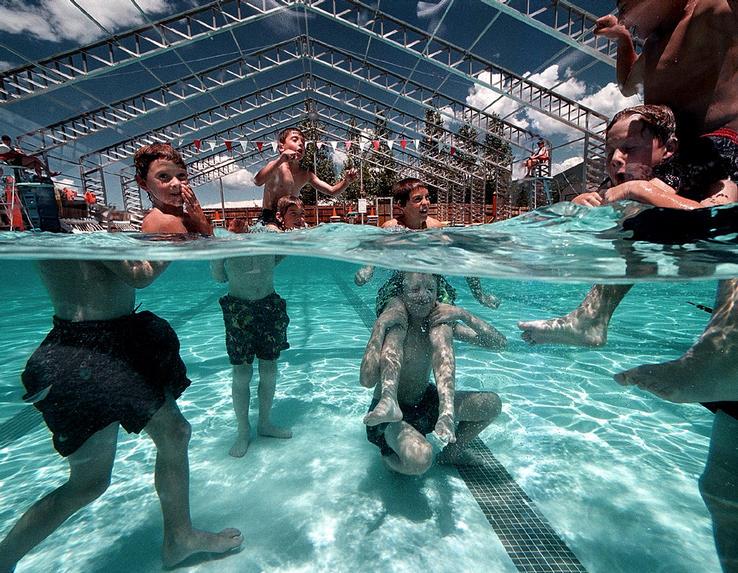

The law of reflection states that
Angle of incidence = Angle of reflection
Angle of incidence = Angle of incidence
Angle of reflection = Angle of translucence
Angle of reflection = Angle of reflection


Light is refracted and spread out by a ____.
concave lens
convex mirror
concave mirror
convex lens
Which optical device bends light inward?
convex lens
concave lens
plane mirror
convex mirror

What type of lens is used in the shown instrument?
concave lens
convex lens
reflection lens
reduction lens
A lens that is thicker in the middle than on the outside is called ___.
diverging
concave
convex
achromatic
A lens that is thinner in the middle than on the outside is called ___.
diverging
concave
convex
achromatic

Lenses that curve out are:
Converse
Concave
Convex
Convection

