wayground logo

Free Printable Worksheets

Font size

S
M
L
XL
Worksheets

Part C Physical Science EOC Review

Total questions: 100

Worksheet time: 2hrs 43mins

Name
Class
Date
1.

The properties of a compound are usually ________________ the properties of the elements making up the compound.

a)

the same as

b)

different from

c)

greater

d)

less than

2.

How many atoms are in the compound Mg(NO3)2?

a)

8

b)

9

c)

10

d)

11

3.
When an atom gains or loses electrons, the charged particle that results is called a(n) __________.
a)
neutron
b)
proton
c)
quark
d)
ion
4.
What does a chemical formula not show?
a)
names
b)
chemical symbols
c)
atoms of elements
d)
elements
5.
Are the atoms more stable when they are bonded together or when they are apart? 
a)
Bonded Together
b)
Apart
6.

What is the number of valence electrons for Oxygen (page 554)?

a)

8

b)

6

c)

2

d)

1

7.

What is the number of valence electrons for Silicon (p 554)?

a)

1

b)

2

c)

6

d)

4

8.
How many valence electrons in this structure?
a)
6
b)
5
c)
4
d)
7
9.

Why do atoms form chemical bonds?

a)

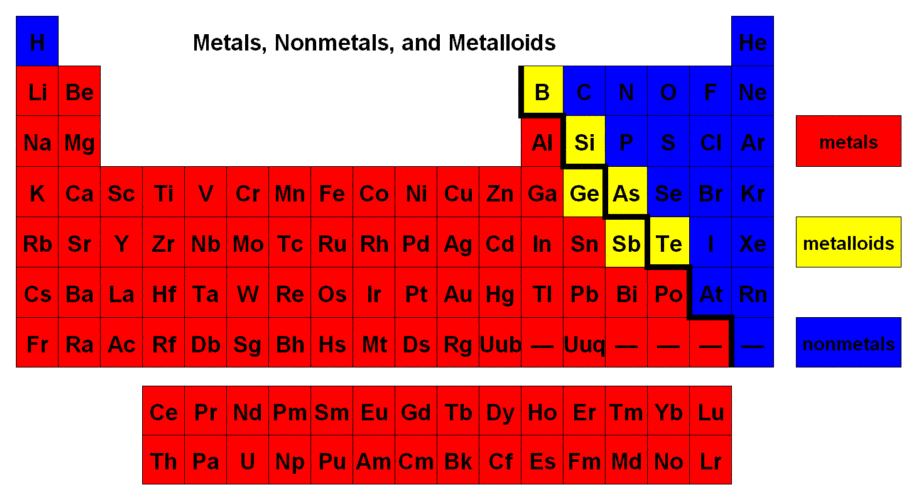
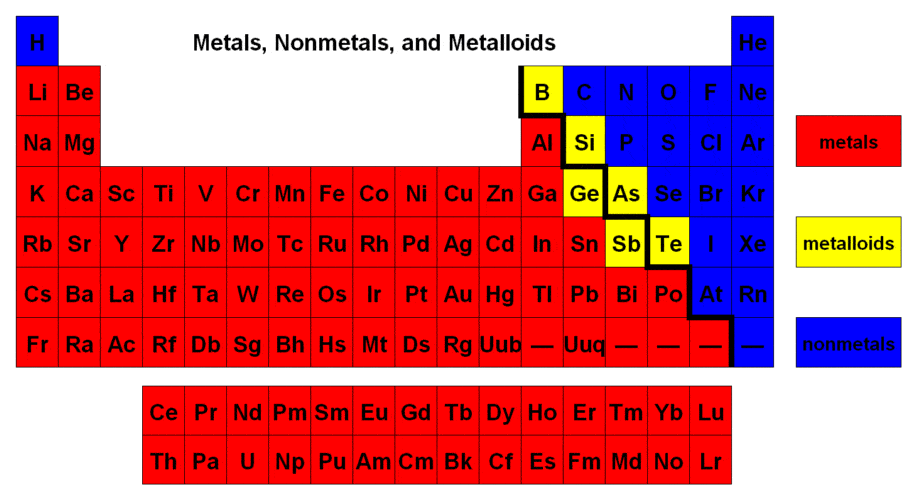
Because they are less stable as compounds

b)

They can fill their valence (outer) level with electrons through chemical bonds.

c)

Because they require more protons

d)

Because they want to be James Bond

10.

Helium only has 2 electrons on it's electron dot diagram. Why is it in the Noble Gas group?

a)

Because it has 2 protons

b)

Because it's atomic number is 2

c)

Because its valence (outer) level is full with 2 electrons

d)

Because it is a prince

11.
What elements generally make an ionic bond?
a)
metal and nonmetal
b)
2 or more nonmetals
c)
metal
d)
none of the above
12.
What elements generally make a covalent bond?
a)
metal and nonmetal
b)
2 or more nonmetals
c)
metal
d)
none of the above
13.
An ionic bond forms when 
a)
Valence electrons are shared
b)
a sea of mobile electrons surround the cations
c)
valence electrons are transferred between atoms
d)
none of the above
14.
What type of diagram is this?
a)
Electron Dot Diagram
b)
Bohr Model
c)
Alkali Diagram
d)
Chemical Diagram
15.
How many valence electrons in this structure?
a)
6
b)
5
c)
4
d)
7
16.
A chemical bond between oppositely charged ions.
a)
compound
b)
ion
c)
covalent bond
d)
ionic bond
17.
A chemical bond formed between shared atoms.
a)
chemical bond
b)
covalent bond
c)
oxidation #
d)
ionic bond
18.
Tells what elements a compound contains and the number of those atoms.
a)
compound
b)
ion
c)
chemical formula
d)
ionic bond
19.
How many atoms of Oxygen are in this compound?
a)
4
b)
1
c)
12
d)
7
20.

Combing Ba+2 with Br-1 will yield

a)

BrBa

b)

Br2Ba2

c)

BaBr2

d)

Br2Ba

21.

Combining Ca+2 with O-2 will yield

a)

CaO

b)

OCa

c)

Ca-2O+2

d)

Ca2O2

22.
When adding a subscript to a polyatomic ion, you should...
a)
multiply any subscripts on the polyatomic ion by the subscript you are adding
b)
put parentheses around the polyatomic ion before adding a subscript
c)
write the new subscript next to any subscripts on the polyatomic ion
d)
put the polyatomic ion in square brackets before adding the subscript
23.
Students react baking soda & vinegar.
Which of the following would provide the evidence that the number of atoms present before a chemical reaction is equal to the number of atoms present after the chemical reaction?
a)
The mass of the plastic bag, baking soda, and vinegar before the reaction was equal to the mass after the reaction.
b)
Bubbles were produced during the reaction, which meant that a gas was being produced.
c)
The plastic bag did not change in any way, indicating that it was not involved in the reaction.
d)
The mass of the baking soda was exactly equal to the mass of the vinegar used to create the chemical reaction.
24.
Which of the following is the best description of the results of a chemical reaction?
a)
The substance seems to disappear after dissolving in water.
b)
The substance changes from liquid to solid at a low temperature.
c)
The reaction can be reversed to get back the original substance.
d)
A new substance with different properties is formed.
25.
Which of the following coefficients correctly balances the equation below?
__CH4 + __H2O --> __H2 + __CO
a)
1,1,1,1
b)
2,1,1,2
c)
1,1,3,1
d)
3,2,2,3
26.
Which of the following coefficients correctly balances the equation below?
__F2 + __H2O --> __OF2 + __HF
a)
2,3,2,3
b)
2,1,1,2
c)
1,2,2,1
d)
4,2,2,4
27.
The molar mass of an element is equal to its...
a)
Atomic mass
b)
Atomic number
c)
Oxidation number
d)
Valence electrons
28.
What is the molar mass of table salt (NaCl)?
a)
116.886 g/mol
b)
35.453 g/mol
c)
22.990 g/mol
d)
58.443 g/mol
29.

What is the mass of one mole of Helium?

a)

4 g

b)

2 g

c)

8 g

d)

There is no way to know

30.

What are the products of the chemical reaction pictured?

a)

CH4 and CO2

b)

CH4 and O2

c)

CO2 and H2O

d)

O2 and H2O

31.

If the reactants' mass is 18g , what is the mass of the products?

a)

15 g

b)

36 g

c)

81 g

d)

18 g

32.
What is the left part of a chemical equation called?
H2 + O → H2O
a)
Reactants
b)
Products 
c)
Yields 
d)
Chemical Equation 
33.
The reactants are on the left side of the chemical equation.
a)
True
b)
False
34.

How many reactants are in A + B ---> C ?

a)

1

b)

2

c)

3

d)

4

35.

How many products are in A + B ---> C ?

a)

1

b)

2

c)

3

d)

4

36.
2H2 + O2 ----> 2H2O What is the product?
a)
------>
b)
2H2O
c)
2H2+ O2
37.
This is used to represent the number of each atom being represented. 
a)
A Exponent
b)
The Coefficient
c)
A Molecule
d)
The Subscript
38.

In a chemical reaction, bonds are broken and new bonds are formed. Which has their bonds broken?

a)

Reactants

b)

Products

39.

In a chemical reaction, bonds are broken and new bonds are formed. Which has new bonds formed?

a)

Reactants

b)

Products

40.
AB + CD →AD + CB
a)
Double Replacement
b)
Single Replacement
c)
Synthesis
d)
Decomposition
41.
Identify this type of reaction,
Cl2 + 2KI -->  I2 + 2KCl
a)
Synthesis
b)
Single displacement
c)
Double displacement
d)
Decomposition
42.
2 RbNO3 + BeF2 --> Be(NO3)2 + 2 RbF
a)
single displacement
b)
double displacment
c)
decomposition
d)
synthesis
43.
Which of the following is an example of synthesis?
a)
Na + Br--> NaBr
b)
KClO--> KCl + O2
c)
HgO + Cl2-->HgCl + O2
d)
Cl2 + NaBr --> NaCl + Br2
44.
2 AgNO3 + Cu --> Cu(NO3)2 + 2 Ag 
a)
single displacement
b)
double displacement
c)
decomposition
d)
synthesis
45.
A + BC →B + AC
a)
Single Replacement
b)
Decomposition
c)
Double Replacement
d)
Synthesis
46.
NO2 →N2 + O2
a)
Synthesis (combination)
b)
Decomposition
c)
Single replacement
d)
Combustion
47.
2NaCl →2Na +Cl2
a)
Synthesis Reaction
b)
Decomposition Reaction
c)
Single Displacement Reaction
d)
Double Displacement Reaction
48.
 C + O→ CO2
a)
Synthesis Reaction
b)
Decomposition Reaction
c)
Single Displacement Reaction
d)
Double Displacement Reaction
49.
Which of the following describes a precipitate?
a)
a liquid forms when a block of metal is heated
b)
a solid forms when one liquid is poured into another
c)
a gas forms when a solid is placed in a liquid
d)
bubbles form when an acid is poured on a rock
50.
The force that holds 2 atoms together is called a ________________.
a)
Chemical Reaction
b)
Chemical Bond
c)
Diatomic Chemical
d)
Glue
51.

What is the measure of how fast molecules are moving?

a)

Speedometer

b)

Volume

c)

Temperature

d)

Thermometer

52.

In EXOTHERMIC reactions, energy is _____ from the reaction to the surroundings.

a)

Absorbed

b)

Released

c)

Eliminated

d)

Evaporated

53.

In ENDOTHERMIC reactions, energy is _____ by the reaction system from the surroundings.

a)

Absorbed

b)

Released

c)

Eliminated

d)

Obliterated

54.

What usually happens to TEMPERATURE in an ENDOthermic reaction?

a)

Increases

b)

Decreases

c)

Stays the same

55.

Temperature usually _____ in EXOthermic reactions.

a)

Stays the same

b)

Increases

c)

Decreases

56.

Fireworks are an _____ reaction.

a)

EXOthermic

b)

ENDOthermic

57.

The starting temperature of a reaction was 21 degrees Celsius and the ending temperature was 44 degrees Celsius. What type of reaction occurred?

a)

EXOthermic

b)

ENDOthermic

58.

A chemist is doing an ENDOthermic reaction. The starting temperature was 25 degrees Celsius. Which of the following would be a reasonable ending temperature

a)

44 degrees

b)

30 degrees

c)

15 degrees

d)

25 degrees

59.

If a chemical reaction produces light or sound, it is likely a _____ reaction.

a)

EXOthermic

b)

ENDOthermic

60.

Which of the following is a sign that a chemical reaction has occurred?

a)

Color change

b)

Emits an odor

c)

Produces a gas

d)

All of the above

61.
In an endothermic reaction, heat is 
a)
taken in
b)
given out
62.
Activation energy is required to start a chemical reaction. What is activation energy?
a)
The energy needed for a reaction to occur
b)
The minimum amount of energy needed for a reaction to potentially occur
c)
The energy added by a catalyst
d)
The energy possessed by the products
63.
The amount of a substance in a given volume.
a)
concentration
b)
temperature
c)
surface area
d)
catalyst
64.
Exposing more particles for collisions is an increase in 
a)
concentration
b)
surface area
c)
temperature
d)
catalyst
65.
This slows down or even stops a chemical reaction.
a)
de-activator
b)
catalyst
c)
enzyme
d)
inhibitor
66.
One clue of a chemical change is the formation of a precipitate. A precipitate is formed when
a)
Two liquids react and a gas is produced
b)
A solid dissolves in a liquid
c)
One liquid dissolves in another
d)
Two liquids react and a solid is formed
67.
Some chemical reactions require a substance called a catalyst. The main purpose of a catalyst is
a)
To warm up the reaction
b)
To speed up the reaction
c)
To create more reactants
d)
To stop the reaction
68.
Smaller particle size allows for a _________ surface area to be exposed for the reaction.
a)
larger
b)
smaller
69.

Increasing the concentration of the reactants will usually slow down the reaction.

a)

false

b)

true

70.
If an acid is combined with a base of equal strength, the result will most likely be
a)
a neutral solution.
b)
a stronger acid.
c)
impossible to tell without testing the pH.
d)
a stronger base
71.
 Which of the following is an acid?
a)
shampoo
b)
baking soda
c)
orange juice
d)
water
72.
Which type of ion does a base produce when it is dissolved in water?
a)
oxide
b)
oxygen
c)
hydrogen
d)
hydroxide
73.
Explain what happens when a strong acid and a strong base are poured into the same container.
a)
they form separate layers
b)
they mix physically but not chemically
c)
they break apart into separate elements
d)
they react chemically to form a salt
74.
The pH scale measures...
a)
...the strength of an acid.
b)
...the strength of hydrogen ions.
c)
...the concentration of hydrogen ions.
d)
...the concentration of an acid
75.

Which type of ion does an acid produce when it is dissolved in water?

a)

oxide

b)

oxygen

c)

hydronium

d)

hydroxide

76.

The solutions in the chemical equation show the presence of a...

a)

Strong Acid

b)

Strong Base

c)

Weak Acid

d)

Weak Base

77.

The solutions in the chemical equation show the presence of a...

a)

Strong Acid

b)

Strong Base

c)

Weak Acid

d)

Weak Base

78.

The solutions in the chemical equation show the presence of a...

a)

Strong Acid

b)

Strong Base

c)

Weak Acid

d)

Weak Base

79.

On the pH Scale , pure water has a pH of...

a)

0

b)

7.0

c)

8.0

d)

14

80.

A substance is found to have the following characteristics:


Very bitter taste

Feels slippery to the touch

Produces OH- ions when dissolved in water


In what category would the substance be classified?

a)

acid

b)

base

c)

enzyme

d)

fatty acid

81.

Most likely, HNO2

a)

is a base

b)

is a salt

c)

is an acid

d)

is an ionic compound

82.

Releases hydrogen ions in an aqueous solution.

a)

base

b)

strong base

c)

acid

d)

weak base

83.

What is the [H+] concentration if the pH is 4.0?

a)

1.0 x 10⁻¹⁰ M

b)

1.0 x 10⁻⁴ M

c)

1.0 x 10⁻¹⁴ M

d)

1.0 x 10⁻⁷ M

84.

Acid react with metal to form

a)

salt+ carbon dioxide

b)

salt + hydrogen

c)

Salt + Water

d)

Salt + metal oxide

85.

What is it called when an acid and a base combine then form a salt and H2O

a)

Neutralization

b)

Acidification

c)

Chemical Bonding

d)

Ionic Reaction

86.

Postassium Nitrate (KNO3) is a salt that if often used in the manufacturing of...

a)

Batteries

b)

Paint

c)

Fertilizer

d)

Detergent

87.
The base unit of metric length.
a)
Meter
b)
Liter 
c)
Kilogram
d)
milligram
88.
The basic unit of metric volume is called a_____.
a)
Kilogram
b)
milligram
c)
Liter
d)
milliliter
89.
The base for mass is the
a)
meter
b)
gram
c)
kilogram
d)
liter
90.
What is the length of the key?
a)
2 cm
b)
0 cm
c)
4 cm
d)
2 inches
91.
What is the correct volume of the blue liquid?
a)
5 ml
b)
15 ml
c)
20 ml
d)
25 ml
92.
The amount of matter in an object is the
a)
mass
b)
volume
c)
length
d)
density
93.

All of the following would classify an element as a metal except?

a)

Dullness

b)

Luster

c)

Malleable

d)

Ductile

94.
Describe what luster means
a)
How an object reflects light
b)
How soft an object is
c)
If an object floats
d)
If an object can be dug out of the earth.
95.

If you have a material that can conduct electricity well, it is probably a...

a)

Metalloid

b)

Matter

c)

Non-metal

d)

Metal

96.

Which of the following is the only metal that exist as a liquid at room temperature?

a)

Gold (Au)

b)

Mercury (Hg)

c)

Titanium (Ti)

97.

This picture illustrates copper's

a)

brittleness

b)

malleability

c)

ductility

98.
What element in air reacts with Iron to make Iron Oxide
a)
Carbon
b)
Oxigen
c)
Oxygen
d)
Nitrogen
99.
Iron is a good conductor, malleable and magnetic. What type of element is Iron? 
a)
Metal
b)
Nonmetal
c)
Metalloid
100.

The metal which can be cut with knife.

a)

Iron

b)

Silver

c)

Sodium

d)

Magnisium