Worksheets
Physics Pretest Semester 1
Total questions: 100
Worksheet time: 3hrs 3mins
What is the period of an object in uniform circular motion?
The time it takes for the object to complete one full revolution
The time it takes for the object to travel half of the circle
The time it takes for the object to reach its maximum speed
The time it takes for the object to come to a stop
In uniform circular motion, objects have a constant speed but not a constant velocity. Why is this?
The objects are constantly changing direction
The objects are constantly changing their radius
The objects are constantly changing their mass
The objects are constantly changing their shape
What force is responsible for an object's circular movement in uniform circular motion?
Friction
Gravity
Centripetal force
Tension
What is the centripetal acceleration of a runner moving at a speed of 8.8 m/s around a bend with a radius of 25m?
1.2 m/s^2
2.5 m/s^2
3.1 m/s^2
4.5 m/s^2
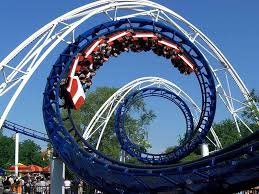
In the example of the rubber ball swung in a horizontal circle, what would happen to the speed of the ball and the tension in the string if the ball made a revolution in less than 1 second?
The speed would decrease and the tension would decrease
The speed would decrease and the tension would increase
The speed would increase and the tension would decrease
The speed would increase and the tension would increase
What is the force of friction necessary to keep the worker from falling off the platform?
120.07 N
0.27
Friction
Movement
What is the coefficient of friction?
120.07 N
0.27
Friction
Movement
What would happen to the worker if the merry-go-round had a layer of ice while it was spinning?
The worker would fly off
The worker would never move
The worker would slide faster
The worker would stick to the platform
What is the greatest speed the car can have without skidding?
19.2 m/s
0.82
1200 kg
45 m
What is the minimum speed that the bucket must swing so that it does not come crashing down at the top of its loop?
30.86 N
54.86 N
2.65 m/s
0.7 m
In a conical pendulum, what is the angle of the pendulum if the period of the pendulum in a perfect circle is 1.4 s and the ball is traveling at 2 m/s?
30 degrees
41.63 degrees
53 degrees
65 degrees
What is the tension in the string of a 1.45-kg ball suspended from a 0.8m string and swinging in a horizontal circle at a constant speed, making an angle of 14 degrees with the vertical?
10.25 N
14.94 N
19.37 N
23.45 N
A car rounds a corner with a radius of 65m and is banked at 20 degrees. What speed should the car have in order to make the turn with no assistance from friction?
10.25 m/s
15.38 m/s
20.50 m/s
25.63 m/s
If a roadway is banked at the proper angle, a car can round a corner without any assistance from friction between the tires and the road. Find the appropriate banking angle for a car traveling at 20.5 m/s in a turn of radius 85m.
15.2 degrees
20.7 degrees
26.3 degrees
31.9 degrees
Determine the force of gravitational attraction between the earth (m = 5.98 x 10^24 kg) and a 70kg physics student if the student is standing at sea level (a distance of 6.38 x 10^6 m from earth's center).
686 N
738 N
795 N
853 N
Two objects attract each other gravitationally. If the distance between their centers is cut in half, the gravitational force:
A) is cut to one fourth.
B) is cut in half.
C) doubles.
D) quadruples
A student who weighs 500 N on Earth travels to a planet that has a mass and radius that double the Earth’s. His weight on that planet is about:
A) 250 N
B) 500 / √2 N
C) 500 N
D) 1000 N
An astronaut goes out for a "space walk" at a distance above Earth's surface equal to the radius of Earth. What is her acceleration due to gravity?
A) zero
B) g
C) g/2
D) g/4
Spacecraft X has twice the mass of Spacecraft Y. They have the same distance from Earth as they orbit. Which of these must be true?
A) X feels a greater gravitational force than Y
B) X travels twice as fast as Y
C) X takes twice as long to complete an orbit
D) The orbital period of X is the same as Y
Neptune orbits the sun with an orbital radius of 4.495 x 10^12 m. If the mass of the sun is 1.99 x 10^30 kg, what is the period of Neptune’s orbit (in seconds and in days)?
A) 5,197,387,949 s
B) 60,154.95 days
C) 5434.06 m/s
D) 6.569 x 10^-6 m/s^2
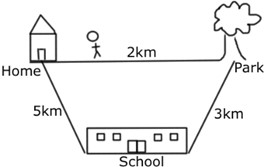
Jerry walked from home to school, then from the school to the park. What is his total distance?
2 km
5 km
8 km
10 km
Nathaniel walks 50 meters directly north, stops, reverses direction, and then travels 32 meters directly south. What is is the distance travelled?
82 meters
18 meters
32 meters
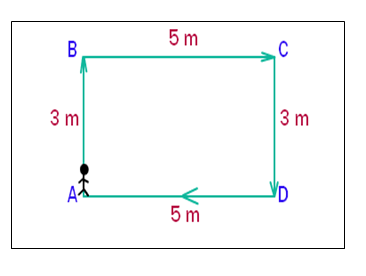
Sara walks from Point A to Point B. Which is true about Sara's distance and displacement?
Distance and Displacement are equal
Distance is less than displacement
Displacement is less than distance
Jerry runs exactly 2 laps around a 400 meter track. What is his displacement?
800
400
0
200

The SI unit for measuring distance and displacement is the ________ .
mile
foot
kilometer
meter
A man walks 5 miles forwards, 6 miles backwards and then 2 miles forwards. What is his displacement?
1 mile forward
13 miles
3 miles forward
1 mile
Which is the length of the path an object has traveled?
displacement
distance
motion
reference point
The sum of all movements from start to the end of motion is best described as____.
distance
displacement
motion
donkey
refers to the repeatability of data
precision
accuracy
experimental error
sig figs
The one difference between a control group and experimental group is the
controlled variable
Dependent (responding) variable
Independent (manipulated) variable
Hypothesis
(T/F) Are hypotheses written as a question?
True
False
What is the basic unit for time?
minutes
hours
seconds
days



Which type of material rises?
Material that is more dense
Material that is less dense
The density does not determine if particles will rise or fall
Which is an example of convection?
Touching a hot pot
Gases rising and falling in the atmosphere
Cooking a burger

What is the volume of this rectangular prism?
9 cubic cm
6 cubic cm
18 cubic cm
8 cubic cm
Where did Mr. Boyd go to college?


A scalar quantity has . . .
magnitude only
direction only
both magnitude and direction
neither
A vector quantity has . . .
magnitude only
direction only
both magnitude and direction
neither
Which quantity do we use an arrow to represent?
scalars
vectors
Temperature is an example of a
scalar
vector
Acceleration is an example of a
scalar
vector
Time is an example of a
scalar
vector
Which of the following is a scalar quantity?
distance
displacement
What is dimensional analysis?
A method used to convert units
A method used to measure length, mass, and volume
A method used to solve algebraic equations
A method used to analyze chemical reactions
Which units are used in the SI unit system for length, mass, and volume?
Length: centimeters, Mass: grams, Volume: liters
Length: meters, Mass: kilograms, Volume: liters
Length: inches, Mass: pounds, Volume: gallons
Length: millimeters, Mass: milligrams, Volume: milliliters
What is the conversion factor for 60 minutes to 1 hour?
1 minute = 60 hours
1 hour = 60 seconds
1 minute = 1 hour
1 hour = 60 minutes
How many centimeters are in 2.7 meters?
27 cm
270 cm
2.7 cm
0.027 cm
How many feet are equal to 54.7 inches?
5.47 ft
547 ft
4.56 ft
45.7 ft
A vector quantity that refers to the rate at which an object changes speed or velocity.
Velocity
Acceleration
Displacement
Distance

What are the units for acceleration?
m/s
m
sm2
s2m


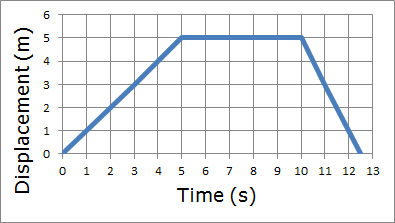

What is the speed of a cheetah that travels 112.0 m in 4.0 s?
0.0357 m/s
30 m/s
0.036 m/s
28.0 m/s


The slope of this graph represents..
Constant velocity
Time
Velocity
Acceleration
The location of an object related to a zero point.
position
speed
distance
displacement
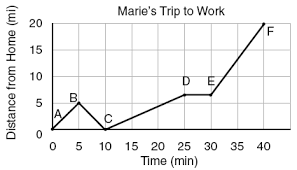
During what period of time was Marie stopped?
0-5 minutes
5-10 minutes
10-25 minutes
25-30 minutes
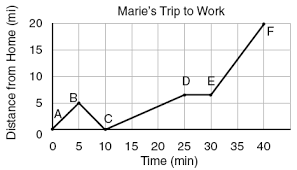
What could account for Marie’s motion at 27 minutes?
She was late so she broke the speed limit
She forgot something at home and ran back to get it
She was stopped at a red light
She was driving across the top of a hill
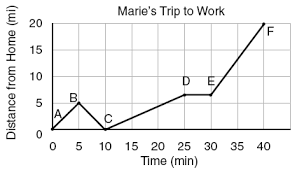
How does her speed at 3 minutes compare with her speed at 7 minutes?
She is driving faster at 3 minutes.
She is driving faster at 7 minutes
She is driving forward at 3 minutes and back at 7.
She is moving up at 3 minutes and down at 7 minutes
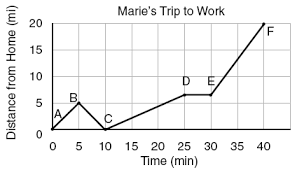
It usually takes Marie 30 minutes to get to work. Did her trip take...
The average amount of time.
Longer then average amount of time.
Shorter then average amount of time.
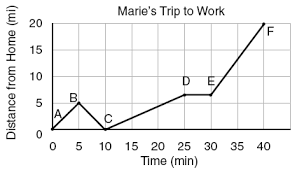
How far away is Marie's work from her house?
40 mi
25 mi
20 mi
5 mi
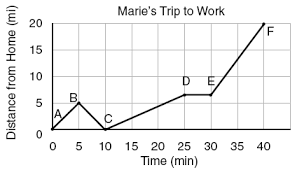
What could be a possible explanation for why Marie turned around at point B.
She arrived at work.
She forgot her lunch
She was waiting at a stop light.
She was sick and went home to sleep.
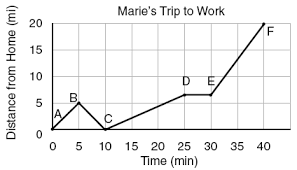
How far did Marie go before she turned around?
20 mi
5 mi
10 mi
25 mi
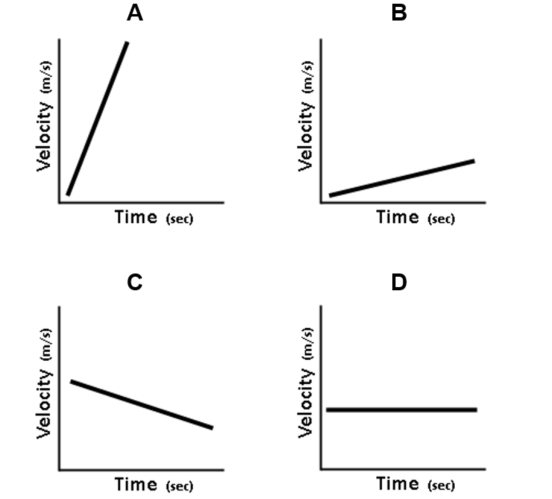

Which of the following units is the SI unit of velocity?
seconds
kilograms
meters
meters per second

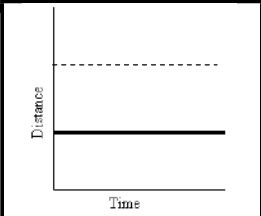
Displacement is
position of object
final position minus initial position
distance divided by time
initial position plus final position

What is the creature's final displacement?
23 m
9 m
-9 m
-23 m

An old lady rolls down a hill at 3 meters/second. The hill is 36 meters long. How many seconds does it take the old lady to reach the bottom of the hill?
39 seconds
12 seconds
15 seconds
33 seconds
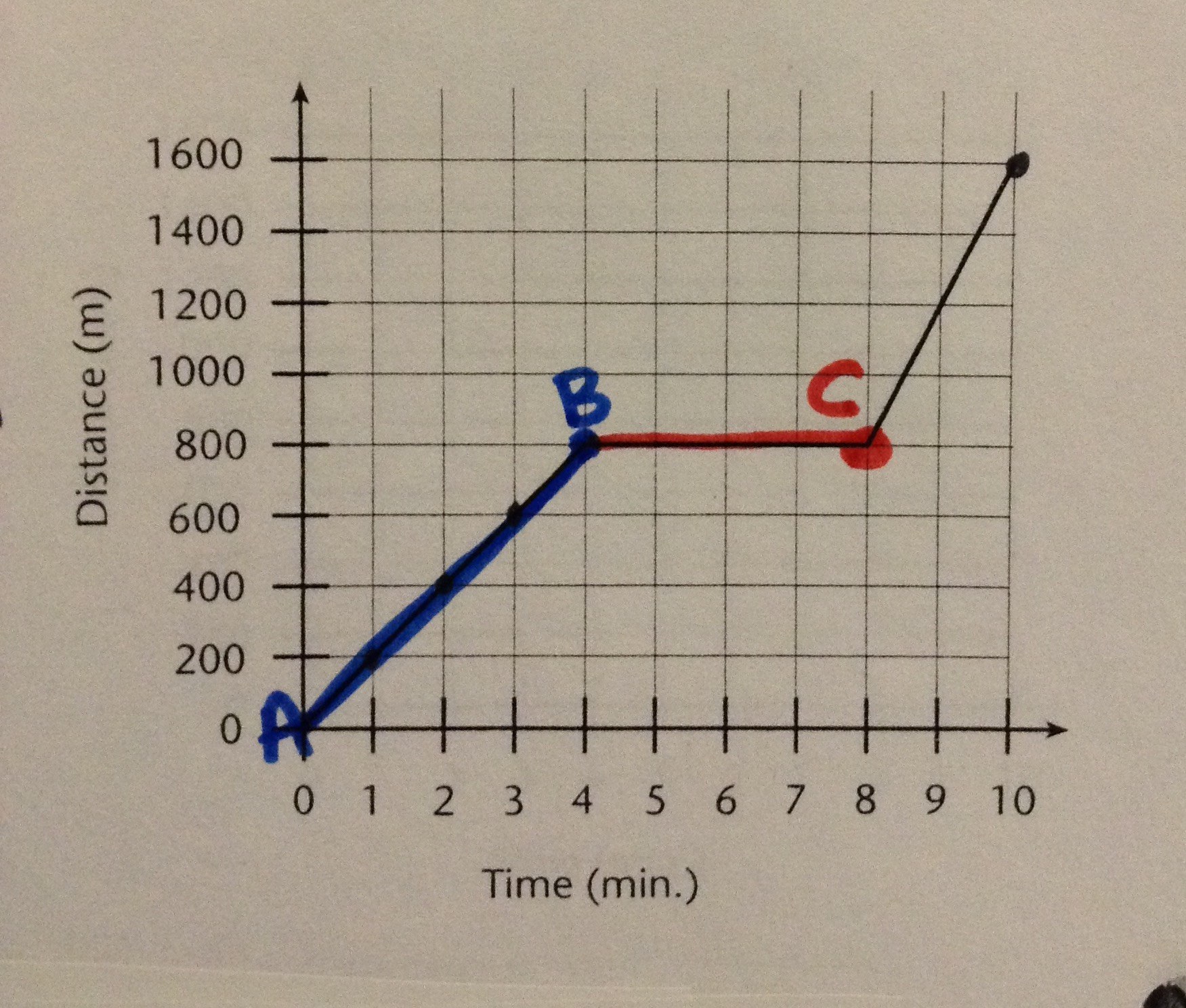
What is occurring from point A to point B?
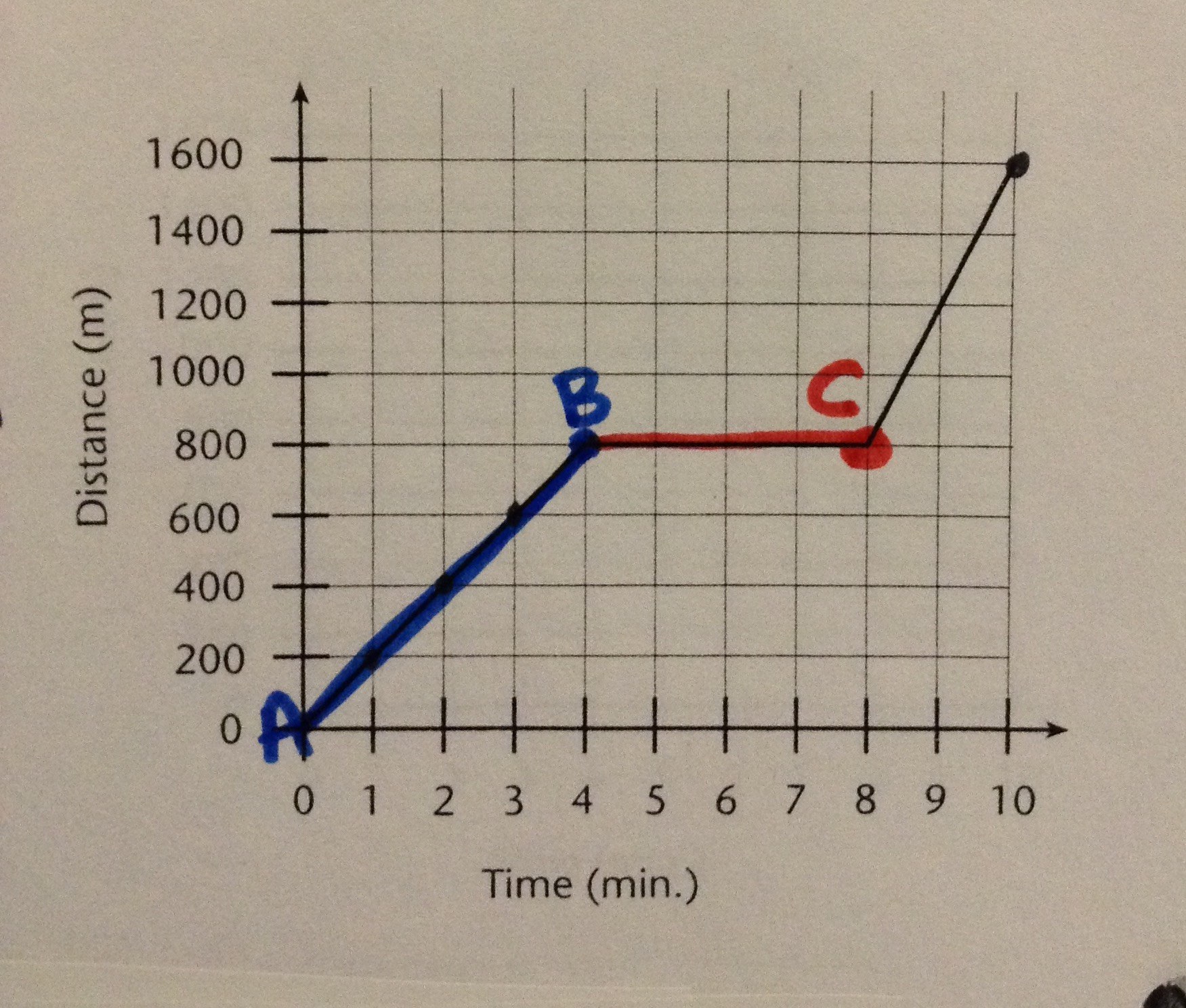
What was her average speed for the ENTIRE trip?