
 Worksheets
Physical Science GA Milestone Review
Total questions: 100
Worksheet time: 2hrs 20mins
The half-life of cadmium-109 is 464 days. A scientist measures out a 256.0 gram (g) sample.
Approximately how many grams of cadmium-109 would remain after 1,392 days?
32.0g
64.0g
2,048.0g
1,024.0g
The elements neon and argon are not reactive.
Which hypothesis BEST explains this?
They are not stable atoms.
They are not readily available on Earth.
They tend to give up all of their valence electrons easily
They have the maximum possible number of electrons in their outermost shell.
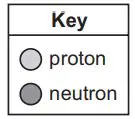
A group of students proposed four different models to show the fusion of hydrogen to form helium. The key to the models is shown.
Which model shows the process of nuclear fusion?


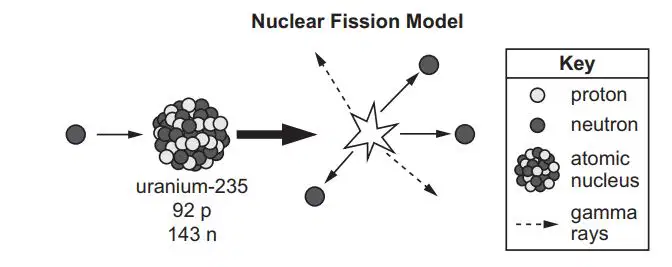
A student is modeling the fission of uranium nuclei. The student started the model as shown in the diagram.
Which TWO particles should the student add to the right-hand side of the model to complete the fission reaction?


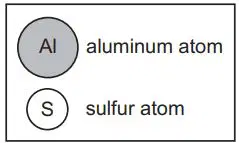
A student is modeling the units in the formula for aluminum sulfide using the spheres shown below to represent aluminum (Al) and sulfur (S) atoms.
Which model correctly shows a stable ionic compound for aluminum sulfide?


Use this chemical equation to answer the question.
_Fe + _O2 → _Fe2O3
What coefficients of Fe, O2 and Fe2O3 will show that matter is conserved in this chemical reaction?
2, 1, 2
2, 3, 2
4, 1, 2
4, 3, 2
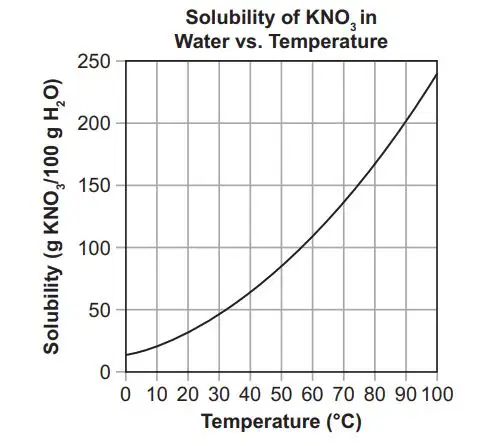
A solubility curve for potassium nitrate (KNO3) is shown.
According to the graph, what is the maximum approximate mass of KNO3 that would dissolve at 60°C and what is the relationship between temperature and solubility?
The mass is approximately 140 g; increased temperatures lead to a decrease in solubility
The mass is approximately 110 g; increased temperatures lead to an increase in solubility.
The mass is approximately 140 g; increased temperatures lead to an increase in solubility.
The mass is approximately 110 g; increased temperatures lead to a decrease in solubility.
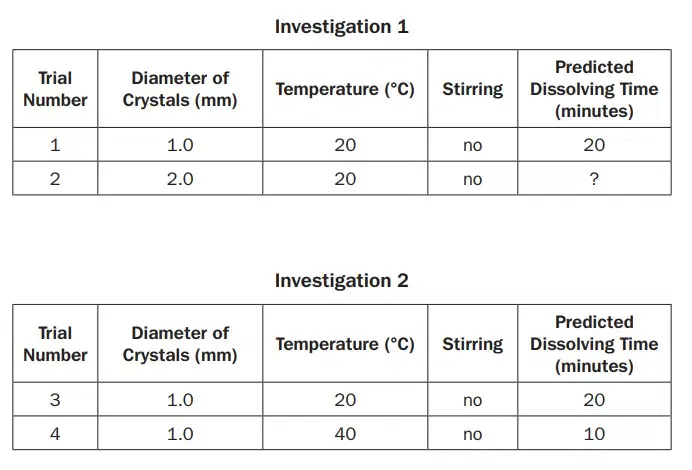
A student plans to investigate how different factors affect the dissolving rate of a certain mass of potassium chloride (KCl) in water. The student will test a different variable in each investigation: the diameter of the crystals in millimeters (mm), the temperature of the solution in degrees Celsius (°C), and agitation (stirring) of the solution. The first table shows details and predictions for investigation 1 and Investigation 2.
Based on the predicted dissolving times for trials 1, 3, and 4, which statement contains the BEST prediction for the dissolving time in trial 2?
5 minutes, because the larger diameter of crystals increases the total surface area of the solute exposed to the solvent, decreasing the length of exposure to the solvent
15 minutes, because the larger diameter of crystals increases the total surface area of the solute exposed to the solvent, increasing the length of exposure to the solvent
20 minutes, because the larger diameter of crystals decreases the total surface area of the solute exposed to the solvent, but the length of exposure to the solvent stays the same
30 minutes, because the larger diameter of crystals decreases the total surface area of the solute exposed to the solvent, increasing the length of exposure to the solvent
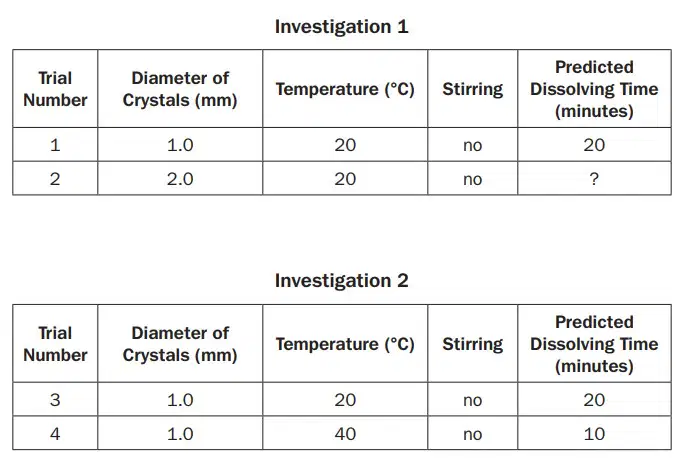
A student plans to investigate how different factors affect the dissolving rate of a certain mass of potassium chloride (KCl) in water. The student will test a different variable in each investigation: the diameter of the crystals in millimeters (mm), the temperature of the solution in degrees Celsius (°C), and agitation (stirring) of the solution.
How should the student design investigation 3 to finish testing the factors that affect the dissolving rate of KCl?
Increase the diameter of crystals to 2.0 mm. Keep the temperature at 40°C. Do not stir the solution.
Keep the diameter of crystals at 1.0 mm. Keep the temperature at 20°C. Stir the solution.
Increase the diameter of crystals to 4.0 mm. Decrease the temperature to 0°C. Do not stir the solution.
Keep the diameter of crystals at 1.0 mm. Increase the temperature to 60°C. Stir the solution.
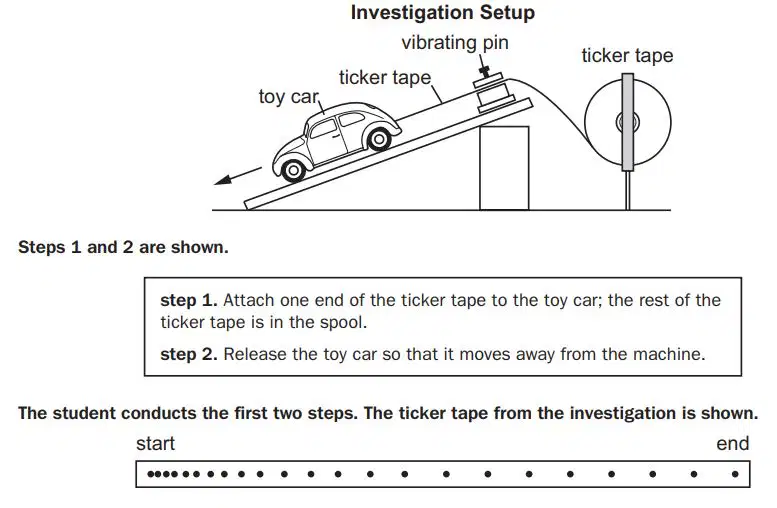
A student sets up an investigation to analyze the motion of a battery-powered toy car. The student uses a machine with a vibrating pin that makes a mark every 0.1 second on a long narrow piece of paper called ticker tape.
Which action should the student take in step 3 to determine the speed of the car, and which analysis of the speed of the car is correct?
step 3. Count the total number of dots on the ticker tape. analysis: The speed remained constant during the entire period.
step 3. Measure the distance between each successive dot on the ticker tape. analysis: The speed decreased at first and then became constant.
step 3. Count the total number of dots on the ticker tape. analysis: The speed continued to increase during the entire period.
step 3. Measure the distance between each successive dot on the ticker tape. analysis: The speed increased at first and then became constant.
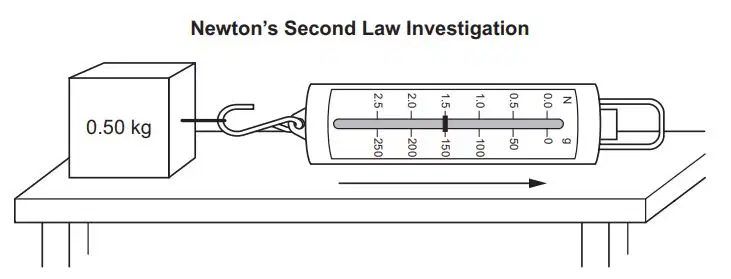
To investigate Newton’s second law of motion, a student used a motion sensor and a spring scale to measure the force acting on a lead block as it was pulled in the direction of the arrow, across the top of a table. A diagram of the setup is shown.
The student measured a force of 1.5 newtons (N) acting on the lead block. The student expected the block to accelerate in the same direction as the arrow; however, as the block moved across the table, the motion sensor detected a constant velocity. The student interpreted the results and claimed that Newton’s second law does not always apply. Which explanation BEST describes why the student’s claim is invalid?
The 1.5 N reading on the spring scale is due to the force of friction acting in the opposite direction of the motion, since the net force is zero at constant velocity. Without friction, the lead block would have accelerated at 0.33 m/s2.
The 1.5 N reading on the spring scale is due to the net force of 1.50 N to the right acting on the block, as indicated by the constant velocity to the right. Without this force, the lead block would have accelerated at 0.33 m/s2.
. The 1.5 N reading on the spring scale is due to the force of friction acting in the opposite direction of the motion, since the net force is zero at constant velocity. Without friction, the lead block would have accelerated at 3.0 m/s2.
The 1.5 N reading on the spring scale is due to the net force of 1.50 N to the right acting on the block, as indicated by the constant velocity to the right. Without this force, the lead block would have accelerated at 3.0 m/s2.
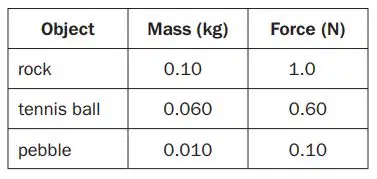
A teacher dropped three different objects down a 5.0 m vacuum chamber. The teacher then determined the force on each object given its mass and created the table shown.
What relationship can be determined based on an analysis of the data?
Each object has a final velocity that is proportional to its mass.
Each object has an acceleration that is proportional to its mass.
All three objects have the same downward acceleration regardless of mass.
All three objects have the same amount of inertia regardless of mass
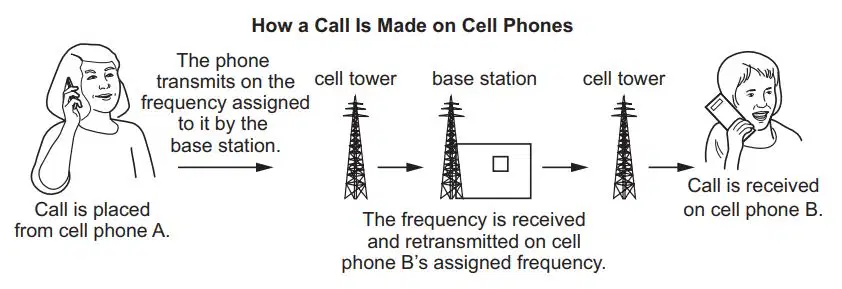
A student investigated the energy transformations that occur when a call is placed from cell phone A and received by cell phone B. The student drew a diagram to show the process.
Based on the diagram, what evidence is there for the transformation of chemical energy into electrical energy, and which other energy transformations must occur for the call to be received by cell phone B?
evidence: Cell phones are powered by a battery that produces the electricity used to send or receive a call. transformation 1: Sound energy is transformed into electrical energy by cell phone A. transformation 2: Electrical energy is transformed into mechanical energy in the cell towers and base station.
evidence: Cell phones are powered by a battery that produces the electricity used to send or receive a call. transformation 1: Sound energy is transformed into electromagnetic waves by cell phone A. transformation 2: Electromagnetic waves are transformed back into sound energy by cell phone B
evidence: Base stations are powered by a battery that produces the electricity used to receive and forward a call. transformation 1: Sound energy is transformed into electrical energy by cell phone A. transformation 2: Electrical energy is transformed into mechanical energy in the cell towers and base station.
evidence: Base stations are powered by a battery that produces the electricity used to receive and forward a call. transformation 1: Sound energy is transformed into electromagnetic waves by cell phone A. transformation 2: Electromagnetic waves are transformed back into sound energy by cell phone B.
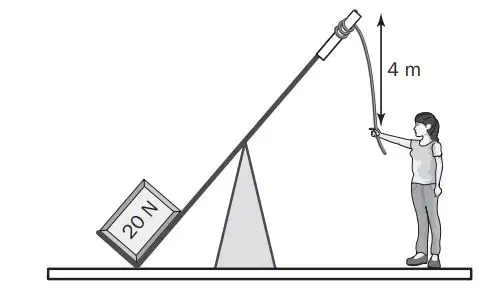
A student pulls a lever down 4 m. The lever lifts a box that weighs 20 N up a distance of 2 m.
How much work was done on the box?
10 J
40 J
80 J
160 J
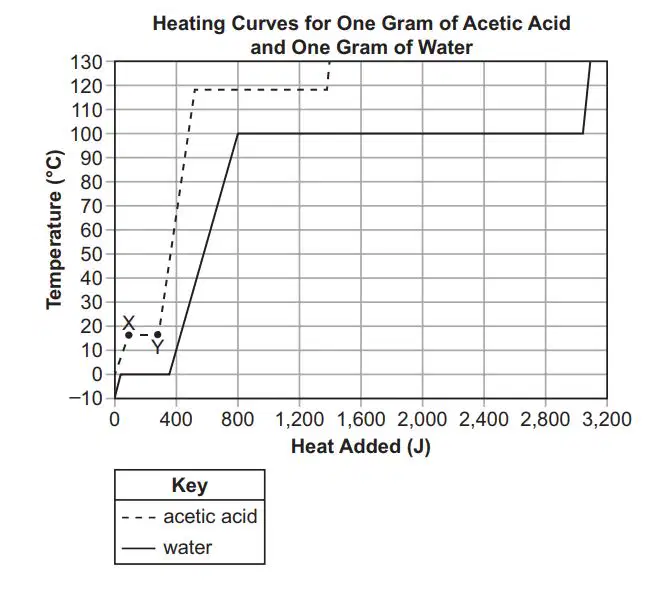
A student collected thermal data for acetic acid (CH3COOH) and water (H2O) and graphed the heating curves for the two substances.
What is happening to the acetic acid between points X and Y on the graph?
Liquid acetic acid is becoming warmer as it absorbs heat energy from the surroundings.
Liquid acetic acid is being converted from a liquid to a gas by absorbing heat energy from the surroundings.
Solid acetic acid is becoming warmer as it absorbs heat energy from the surroundings.
Solid acetic acid is being converted from a solid to a liquid by absorbing heat energy from the surroundings.
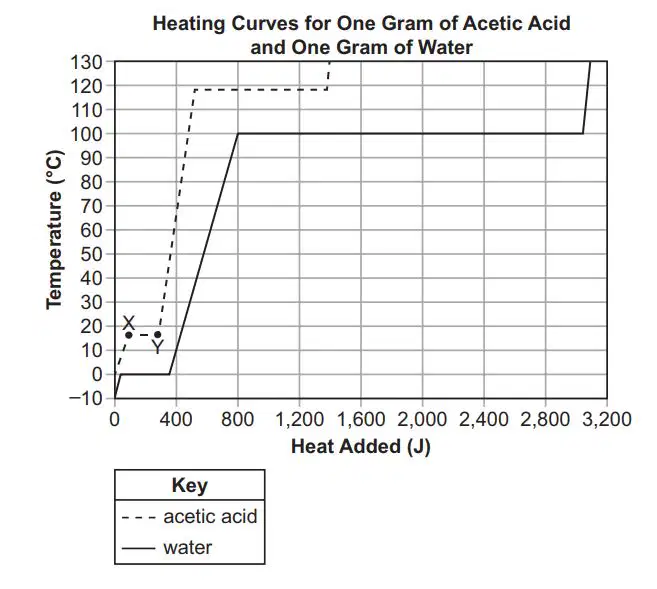
Which comparison can be made about a phase change common to acetic acid and water based on the graph?
More heat energy is required to melt a gram of acetic acid than to melt a gram of water
More heat energy is required to vaporize a gram of water than to vaporize a gram of acetic acid.
Given the same rate of added heat, the temperature of a gram of water will increase at a faster rate than a gram of acetic acid.
Given the same rate of heat loss, the temperature of a gram of acetic acid vapor will decrease at a slower rate than a gram of water.
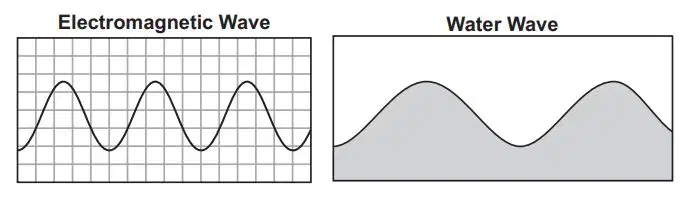
A student drew models of an electromagnetic wave and a water wave.
Which scientific question did the student MOST LIKELY ask to know how to draw these models?
Are water waves and electromagnetic waves examples of transverse waves?
Do water waves travel at a slower speed than electromagnetic waves?
Can water waves and electromagnetic waves travel through different media?
How do water waves and electromagnetic waves increase their amplitude?
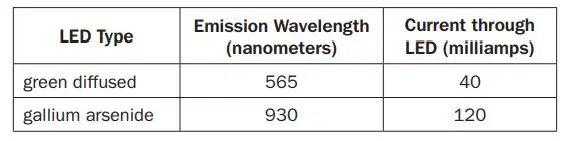
The table compares data for two different light-emitting diodes (LEDs).
Based on the data, what can be identified about the energy of the waves emitted by the LEDs?
The wave energy of the green diffused LED is 1.65 times that of the gallium arsenide LED
The wave energy of the green diffused LED is 0.333 times that of the gallium arsenide LED.
The wave energy of the green diffused LED is 0.608 times that of the gallium arsenide LED.
The wave energy of the green diffused LED is 3.00 times that of the gallium arsenide LED.
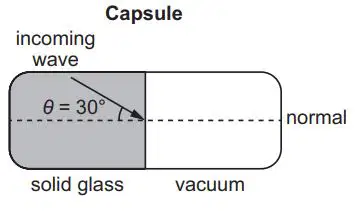
A student is investigating the differences between light waves and sound waves. The student does this by using a capsule filled with solid glass at one end and a vacuum at the other end. The student will transmit waves into the capsule at a 30° angle to the (normal) centerline.
Which TWO questions should the student ask, and which predictions are MOST LIKELY correct based on this investigation?
question: How are electromagnetic waves and mechanical waves affected when traveling from a solid glass medium to a vacuum? prediction: The electromagnetic waves and mechanical waves will continue through the vacuum at a lower speed.
question: How is the speed of electromagnetic waves affected when traveling from a solid glass medium to a vacuum at a 30° angle? prediction: The electromagnetic waves will travel in a straight line, showing that they have maintained a constant speed.
question: How are electromagnetic waves and mechanical waves affected when traveling from a solid glass medium to a vacuum? prediction: The electromagnetic waves will continue through the vacuum, while the mechanical waves will go no farther.
question: Can electromagnetic waves and mechanical waves travel from a solid glass medium into a liquid medium? prediction: Both electromagnetic waves and mechanical waves will bend, showing that they have passed through each medium.
question: How is the speed of electromagnetic waves affected when traveling from a solid glass medium to a vacuum at a 30° angle? prediction: The electromagnetic waves will bend downward, showing that they have sped up slightly.
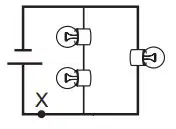
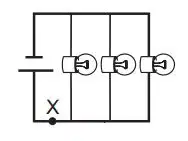
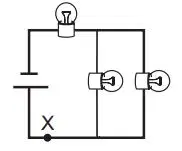
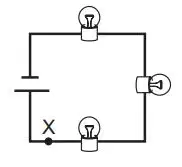
A student is modeling an electric circuit containing three light bulbs and a battery.
Which model shows a circuit where the current flowing through each bulb will be the same as the current at point X?

A student did an investigation to determine the effect of a magnetic field on a moving steel sphere. The student recorded the motion of the steel sphere in trial 1 and then drew the desired motion of the steel sphere for trial 2 as shown in the diagram.
If the steel sphere has the same initial velocity in both trials, which action would BEST help to achieve the motion of the steel sphere shown in trial 2?
putting a resistor between the battery and switch
replacing the nail with one made out of aluminum
reversing the direction of the poles of the iron core
increasing the number of coils of insulated copper wire
A parallel circuit contains a battery with a voltage of 9 volts. The total resistance in the circuit is 18 ohms.
Which claim about the current in the circuit can be supported mathematically from the relationships between voltage, current, and resistance?
claim 1: the current flowing through the circuit is 0.5 amps because current is related to voltage and resistance by the formula I = V/R
claim 2: the current flowing through the circuit is 2 amps because current is related to voltage and resistance by the formula I = R/V
claim 3: the current flowing through the circuit is 27 amps because current is related to voltage and resistance by the formula I = R + V
claim 4: the current flowing through the circuit is 162 amps because current is related to voltage and resistance by the formula I = VR
A scientist is studying the decay of a radioactive isotope with a half-life of 3 years. If the initial mass of the isotope is 200 grams, how much of the isotope will remain after 9 years?
12.5 grams
100 grams
50 grams
25 grams
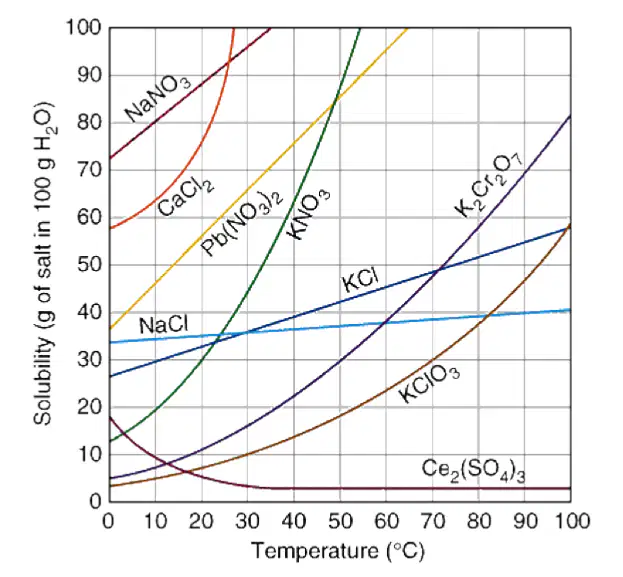
A student observes a solubility curve for sodium chloride (NaCl) and notes that at 80°C, the solubility is about 40 g per 100 g of water. What is the expected solubility at 20°C, and how does temperature affect solubility?
The solubility is approximately 36 g; increased temperatures lead to an increase in solubility.
The solubility is approximately 36 g; increased temperatures lead to a decrease in solubility.
The solubility is approximately 32 g; increased temperatures lead to an increase in solubility.
The solubility is approximately 32 g; increased temperatures lead to a decrease in solubility.
A teacher demonstrates the effect of gravity by dropping a feather and a metal ball in a vacuum chamber. What conclusion can be drawn from this demonstration?
The feather and the metal ball fall at different rates due to their masses.
The metal ball falls faster than the feather because it is denser.
The feather and the metal ball fall at the same rate because there is no air resistance.
The feather falls slower than the metal ball due to its shape.
A lever is used to lift a heavy load with minimal effort. What is the mechanical advantage of the lever if the effort arm is 4 meters and the load arm is 1 meter?
3
4
1
2
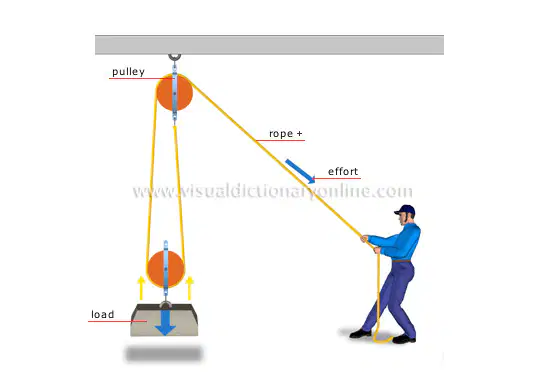
A pulley system is used to lift a 100 N weight. If the mechanical advantage of the system is 5, what is the force required to lift the weight?
20 N
25 N
10 N
5 N
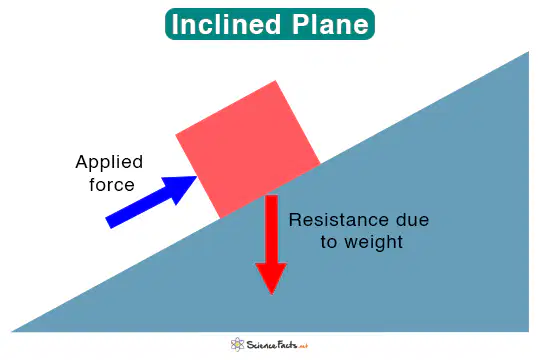
A student uses an inclined plane to move a box to a higher platform. The length of the inclined plane is 10 meters, and the height of the platform is 2 meters. What is the mechanical advantage of the inclined plane?
2
3
4
5
According to Boyle's Law, what happens to the pressure of a gas if the volume is decreased while the temperature remains constant?
The pressure increases.
The pressure decreases.
The pressure remains the same.
The pressure fluctuates randomly.
Charles's Law states that the volume of a gas is directly proportional to its temperature. If the temperature of a gas is doubled, what happens to its volume, assuming pressure is constant?
The volume is halved.
The volume remains the same.
The volume doubles.
The volume quadruples.
A student is conducting an experiment to understand the relationship between pressure and volume of a gas at constant temperature. According to Boyle's Law, what should the student expect if the volume of the gas is doubled?
The pressure will double.
The pressure will fluctuate randomly.
The pressure will be halved.
The pressure will remain the same.
A scientist is observing the phase change of water from liquid to gas. What is the primary energy transformation occurring during this phase change?
Electrical energy is being converted into chemical energy.
Thermal energy is being absorbed to break intermolecular bonds.
Thermal energy is being released as new bonds form.
Mechanical energy is being converted into thermal energy.
A student is analyzing the motion of a pendulum. What type of energy transformation occurs as the pendulum swings from its highest point to its lowest point?
Thermal energy is transformed into kinetic energy.
Potential energy is transformed into kinetic energy.
Chemical energy is transformed into potential energy.
Kinetic energy is transformed into potential energy.
A velocity-time graph shows a straight line with a positive slope. What does this indicate about the object's motion?
The object is moving at a constant speed.
The object is decelerating at a constant rate.
The object is accelerating at a constant rate.
The object is stationary.
An object is moving in a straight line and its motion is represented by a distance-time graph. What does a horizontal line on this graph indicate?
The object is moving at a constant speed.
The object is moving in the opposite direction.
The object is accelerating.
The object is stationary.
What is the specific heat capacity of a substance?
The amount of heat required to raise the temperature of 1 liter of the substance by 1 degree Celsius.
The amount of heat required to raise the temperature of 1 kilogram of the substance by 1 degree Celsius.
The amount of heat required to raise the temperature of 1 mole of the substance by 1 degree Celsius.
The amount of heat required to raise the temperature of 1 gram of the substance by 1 degree Celsius.
A metal block with a mass of 2 kg is heated from 20°C to 50°C, requiring 6000 J of energy. What is the specific heat capacity of the metal?
300 J/kg°C
200 J/kg°C
100 J/kg°C
400 J/kg°C
Which of the following is a characteristic of ionic compounds?
They have low melting points.
They conduct electricity when dissolved in water.
They are usually gases at room temperature.
They are formed by sharing electrons.
What is the primary difference between ionic and covalent bonds?
Ionic bonds are weaker than covalent bonds.
Ionic bonds involve the transfer of electrons, while covalent bonds involve the sharing of electrons.
Ionic bonds occur between nonmetals, while covalent bonds occur between metals.
Ionic bonds form molecules, while covalent bonds form crystals.
Which of the following compounds is an example of a covalent compound?
NaCl
MgO
CaF2
H2O
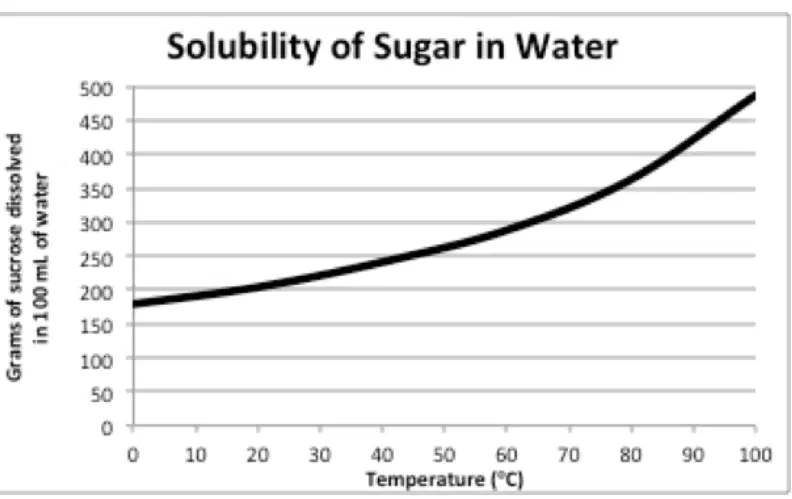
A solubility curve for sugar is shown. What is the expected solubility of sugar at 50°C, and how does temperature generally affect the solubility of sugar in water?
The solubility is approximately 260 g; increased temperatures lead to an increase in solubility.
The solubility is approximately 150 g; increased temperatures lead to an increase in solubility.
The solubility is approximately 150 g; increased temperatures lead to a decrease in solubility.
The solubility is approximately 260 g; increased temperatures lead to a decrease in solubility.
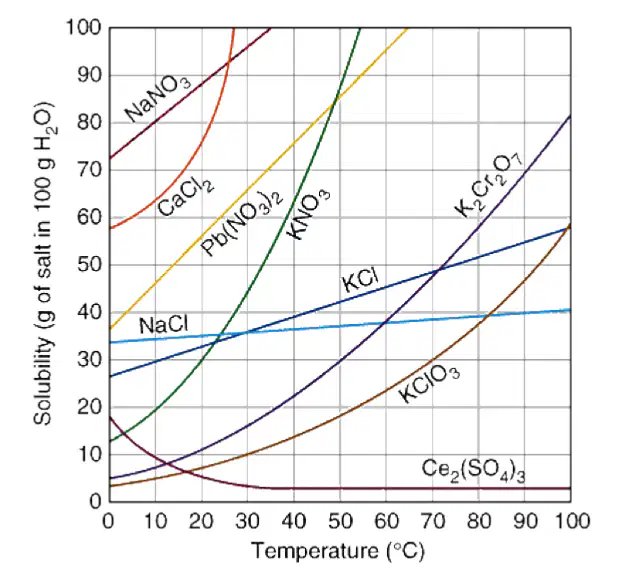
A student observes a solubility curve for potassium chloride (KCl) and notes that at 70°C, the solubility is 48 g per 100 g of water. What is the expected solubility at 30°C, and how does temperature affect solubility?
The solubility is approximately 35 g; increased temperatures lead to an increase in solubility.
The solubility is approximately 35 g; increased temperatures lead to a decrease in solubility.
The solubility is approximately 30 g; increased temperatures lead to an increase in solubility.
The solubility is approximately 40 g; increased temperatures lead to a decrease in solubility.
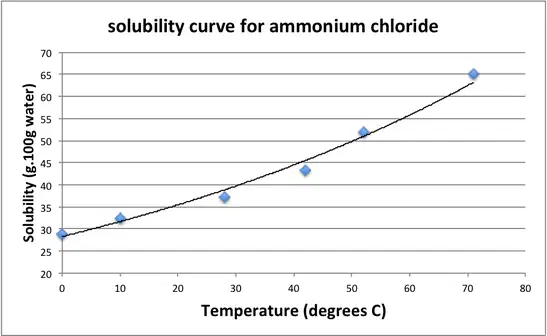
A solubility curve for ammonium chloride (NH4Cl) is shown. According to the graph, what is the maximum approximate mass of NH4Cl that would dissolve at 40°C and what is the relationship between temperature and solubility?
The mass is approximately 44 g; increased temperatures lead to a decrease in solubility.
The mass is approximately 50 g; increased temperatures lead to an increase in solubility.
The mass is approximately 45 g; increased temperatures lead to a decrease in solubility.
The mass is approximately 44 g; increased temperatures lead to an increase in solubility.
Which of the following is a balanced chemical equation?
H2 + 2O2 → H2O2
2H2 + O2 → 2H2O
2H2 + O2 → 2H2O2
H2 + O2 → H2O
What type of chemical equation is represented by the following reaction: CH4 + 2O2 → CO2 + 2H2O?
Synthesis
Decomposition
Single replacement
Combustion
Which of the following chemical equations represents a double displacement reaction?
2KClO3 → 2KCl + 3O2
NaCl + AgNO3 → NaNO3 + AgCl
2H2O → 2H2 + O2
Fe + CuSO4 → FeSO4 + Cu
Which of the following reactions is an example of an exothermic process?
Melting of ice
Combustion of gasoline
Evaporation of water
Photosynthesis in plants
In an endothermic reaction, what happens to the energy absorbed from the surroundings?
It is lost as heat to the surroundings
It is stored in the chemical bonds of the products
It is converted into sound energy
It is released as light
What is the common property of elements found in Group 18 of the periodic table?
They are highly reactive metals.
They are transition metals with variable oxidation states.
They are halogens with high electronegativity.
They are noble gases with full valence electron shells.
Which of the following elements is a metalloid?
Silicon
Oxygen
Iron
Helium
Which of the following best describes the law of conservation of mass?
Mass decreases with the decrease in pressure
Mass increases with the increase in temperature
Mass is conserved and remains constant in a closed system
Mass can be created and destroyed in a chemical reaction
A car travels 150 kilometers in 3 hours. What is the average speed of the car?
70 km/h
60 km/h
50 km/h
30 km/h
An object is moving with a constant velocity of 10 m/s. What is the acceleration of the object?
5 m/s²
0 m/s²
10 m/s²
15 m/s²
A cyclist increases her velocity from 5 m/s to 15 m/s in 5 seconds. What is her acceleration?
1 m/s²
2 m/s²
3 m/s²
4 m/s²
A car accelerates from rest at a constant rate of 3 m/s². What is the force acting on the car if its mass is 1000 kg?
1000 N
500 N
1500 N
3000 N
An object with a mass of 10 kg is subjected to a force of 50 N. What is the acceleration of the object?
2 m/s²
5 m/s²
0.5 m/s²
10 m/s²
A 5 kg object is lifted to a height of 20 meters. What is the weight of the object? (Assume g = 10 m/s2)
50 N
100 N
150 N
200 N
According to Ohm's Law, what is the current flowing through a circuit with a voltage of 12 volts and a resistance of 4 ohms?
6 A
4 A
3 A
2 A
A resistor in a circuit has a resistance of 10 ohms and the current flowing through it is 2 amperes. What is the voltage across the resistor?
20 V
10 V
30 V
5 V
In a series circuit, the total resistance is 15 ohms and the total voltage is 45 volts. What is the total current flowing through the circuit?
2 A
4 A
3 A
1 A
Which of the following substances is considered a strong acid?
NH3
CH3COOH
NaOH
HCl
What is the pH range of a basic solution?
7
0-14
7-14
0-7
Which of the following is a characteristic of a base?
It tastes sour.
It turns red litmus paper blue.
It reacts with metals to produce hydrogen gas.
It has a pH less than 7.
What is the pH level of a neutral solution at 25°C?
0
14
10
7
Which of the following solutions is considered acidic?
A solution with a pH of 6
A solution with a pH of 7
A solution with a pH of 8
A solution with a pH of 14
How does the pH scale measure the acidity or basicity of a solution?
By measuring the concentration of carbon ions
By measuring the concentration of nitrogen ions
By measuring the concentration of oxygen ions
By measuring the concentration of hydrogen ions
A worker uses a force of 50 N to push a box 4 meters across a floor. How much work is done on the box?
100 J
250 J
150 J
200 J
A crane lifts a 500 kg object to a height of 10 meters. What is the work done by the crane? (Assume g = 10 m/s²)
10000 J
9800 J
50000 J
5000 J
A person pulls a sled with a force of 30 N at an angle of 30 degrees to the horizontal for a distance of 5 meters. What is the work done on the sled?
75 J
200 J
130 J
150 J
In the reaction C3H8 + O2 → CO2 + H2O, what is the coefficient of O2 when the equation is balanced?
3
5
6
4
A chemical reaction occurs in a closed system where 10 grams of reactant A reacts with 15 grams of reactant B. According to the law of conservation of mass, what should be the total mass of the products?
10 grams
30 grams
25 grams
15 grams
In a chemical reaction, 40 grams of substance X reacts with 60 grams of substance Y to produce 90 grams of substance Z. What is the mass of the remaining reactants or products?
10 grams
20 grams
30 grams
40 grams

What is the half-life of mercury-203?
50 years
50 days
50%
100 days
During _________________, the atoms of one element break down to form atoms of another element.
radioactive decay
relative dating
absolute age
tooth decay
What is the chemical formula for the ionic compound formed between sodium (Na) and chlorine (Cl)?
Na2Cl2
Na2Cl
NaCl2
NaCl
Which of the following is the correct formula for the ionic compound formed between magnesium (Mg) and oxygen (O)?
MgO2
Mg2O2
MgO
Mg2O
What is the formula for the ionic compound formed between aluminum (Al) and sulfur (S)?
Al3S2
Al2S3
AlS
AlS2
What is the correct name for the covalent compound N2O4?
Dinitrogen oxide
Nitrogen tetroxide
Dinitrogen tetroxide
Nitrogen oxide
Which of the following is the correct name for the covalent compound SF6?
Sulfur hexafluoride
Sulfur fluoride
Fluorine sulfide
Hexasulfur fluoride
What is the correct formula for the covalent compound carbon tetrachloride?
CCl
CCl4
C4Cl
C4Cl4
Which of the following elements is most likely to form a covalent bond based on its Lewis dot structure?
Cl
Mg
Na
Ar
What does a Lewis dot structure represent in terms of electron configuration?
The core electrons of an atom
The atomic number of an element
The valence electrons of an atom
The total number of electrons in an atom
Which of the following is an example of a physical change?
Burning wood
Rusting iron
Melting ice
Cooking an egg
Which property is a chemical property of a substance?
Color
Flammability
Density
Boiling point
What is the main difference between a chemical change and a physical change?
A physical change is always reversible, while a chemical change is not.
A chemical change results in the formation of new substances, while a physical change does not.
A physical change involves energy absorption, while a chemical change involves energy release.
A chemical change involves a change in state, while a physical change does not.
What is the charge of an electron in an atom?
Positive
Variable
Negative
Neutral
Which subatomic particle is found in the nucleus of an atom and has no charge?
Positron
Electron
Neutron
Proton
What is the main difference between isotopes of the same element?
Number of protons
Number of electrons
Atomic number
Number of neutrons
Which type of nuclear decay involves the emission of a helium nucleus?
Gamma decay
Beta decay
Neutron emission
Alpha decay
What is the primary difference between beta decay and gamma decay?
Beta decay changes the atomic number, while gamma decay changes the atomic mass.
Beta decay involves the emission of electrons or positrons, while gamma decay involves the emission of high-energy photons.
Beta decay involves the emission of neutrons, while gamma decay involves the emission of protons.
Beta decay occurs in stable isotopes, while gamma decay occurs in unstable isotopes.
Which of the following statements is true about gamma decay?
Gamma decay results in a change in the atomic number of the nucleus.
Gamma decay involves the emission of a particle with mass.
Gamma decay increases the atomic mass of the nucleus.
Gamma decay often accompanies alpha or beta decay to release excess energy.
Which of the following is the correct nuclear decay equation for the alpha decay of Uranium-238?
U-238 → Th-234 + α
U-238 → U-234 + β
U-238 → Th-234 + β
U-238 → U-234 + α
What is the resulting element when Carbon-14 undergoes beta decay?
Nitrogen-14
Boron-14
Oxygen-14
Carbon-12
Which of the following equations represents the gamma decay of Cobalt-60?
Co-60 → Co-58 + γ
Co-60 → Fe-60 + γ
Co-60 → Co-60 + γ
Co-60 → Ni-60 + γ
Which of the following is an example of conduction?
Heat from the sun warming your face
Heat from a stove warming a metal pot
Warm air rising to the ceiling
Heat from a fire warming your hands
What is the primary mechanism of heat transfer in liquids and gases?
Convection
Radiation
Conduction
Insulation
Which of the following statements about radiation is true?
Radiation is the slowest form of heat transfer.
Radiation requires a medium to transfer heat.
Radiation only occurs in solids.
Radiation can occur in a vacuum.
Which of the following wave behaviors occurs when a wave bends around the edges of an obstacle?
Interference
Diffraction
Reflection
Refraction
What happens to the frequency of a wave as it enters a medium where it travels slower?
The frequency increases.
The frequency decreases.
The frequency remains the same.
The frequency doubles.
When two waves meet and the resulting wave has a larger amplitude than either of the original waves, what is this phenomenon called?
Resonance
Constructive interference
Diffraction
Destructive interference

