
 Worksheets
8th grade Final
Total questions: 100
Worksheet time: 3hrs 17mins
Name
Class
Date
1.
The imaginary line running through the center of Earth.
a)
axis
b)
moon
c)
constellation
d)
orbit
2.
What causes Earth's seasons?
a)
the tilt of Earth's axis
b)
Earth's rotation
c)
the revolution of the Moon
d)
Earth's distance from the Sun
3.
The rotation of Earth on its axis causes the pattern of _____.
a)
night and day
b)
constellations
c)
Earth's seasons
d)
the phases of the moon
4.
It takes Earth _________ to make one complete rotation on its axis.
a)
24 hours
b)
365 days
c)
28 days
d)
24 days
5.
It takes Earth _____________ to make one revolution or orbit around the Sun.
a)
365 days
b)
365 hours
c)
28 days
d)
24 hours
6.
It takes about _____________ for the moon to go through all of its phases.
a)
28 days
b)
365 days
c)
24 hours
d)
24 days
7.
a light year is the distance
a)
light travels in two years
b)
light travels in one year
c)
humans can travel in one year in space
d)
none of the above
8.
the imaginary line going from the North and South Poles through the middle of the Earth
a)
axis
b)
equator
c)
time zone
9.

Which moon phase?
a)
new moon
b)
waning gibbous
c)
waxing gibbous
d)
waning crescent
10.

Which moon phase?
a)
Waxing crescent
b)
waxing gibbous
c)
waning gibbous
11.

Which moon phase?
a)
Waxing gibbous
b)
Waning gibbous
c)
Waning crescent
12.

Which moon phase?
a)
Full moon
b)
waxing crescent
c)
waning crescent
13.

Which moon phase?
a)
new moon
b)
waning gibbous
c)
waning crescent
14.

Which moon phase?
a)
waxing crescent
b)
waning gibbous
c)
waning crescent
15.
A[n] ______________ tide occurs when the sun is at right angles to the line between Earth and the moon.
a)
high
b)
neap
c)
low
d)
spring
16.
A[n] ___________ tide occurs when the sun, Earth, and the moon are nearly in a line.
a)
spring
b)
high
c)
low
d)
neap
17.
The bulge of water on the side of the Earth closest to the moon produces ___________.
a)
high tide
b)
low tide
c)
neap tide
d)
spring tide
18.

Which season is taking place in the Northern Hemisphere in Position 3?
a)
Winter
b)
Spring
c)
Summer
d)
Fall
19.

Which season is taking place in the Northern Hemisphere in Position 4?
a)
Winter
b)
Spring
c)
Summer
d)
Fall
20.

What happens when the area in which you live tilts away from the sun?
a)
It is summer.
b)
It is spring.
c)
It is winter.
d)
It is fall.
21.
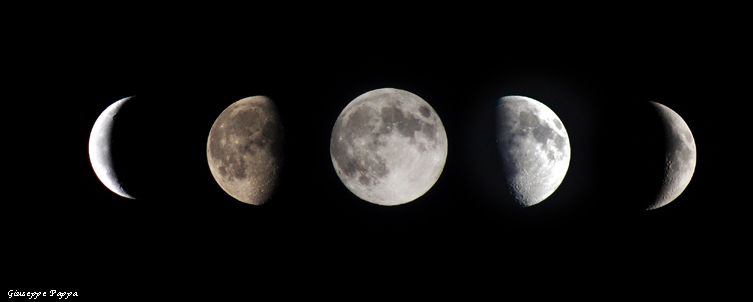
A solar eclipse only occurs during which moon phase?
a)
1st Quarter
b)
New Moon
c)
Full Moon
d)
3rd Quarter
22.
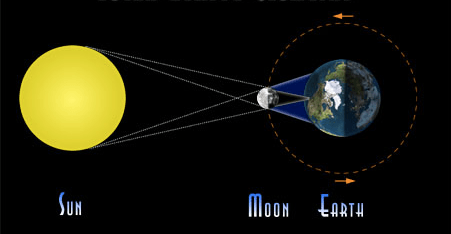
Which type of eclipse is shown in this picture?
a)
Solar Eclipse
b)
Orbit
c)
Lunar Eclipse
d)
Total Eclipse
23.
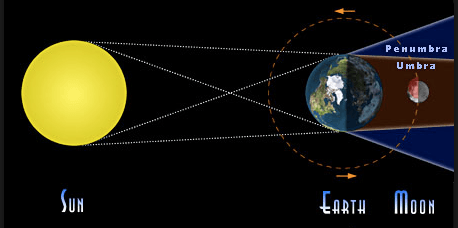
Which type of eclipse is shown in the diagram?
a)
Solar Eclipse
b)
Lunar Eclipse
c)
Total Eclipse
d)
Partial Eclipse
24.

____________ is anything that has mass and takes up space.
a)
matter
b)
compound
c)
particle
d)
subatomic
25.

All mater is composed of __________.
a)
compounds
b)
atoms
c)
water
d)
H2O
26.

_____________ are the smallest unit of matter that retains the identity of the substance.
a)
compounds
b)
atoms
c)
water
d)
H2O
27.

A proton has a ___________ charge.
a)
positive
b)
negative
c)
neutral
28.

What so the blue circles represent?
a)
protons
b)
neutrons
c)
electrons
d)
nucleus
29.

What do the red circles represent?
a)
protons
b)
neutrons
c)
electrons
d)
nucleus
30.

What do the black circles represent?
a)
protons
b)
neutrons
c)
electrons
d)
nucleus
31.
Why does the Earth orbit the Sun and not a planet in the solar system?
a)
The Sun is more massive than the planets so it's mass causes the gravitational pull.
b)
It just happened that way.
c)
The Earth pulls the Sun toward it because it is so massive.
d)
The Earth is closer than the other planets so the distance causes the gravitational pull.
32.
If you look up at 12:00 pm on the summer solstice where would you see the sun?
a)
It would be setting.
b)
You wouldn't see it because it's night.
c)
On the horizon
d)
Directly overhead
33.
Suppose a pitcher threw a ball that traveled 60 m in 2 seconds. How fast did he pitch the ball?
a)
120 m/s
b)
30 m/s
c)
60 m/s
d)
None of the above are correct.
34.

a)
The cart was stationary with a velocity of 0 m/s for the entire 7 seconds.
b)
The cart was stationary except for a short burst of acceleration of 0.5 m/s^2 .
c)
The cart moved at a constant velocity of 0.5 m/s for the entire 7 seconds.
d)
The cart accelerated at a constant rate of approximately 0.8 m/s^2 .
35.

a)
0.2 m/s
b)
0.5 m/s
c)
5.0 m/s
d)
10.0 m/s
36.

a)
The toy train speeds up while going forward and then slows down.
b)
The toy train slows down while going forward and then moves backward.
c)
The toy train moves forward at a constant speed, slows down, and then stops.
d)
The toy train moves forward at an increasing speed, stops, and then moves forward.
37.
A teacher rubbed a match against a piece of sandpaper. The match started to burn. Which statement best describes the energy changes that occurred?
a)
The chemical energy stored in the match changed to thermal energy and light energy.
b)
The thermal energy stored in the match changed to light energy and chemical energy.
c)
The light energy and thermal energy stored in the match changed to mechanical energy.
d)
The light energy and thermal energy stored in the match changed to chemical energy.
38.

Which image represents winter for you?
a)
Position 1, because North America receives the most direct sun
b)
Position 2, because North America is tilted toward the sun
c)
Position 3, because North America is parallel to the sun
d)
Position 4, because North America is tilted away from the sun
39.
(8.5D) The chemical formula for sodium sulfate is Na2SO4. How many sulfur atoms are in the formula for sodium sulfate?
a)
1
b)
2
c)
6
d)
7
40.
(8.5E) The scientist spilled a few drops of dilute hydrochloric acid (HCl) on a lab table. For safety purposes, the scientist sprinkled some baking soda (NaCO3) onto the spill. Which observation would provide the best evidence that a chemical reaction occurred?
a)
The baking soda and hydrochloric acid combined, and bubbles formed.
b)
The baking soda absorbed the hydrochloric acid.
c)
Some of the baking soda dissolved in the hydrochloric acid.
d)
The hydrochloric acid evaporated, leaving only the baking soda.
41.
CaCO3 ---> CaO + CO2
In the chemical reaction shown above, the products are best classified as-- (6.5C)
In the chemical reaction shown above, the products are best classified as-- (6.5C)
a)
two elements
b)
one element and one compound
c)
two compounds
d)
two compounds and one element
42.
(8.5B) A chemist is identifying the elements present in a sample of seawater. What characteristic of an element's atoms always determines the element's identity?
a)
The number of protons
b)
The number of neutrons
c)
The location of valence electrons
d)
The number of valence electrons
43.
(6.5C) The chemical equation shown below represents a reaction that produces fuel for certain cars.
CO + H2O ---> CO2 + H2
Which of these represents an element?
CO + H2O ---> CO2 + H2
Which of these represents an element?
a)
CO
b)
H2O
c)
CO2
d)
H2
44.
Jack has a rock. The rock has a mass of 14g and a volume of 2cm3. What is the density of the rock?
a)
7 mL
b)
7 g/cm3
c)
28 g/cm3
d)
1/7 g/cm3
45.
True or False: The density of a specific type of material never changes.
a)
True
b)
False
46.
Frank has an eraser. It has a mass of 4g, and a volume of 2cm3. What is its density?
a)
8 g/cm3
b)
2 g/cm3
c)
1/2 g/cm3
d)
24 g/cm3
47.
A can of Coke will sink in a bowl of water. A can of Diet Coke will float in a bowl of water. What does this tell you about the density of the Diet Coke?
a)
it is bigger than 1
b)
it is smaller than 1
c)
it is equal to 1
d)
it is equal to -1
48.
Why do ice cubes float in a glass of water?
a)
the ice cubes are more dense than the water
b)
the water is more dense than the ice cubes
c)
the water is more dense than the glass
d)
the ice is more dense than the glass
49.
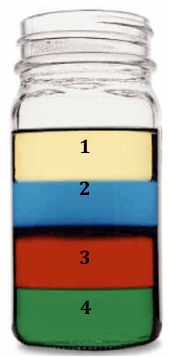
Put the liquids in order from most dense to least dense?
a)
4, 3, 2, 1
b)
1, 2, 3, 4
c)
3, 4, 2, 1,
d)
4, 3, 1, 2
50.

Which box has a higher density?
a)
Box A
b)
Box B
c)
cannot be determined
d)
they are the same
51.
If you cut a wooden block in half, each half would have
a)
Half the density of the original piece
b)
Twice the density of the original piece
c)
The same density as the original piece
d)
No density at all
52.
Volume is ...
a)
Mass/Volume
b)
The amount of matter in an object.
c)
The amount of space an object occupies.
d)
Anything that has mass and occupies space.
53.
The amount of matter an object has.
a)
Weight
b)
Mass
c)
Volume
d)
Density
54.
Water changes its state of matter when heat is added or taken away. When water reaches its boiling point the particles-
a)
are closer together
b)
stay the same
c)
are moving more rapidly
d)
are moving more slowly
55.

A gas
a)
has a definite shape but no definite volume
b)
has a definite volume but no definite shape
c)
has fast-moving particles
56.
Change over time...
a)
Evolution
b)
Variation
c)
Adaptation
d)
Natural Selection
57.
A helpful trait that makes survival easier is called...
a)
an adaptation
b)
evolution
c)
mutation
d)
natural selection
58.
The process by which individuals that are better adapted to their environment are more likely to survive and reproduce than other members of the same species.
a)
natural selection
b)
evolution
c)
adaptation
d)
species
59.
How is natural selection in the evolution of long necks in giraffes best explained?
a)
Shorter-necked giraffes were killed by long-necked giraffes.
b)
Giraffe necks grew longer because of the bone structure of the animals
c)
Giraffes with longer necks survived because they were better suited to the environment.
d)
Long-necked giraffes mated only with other long-necked giraffes.
60.
True or false: you have evolved since you were in 6th grade.
a)
True. I am much smarter and taller.
b)
True
c)
False: only entire species (not individuals) can evolve
d)
False
61.
Why are advantageous traits more likely to be passed onto offspring?
a)
Because they are more likely to survive and reproduce.
b)
Because they come from dominant alleles.
c)
Because they come from recessive alleles.
d)
Because the trait is an acquired phenotype.
62.
Mutations are a change in what?
a)
DNA
b)
tRNA
c)
genotype
d)
phenotype
63.
the passing of genetic traits from parent to offspring.
a)
heredity
b)
trait
c)
gene
d)
allele
64.
AA and Aa always show up as
a)
dominant
b)
recessive
65.
Aa, DD, bB, yy are all examples of
a)
genotypes
b)
phenotypes
66.
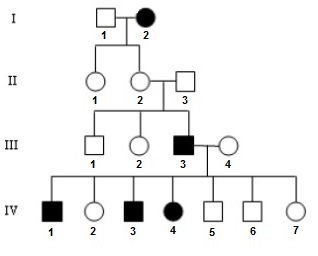
This pedigree represents the inheritance of hemophilia in this family. How many of the females have the hemophilia trait?
a)
8
b)
5
c)
2
d)
3
67.

Huntington's Disease is a dominant trait.
What is the correct genotype for individual I-2?
What is the correct genotype for individual I-2?
a)
HH
b)
Hh
c)
hh
d)
H_
68.

How many individuals are there in the 3rd generation?
a)
2
b)
3
c)
4
d)
6
69.

In the second generation-how many people have the disease or display the physical trait?
a)
2
b)
4
c)
5
d)
6
70.

If this pedigree shows an autosomal recessive disorder, what MUST the genotype of individual II-3 be?
a)
HH
b)
Hh
c)
hh
d)
None of the above
71.

How many generations are shown in this pedigree?
a)
1
b)
2
c)
3
d)
4
72.

How many girls did the mother and father from the first generation have?
a)
2
b)
4
c)
5
d)
6
73.

In the second generation-how many people are carriers of the trait?
a)
2
b)
3
c)
5
d)
6
74.
How many alleles (letters) do each person carry for a trait?
a)
1
b)
2
c)
3
d)
4
75.
Aa is
a)
homozygous
b)
heterozygous
76.

Give the genotype for person III-3
a)
GG
b)
Gg
c)
gg
77.

T - tall and t = short
In the punnett square below, what belongs in the missing square
In the punnett square below, what belongs in the missing square
a)
tt
b)
Tt
c)
Bb
d)
TT
78.

B = brown fur b = white fur
In the punnett square, what is the probability for white fur?
In the punnett square, what is the probability for white fur?
a)
0%
b)
25%
c)
50%
d)
75%
79.

In a certain species of plant, the color purple (P) is dominant to the color white (p).
According to the Punnett Square, what is the probability of an offspring being white?
According to the Punnett Square, what is the probability of an offspring being white?
a)
25%
b)
0%
c)
100%
d)
50%
80.

This graph shows
a)
An object stopped
b)
An object slowing down
c)
An object speeding up
d)
An object moving at constant speed
81.

This graph shows
a)
An object stopped
b)
An object speeding up
c)
An object slowing down
d)
An object moving at constant speed
82.

This graph shows
a)
An object stopped
b)
An object moving at constant speed
c)
An object slowing down
d)
An object speeding up
83.

This graph shows
a)
An object speeding up
b)
An object slowing down
c)
An object stopped
d)
An object moving at constant velocity
84.

This graph shows
a)
An object stopped
b)
An object slowing down
c)
An object speeding up
d)
An object moving at constant speed
85.

This graph shows
a)
An object speeding up
b)
An object slowing down
c)
An object stopped
d)
An object moving at constant speed
86.
Speed is different from velocity because
a)
Velocity has a direction
b)
Speed uses Distance /Time
c)
Velocity doesn't include time
d)
Velocity doesn't include distance
87.

This graph shows
a)
An object speeding up
b)
An object stopped
c)
An object speeding up
d)
An object slowing down
88.

This graph shows
a)
An object stopped
b)
An object speeding up
c)
An object slowing down
d)
An object moving at constant speed
89.
An object's change in position over time when compared with a reference point is known as ________
a)
force
b)
motion
c)
friction
d)
acceleration
90.
The rate at which an object moves (distance/time) is known as ______
a)
force
b)
velocity
c)
net force
d)
speed
91.
The speed of an object WITH a direction
a)
motion
b)
force
c)
velocity
d)
acceleration
92.
The rate at which velocity changes is known as __________
a)
acceleration
b)
net force
c)
speed
d)
velocity
93.

When calculating the speed for the object in this graph, the units will be
a)
m/s
b)
km/h
c)
mph
d)
m/h
94.

The slope of this graph will represent the
a)
time
b)
distance
c)
speed
95.

The average speed between 4 and 16 seconds is?
a)
5.2 km/s
b)
.192 m/s
c)
.181 km/s
d)
5.5 km/s
96.

D-Lo watches a red buggy car, which is his favorite activity. He watches the car cover 2 meters every second. Which graph would represent this?
a)
A (upper left)
b)
B (bottom left)
c)
C (upper right)
d)
D (bottom right)
97.
Which is an example of zero acceleration?
a)
A merri-go-round moving at a constant rate
b)
A car coming to a stop
c)
A boat speeding up
d)
A person running on a treadmill at a rate of 6 MPH
98.

Which graph shows an object slowing down?
a)
A
b)
B
c)
C
d)
E
99.
Morgan walks 10 miles South. Trevor walks 10 miles North in the same amount of time. They have:
a)
Different average speeds
b)
Different velocities
c)
Same velocity
d)
Same motion
100.
A trip to Cape Canaveral, Florida takes 10 hours. The distance is 816 km. Calculate the average speed.
a)
8 km/hr
b)
81.6 km/hr
c)
.012 km/hr
d)
61.8 km/hr
100 %

