
 Worksheets
Chemistry: 1st Semester Test
Total questions: 100
Worksheet time: 30hrs 13mins
A _____ property of water is that it is unreactive with oil.
Physical
Chemical
Mixture
Bonding
_____ is an example of a physical change.
Freezing
Rusting
Burning
Digesting
Substances have a definite volume and an indefinite shape in the _____ state.
Gas
Solid
Liquid
Molten
Anything that has mass or volume is called _____.
Temperature
Matter
Energy
Work
Phase changes are classified as _____ changes.
Physical
Chemical
Homogenous
Compound
In the gas state, a substance will have a(n) _____ volume.
Indefinite
Definite
Fixed
Equal
In a compound the elements are _____ together, whereas in a mixture the substances are blended together.
Meshed
Mixed
Wired
Bonded
A taco is an example of a _____.
Element
Heterogeneous Mixture
Compound
Homogeneous Mixture
copper (II) chloride (CuCl₂) is a _____
Element
Heterogeneous Mixture
Compound
Homogeneous Mixture
water (H₂O) is a _____
Element
Heterogeneous Mixture
Compound
Homogeneous Mixture
Trix® cereal is a _____
Element
Heterogeneous Mixture
Compound
Homogeneous Mixture
potassium (K) is a _____
Element
Heterogeneous Mixture
Compound
Homogeneous Mixture
Dissolving salt is a _____ change.
Physical Change
Chemical Change
Boiling water is a _____
Physical Change
Chemical Change
Digesting Taco Bell® is a _____
Physical Change
Chemical Change
The name of the type of ion when electrons are lost (ion is positive) is _____.
Lation
Anion
Onion
Cation
The atomic mass is measured in _____.
Kilograms
Atomic mass units
Electrons are found in the _____ around the nucleus.
Cations are formed by electrons being _____.
Gained
Lost
Like or same charges _____ each other.
An atom is said to be _____ when the number of protons equals the number of electrons.
_____ saw that particles in a gas were attracted to the positive plate of the cathode ray.
Einstein
Thomson
Atomic mass is an average of the elements _____.
Molecules
Isotopes
The group of elements that tend to gain electrons is _____.
Metals
Nonmetals
_____ said that atoms of the same element are the same but atoms of different elements are different.
Isotopes have the same number of protons but have different number of _____.
Protons
Neutrons
_____ said that an atom is mostly empty space.
Thomson
Rutherford
The first scientist who thought about atoms was _____.
Einstein
Democritus
The nucleus of an atom is _____
Negatively charged and has a low density.
Negatively charged and has a high density.
Positively charged and has a low density.
Positively charged and has a high density.
Which of the following statements below is FALSE?
Electrons have a negative charge
Electrons have a mass of 1 amu
The nucleus of an atom is positively charged
The neutron is found in the nucleus of an atom
An atom of an element with atomic number 48 and mass number 120 contains _____
48 protons, 48 electrons, and 72 neutrons
72 protons, 48 electrons, and 48 neutrons
120 protons, 48 electrons, and 72 neutrons
72 protons, 72 electrons, and 48 neutrons
The number 13 in the name carbon-13 represents _____
The atomic number
The mass number
The sum of protons and electrons
None of these
_____ is not true.
Atoms of the same element can have different numbers of neutrons and be called isotopes
The nucleus of an atom has a positive charge
Atoms of isotopes of an element have different numbers of protons
Atoms are mostly empty space
Atoms that have the same number of electrons are _____ with each other.
Electrons closest to the nucleus of an atom are _____ in energy.
The 2nd energy level contains these sublevels: _____.
The s sublevel resembles this type of motion (shape): _____.
Spiral
Sphere
Elements lose or gain electrons to become like this group of elements: _____.
Transition Metals
Noble gases
Electrons located in the outermost energy level of an atom are called:
Outermost electrons
Valence electrons
Aufbau electrons
Principle energy levels
Variance electrons
Calcium loses two electrons. What element is it isoelectronic with?
Ar
Ne
Kr
Ti
Xe
A f sublevel can hold a maximum of _____ electrons, with only _____ electrons in each orbital.
The n=_____ shell is the lowest in energy that may contain p-orbitals.
How many electrons can be found in the first energy level?
6
3
0
1
2
Which of the following energy levels can only have an s and p orbital?
3
4
1
6
2
The elements in group 17 are called ___.
Alkali Metals
Alkaline Earth Metals
Noble Gases
Tendency for an atom to attract electrons when chemically bonded to another atom
Ionization Energy
Electronegativity
Electron Energy
Atomic Radii
A term for metalloids that conduct electricity at high temperatures
Insulators
Conductors
Semiconductors
Semi-insulators
Name for group 3-12 elements
Rare Earth Metals
Alkaline Earth Metals
Alkali Metals
The present day Periodic Table is arranged in order of increasing ___.
Atomic Reactivity
Atomic Mass
Atomic Radii
Atomic Number
The property of metals to be made into wire is called ___.
Malleable
Conductivity
Reactivity
Name for group 2 elements
Alkali Metals
Transition Metals
Rare Earth Metals
A property of nonmetals is that they are ___.
Lustrous (shiny)
Hard
Conductive
The anion form of an atom is always ________ than its neutral form.
Smaller
Larger
The same
Crazier
Unable to tell
The cation form of an atom is always ________ than its neutral form.
Energy
Larger
The same
Identical
Smaller
The ____ of an atom is found by measuring the distance between the nuclei of two like atoms and halving that distance.
Electronegativity
Atomic size
Ionic Size
Ionization Energy
None of these
A triple covalent bond shares ________ electrons between atoms.
five
four
three
six
two
Which of the following sets of atoms can be joined by a covalent bond? Please circle the most correct answer. Write your answer on the given lines.
S and F
Mg and Na
Li and Cl
Be and F
Na and Cl
Why do atoms form ionic and covalent bonds?
to attain a noble-gas electron configuration
to become ions and attract each other
to become more polar
to increase their atomic numbers
None of these
Which of the following elements does not want to have eight valence electrons?
magnesium
oxygen
fluorine
hydrogen
nitrogen
An ionic compound is _______.
composed of anions and cations
held together by ionic bonds
Composed of metals and non-metals
all of the above
Ionic compounds are normally in which physical state at room temperature?
gas
solid
liquid
plasma
all of the above
Which is NOT a characteristic of most ionic compounds?
they have low melting points
they are composed of metallic and non-metallic elements
they are likely to conduct an electric current
they are solids
none of the above
Why do atoms share electrons in covalent bonds?
to become ions and attract each other
to increase their atomic numbers
to attain a noble-gas electron configuration
to become more polar

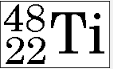

What does the atomic number identify?
The number of neutrons of a given atom.
The number of protons of a given atom.
The number of neutrons and protons of a given atom.
The number of electrons of a given atom.

How many neutrons are in the isotope Carbon-14
6
8
14
12
1s22s22p63s23p64s23d10

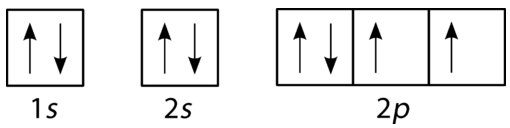


What element has this electron configuration?
boron
carbon
nitrogen
oxygen

How many neutrons does this Neon atom have?
21
11
10
12

What is the mass number of this Neon atom?
10
11
21
20

What type of atom is this?
Neutral atom
Cation
Anion
Isotope


This is a correct dot diagram for neon (Ne)
true
false

According to the diagram below, how many bonds will this atom be able to make?
What type of bond is formed by the transfer of electrons from one atom to another?
Covalent bond
Metallic bond
Ionic bond
Hydrogen bond
Which particle is responsible for bonding?
Electrons
Protons
Nucleus
Neutrons

Examine the image: How many bonds are formed looking at the model of the compound? And also indetify what type of bond is formed.
2 bonds; covalent
4 bonds; metallic
2 bonds; ionic
4 bonds; covalent
Ionic bonding is between a
nonmetal and nonmetal
metal and nonmetal
metal and metal
Depends on the situation
Covalent bonding is between a
nonmetal and nonmetal
metal and nonmetal
metal and metal
It depends on the situation

