
 Worksheets
AP Human Geo Unit 4: Political Patterns & Processes
Total questions: 54
Worksheet time: 28mins
A state is a synonym for a
territory
country
unit
member
The attempt by one country to force its political control over another territory is
constitutionality.
colonialism
self-determination
sovereignty.
Apartheid
The Kurdish people are examples of which of the following?
A people with a sovereign state
A semi-autonomous region
A stateless nation
A nation-state
What four states does Kurdistan exist within?
Syria, Lebanon, Jordan, and Armenia
Turkey, Armenia, Iran, and Georgia
Syria, Turkey, Iran, and Iraq
Iran, Iraq, Saudi Arabia, and Israel
Which decade would have likely seen several new, independent African states created?
1770s
1910s
1960s
2000s
During which war did the US & Soviet Union work to develop alliances to expand power?
World War I
The war on Terror
The Cold War
The Gulf War
During which decade did centrifugal forces tear the Soviet Union apart?
1910s
1930s
1990s
2000s
Advocates of the Domino Theory believed that once one state fell to _____, others would.
Communism
Territoriality
Capitalism
Organic Theory

Costa Rica is a peaceful, democratic republic where power is only given by the central government. Laws and taxes of the central government have full control over the regional division.
Parliamentary
Confederal
Unitary
Autocracy
Since its 1917 constitution, Mexico has had a central government based in its capital, Mexico City, and thirty-one states that also have their own state governments and share power with the central government. Which system of government is being represented?
Unitary
Confederal
Federal
Parliamentary
How did the Industrial Revolution spur (increase) Europeans' desire to colonize Africa?
They needed more land.
They wanted to control everything.
They needed more raw materials.
What was the purpose of the Berlin Conference?
To establish rules for claiming land without conflict.
To provide Germany with land in Africa.
To give Great Britain and France land in Africa.

Which choke point is an important passage for oil in the Persian Gulf and Indian Ocean?
Strait of Hormuz
Strait of Malacca
Strait of Malacca
Strait of Magellen

Which choke point is a man-made passage between the Pacific and Atlantic coasts of North & South Americas.
Strait of Magellan
Panama Canal
Suez Canal
Strait of Malacca
This refers to the area of land or water that is the jurisdiction of the state.
Exclusive Economic Zone (EEZ)
Sovereignty
Territory
United Nations Convention for the Law of the Sea (UNCLOS)
This is an area where a country has sovereign rights to explore, exploit, conserve, and manage natural resources.
Exclusive Environmental Zone
UNCLOS
High Seas
Exclusive Economic Zone
How many nautical miles does a country have in terms of its Exclusive Economic Zone (EEZ)?
200-nautical miles
250-nautical miles
140-nautical miles
100-nautical miles
An area that is part of a state but has been given a measure of local control such as an Indian reservation in the U.S.
multinational state
multi-state nation
decolonization
semi-autonomous region
An area that is part of a state but has been given local control
nation
state
political entity
autonomous region
The collapse of colonial empires. Between 1947 and 1962, practically all former colonies in Asia and Africa gained independence.
dependent states
semi-autonomous regions
decolonization
stateless nations
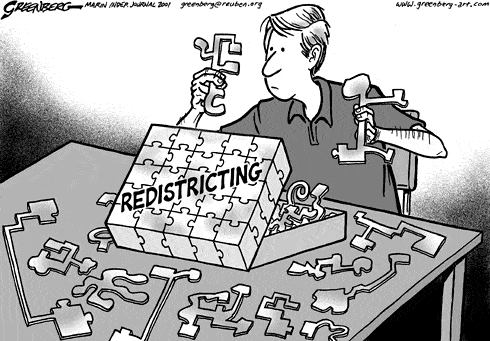
What is redistricting?
the process of establishing the number of representatives in the U.S. Senate
the process of re-drawing United States and state electoral district boundaries
the idea that all states should have an equal number of people in Congress
the use of the Census to determine who should run for office
How often does the census occur?
Every 4 years
Every 8 years
Every 10 years
Every 25 years
What is gerrymandering?
a federally governed process designed to ensure equal representation.
a system of checks and balances used to ensure fairness in the House of Representatives.
a legal process that helps parties keep power.
the use of redistricting to unfairly disenfranchise specific groups of people.
Redistricting is important because:
it can benefit the party in power and help it stay in power.
the seats in House of Representatives can only be determined when new districts are developed.
district boundaries should be changed periodically to reflect changes in population.
It is the only way to accurately measurement the US population.
Reapportionment is:
When district boundaries are drawn in order to benefit the party in power and help it stay in power
When seats in the House of Representatives are redistributed among states because of changes in population
When district boundaries are redrawn to reflect changes in population.
A measurement of the US population that occurs every ten years
Gerrymandering affects:
The House of Representatives
The Senate
The Presidency
Congress as a whole

