wayground logo

Free Printable Worksheets

NEW

Font size

S
M
L
XL
Worksheets

Properties of Matter / Volume & Density

Total questions: 45

Worksheet time: 45mins

Name
Class
Date
1.

The amount of space an object takes up.

a)

Volume

b)

Density

c)

Mixture

d)

Mass

2.

How tightly packed matter is in an object.

a)

Volume

b)

Density

c)

Mass

d)

Mixture

3.

When two or more substances are put together.

a)

Volume

b)

Density

c)

Mixture

d)

Mass

4.

Sometimes when mixing two substances something new will be created because of a ____________________.

a)

Volume

b)

Chemical Reaction

c)

Physical Reaction

d)

Mass

5.

If you traveled from Earth to the moon, your mass would NOT change.

a)

True

b)

False

6.

The measurement of how much matter is in an object.

a)

Weight

b)

Density

c)

Mass

d)

Volume

7.

The unit of measurement used for mass in physics.

a)

Newton

b)

Kilograms

8.

The unit of measurement used for weight in physics.

a)

Newton

b)

Kilograms

9.

_____________ stays the same no matter where you are.

a)

Mixture

b)

Mass

c)

Weight

d)

Volume

10.
What is the volume of the rock? The water level is displaced from 20 mL to 23 mL with the rock.
a)
3 mL
b)
23 mL
c)
20 mL
d)
43 mL
11.
What would be the best way to measure the volume of a small rock?
a)
L x W x H with a ruler
b)
Put on triple beam balance
c)
Mass ÷ Volume
d)
Displacement method using graduated cylinder
12.
Which statement is true?
a)
Oil is the most dense substance.
b)
Corn syrup is less dense than water.
c)
Oil is less dense than water.
d)
Oil and corn syrup have the same density but different masses.
13.
How is density calculated? 
a)
volume divided by mass
b)
mass divided by volume
c)
putting the object on a scale
d)
melting the object
14.
True or false?   The density of an object determines whether it will float or sink in another substance. 
a)
true
b)
false
15.

___ is anything that takes up space and has mass.

a)

Density

b)

Weight

c)

Volume

d)

Matter

16.
Any measurable or observable attribute that describes matter
a)
Physical Property
b)
Chemical Property
17.
A physical property that describes how tightly packed molecules are in a substance
a)
Density
b)
Conductivity
c)
Solubility
d)
Magnetistm
18.
Density is measured in ___________
a)
g
b)
g/mL
c)
mL
d)
N
19.
Physical property that describes the ability of a substance to dissolve in another substance, usually water.
a)
Density
b)
Magnetism
c)
Solubility
d)
Melting Point
20.
The temperature in which a solid substance is completely melted to a liquid state.
a)
Solubility
b)
Melting Point
c)
Boiling Point
d)
Conductivity
21.
The temperature at which a substance begins to boil after it is heated.
a)
Density
b)
Magnetism
c)
Boiling Point
d)
Melting Point
22.
If you take a 100-milliliter (mL) graduated cylinder and fill it to the 50-mL mark. After you place the marble in the graduated cylinder, the water level reads 56 mL. What is the volume of the marble?
a)
6 mL
b)
50 mL
c)
56 mL
d)
100 mL
23.
A rock has a mass of 14g and a volume of 2cm3. What is the density of the rock?
a)
7 mL
b)
7 g/cm3
c)
28 g/cm3
d)
1/7 g/cm3
24.
What is the density of a liquid that has a mass of 27g and a volume of 30mL?
a)
0.9 g/mL
b)
3 g/mL
c)
57 g/mL
d)
810 g/mL
25.
Which lab tool might you use to measure the volume of a liquid?
a)
electric scale
b)
bunsen burner
c)
test tube
d)
graduated cylinder
26.
What is the formula for density?
a)
density = mass x volume
b)
density = mass / volume
c)
density = mass + volume
d)
density = mass - volume
27.
An eraser has a mass of 4g and a volume of 2cm3. What is its density?
a)
8 g/cm3
b)
2 g/cm3
c)
1/2 g/cm3
d)
24 g/cm3
28.
Calculate the density of the cube. (Hint: calculate the volume of the cube using V= Bh)
a)
0.33 g/cm3
b)
0.4 g/cm3
c)
0.6 g/cm3
d)
0.5 g/cm3
29.
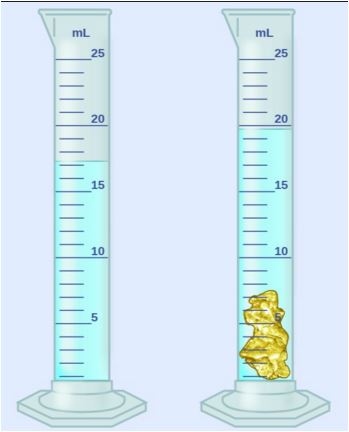
An irregularly shaped piece of gold was lowered into a graduated cylinder holding a volume of water equal to 17 ml. The height of the water rose to 20 ml. If the mass of the gold was 27 g, what was its density?
a)
9 g/mL
b)
10.5 g/mL
c)
6.5 g/mL
d)
8 g/mL
30.
How much water has been displaced in the image shown?
a)
40 mL
b)
65 mL
c)
20 mL
d)
25 mL
31.

Find the volume if a substance has a density of 19.3g/cm3 and a mass of 10g.

a)

.52cm3

b)

193cm3

c)

1.93cm3

d)

29.3cm3

32.
Find the density of a 2 cm x 2 cm x 2 cm cube with a mass of 64 g.
a)
6 cm3
b)
12 g/cm3
c)
128 g/cm3
d)
8  g/cm3
33.
What is the density of water?
a)
0 g/ml
b)
1 g/ml
c)
10 g/ml
d)
100 g/ml
34.

What 2 measurements are used for DENSITY

a)

Mass and Weight

b)

Mass and Acceleration

c)

Mass and Volume

d)

Length and Width

35.
Which of the following is not a chemical property? 
a)
rusting 
b)
boiling 
c)
rotting 
d)
burning 
36.
Which one of these is a chemical property?
a)
melting point
b)
boiling point
c)
color
d)
flammability
37.
Ability to rust is this type of property:
a)
Physical property
b)
Chemical property
38.
Which is an example of a physical property?
a)
ability to react with acid
b)
 state of matter
c)
flammability
d)
ability to react with oxygen
39.
Which of the following is a chemical change?
a)
human digestion
b)
cutting a tree down
c)
melting a chocolate bar
d)
Has a density of 1 gm/mL
40.
What kind of properties can only be observed when a substance changes into a different substance?
a)
physical properties
b)
chemical properties
c)
liquid properties
d)
real properties
41.
Properties that can be observed without trying to change the identity of the substance.
a)
Physical
b)
Chemical
42.
What is calculated by multiplying
 l x w x h?
a)
mass
b)
weight
c)
volume
d)
grades
43.
Ice melting is an example of a
a)
physical change
b)
chemical change
c)
physical property
d)
chemical property
44.
Which is an example of a physical property?
a)
ability to react with acid
b)
 color
c)
flammability
d)
ability to react with oxygen
45.
Which is an example of a chemical change?
a)
melting ice to make water
b)
baking cake batter to make a cake
c)
putting cheese on bread to make a cheese sandwich
d)
cutting an orange into slices for a snack