Worksheets
Unit 1 Intro Sociology - Compass Paternostro
Total questions: 40
Worksheet time: 3hrs 41mins
Sociology is defined as the:
Qualitative analysis of human phenomenon.
Systematic study of society and social interaction.
Quantitative analysis of social transgressions.
Theorectical examination of life's orgins.
A group of people who share a culture and a territory is known as a(n) __________.
global group
extended family group
society
global village
The __________ uses objective, systematic observations to test theories.
naturalistic method
commonsense method
scientific method
research-free technique
a group's shared practices, values, and beliefs
function
figuration
significant others
culture
a wide-scale view of society would be.... (example, looking at census data to draw conclusions about race & income levels in America)
micro-level
macro-level
manifest functions
paradigms
People who share the same language and live in the same area could still have pretty different cultures:
True
False
If you conduct observations of different groups, with one group being altered and a control group not being altered, which data collection method are you using?
Experiment
Survey
Participant Observation
Existing Resources
If you wanted to know about what life is like on the South Side of Chicago so you moved in with a family there for a year, which data collection method are you using?
Experiment
Survey
Participant Observation
Existing Resources
When you design your experiment and analyze the data you gather, you need to remain as ________ as possible. This means trying to remove your bias.
Objective
Subjective

Society can be both big, small or inbetween:
True
False

Research that relies on numerical data is known as:
Query Research
Quality Research
Qualitative Research
Quantitative Research

Research that uses observation and relies on descriptive data, more like an interview, is known as:
Query Research
Quality Research
Qualitative Research
Quantitative Research

This type of research takes place in a natural setting (not in a laboratory):
Experiment
Field Research
Survey
Case Study

The most common, probably easiest, method of sociological research is:
Experiments
Field Research
Surveys
Case Studies

This type of survey uses open-ended questions:
Experiment
Questionnaire
Interview
Case Study

This type of survey uses closed-ended forms and questions:
Experiment
Questionnaire
Interview
Case Study
an advantage of using questionnaires could be
relatively easy in terms of effort
relatively inexpensive
relatively time efficient
All of these options
the goal of research should always be to
Increase our knowledge of the social world
improve our understanding of the relationships within our world
Develop explanations as to why things happen
all of these
An effective Hypothesis must always be
Rejected
Accepted
Testable
Short
Which would a quantitative sociologists use to gather data?
A large survey
A literature search
An in-depth interview
A review of television programs
Why is it hard to do experiments in sociology?
It is not fun
They can violate ethics rules
it is hard
People are easy to control for a study

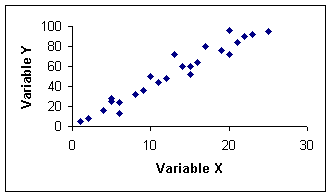
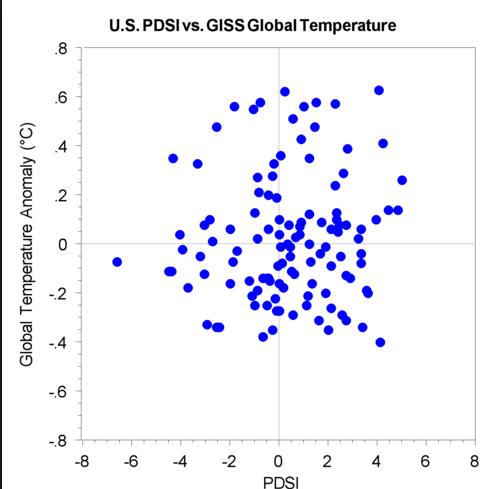
A statistical relationship (with or without causation) between two variables is called
control group
Hawthorne Effect
Correlation
official statistics


Because of the ______________, researchers need to be careful about subjects knowing that they are being studied, because they might behave different than normal.
Hawthorne Effect
Researcher Effect
Verstehen Effect
Seminology
Which complicating fact is true concerning causation?
Causation always exists if two variables are correlated.
Most events have just 1 single cause.
Most social behavior has multiple causes. It is hard to find only 1 cause of behavior.
Almost nothing has a cause.
An experiment is performed on plants to see how different liquids affect plant growth. Each plant in the experiment is given a different liquid; water, apple juice, or milk. Each plant has the same amount of soil, sunlight, and listens to the same music.
In this investigation, the independent variable is ...
The type of plant
The amount of sunlight
The type of music
The type of liquid
An experiment is performed on plants to see how different liquids affect plant growth. Each plant in the experiment is given a different liquid; water, apple juice, or milk. Each plant has the same amount of soil, sunlight, and listens to the same music.
In this investigation, what is the dependent variable?
Type of plant
Water, apple juice, milk
Plant growth
Color of the plant's leaves
Ms. S set up an experiment to see how the mass of a ball affects the distance it rolls off a ramp.
What is the dependent variable?
Distance traveled by the ball
Height of the ramp
Mass of the ball
Where the experiment took place.
How many variables do we want to test/change during a controlled experiment?
1
2
3
unlimited

When you want your tested group to accurately reflect the larger group
Representative Sample
Biased Sample
Unbiased Sample
The "Grocery Cart" Method

Why did the "Gang Leader for a Day' guy live among the gang for 7 years?
The gang loved him and found him funny
He grew up in the Chicago projects, it was his home
Because interviewing gang members wasn't going to get real answers about gang behavior
Because he got caught up in their crime and needed protection
Why do we use ethics in Science?
To restrict how we do science
To ensure that we only sometimes do the right thing
To ensure that we are always doing the right thing in our experiments
To justify everything that we do
The purpose of a code of ethics is
set standards for a profession
know our unique values and makes decisions based off them
be a guide for professional behavior
all of these

Which of the following were problems raised by the Stanford Prison Experiment?
A subject who wanted to leave was instead asked to inform on other prisoners
Zimbardo's dual role as "warden" and head of the study
The subjects acted as if they were performing roles and not as true subjects
All of these
In the Stanford Prison Experiment, the most cruel of the guards was most surprised by what?
The hunger strike
The resistance by the prisoners
The other guards standing up to him
The other guards following going along with him
Why was the Stanford Prison Experiment terminated early?
It wasn't.
Another professor saw how the subjects were being treated
Zimbardo concluded on his own it should end
The subjects all refused to continue
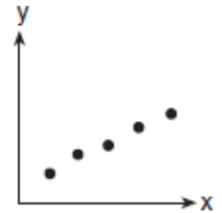
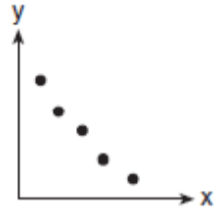
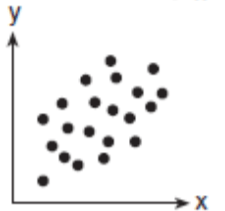
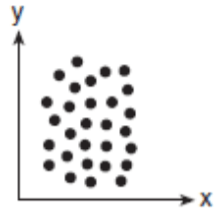
Which scatter plot diagram shows the strongest positive correlation?