Wayground logo

Free Printable Worksheets

Font size

S
M
L
XL
Worksheets

Chemical Bonding, Properties of Matter and Organic Compounds

Total questions: 55

Worksheet time: 28mins

Name
Class
Date
1.
Chemical bonds form when atoms
a)
combined nuclei
b)
give up neutrons
c)
gain protons
d)
share or transfer electrons
2.

Why do atoms bond?

a)

They typically don't bond

b)

To add or take away energy levels

c)

To have a full valance shell.

d)

To have a full inner shell

3.

An atom that gains or loses an electron becomes

a)

an isotope

b)

a new element

c)

an ion

d)

a molecule

4.
If an atom loses two electrons what charge will it have?
a)
+ 2
b)
 - 2
c)
+1
d)
-1
5.
If an atom gains one electron what charge will it have?
a)
-2
b)
-1
c)
+1
6.

Ionic bonding is between a

a)

nonmetal and nonmetal

b)

metal and nonmetal

c)

metal and metal

d)

Depends on the situation

7.
Do ionic bonds share or transport electrons?
a)
Share
b)
Transport
8.

Covalent bonding is between a

a)

nonmetal and nonmetal

b)

metal and nonmetal

c)

metal and metal

d)

It depends on the situation

9.
Do covalent bonds share or transport electrons?
a)
Share
b)
Transport
10.
Bonds that form between two metals are called ______________ bonds.
a)
ionic 
b)
covalent
c)
metallic
d)
pervasive
11.

Which category of elements usually form negative ions?

a)

metals

b)

nonmetals

c)

metalloids

d)

noble gases

12.

What category of element usually forms a positive ion?

a)

Metals

b)

Nonmetals

c)

metalloids

d)

Noble gases

13.

What do positive ions tend to do?

a)

lose electrons

b)

gain electrons

c)

lose protons

d)

gain protons

14.

What do negative ions tend to do?

a)

lose electrons

b)

gain electrons

c)

lose protons

d)

gain protons

15.

What is the ionic formula for a bond between Calcium and Phosphorus?

a)

Ca2P3

b)

Ca3P2

c)

Ca2P5

d)

P5Ca2

16.

What is the ionic formula for a bond between Sodium and Oxygen?

a)

Na2O

b)

NaO2

c)

NaO

d)

Na2O2

17.

What is the ionic formula for a bond between Aluminum and Chlorine?

a)

AlCl

b)

Al3Cl

c)

Al3Cl3

d)

AlCl3

18.

What is the chemical formula for Lithium Nitride?

a)

Li3N

b)

LiN3

c)

NLi3

d)

N3Li

19.
What is the formula for aluminum fluoride?
a)
AlF
b)
Al2F3
c)
AlF3
d)
Al3F2
20.
What is the formula for silicon dioxide?
a)
SO2
b)
NaO2
c)
SiO2
d)
SiO
21.

What is the covalent formula for a bond between Hydrogen and Chlorine?

a)

H2Cl

b)

HCl

c)

HCl2

d)

H2Cl2

22.

What is the covalent formula for a bond between Hydrogen and Oxygen?

a)

HO

b)

HO2

c)

H2O

d)

H2O2

23.

What is the covalent formula for a bond between Chlorine and Chlorine?

a)

Cl - Chlorine Gas

b)

Cl2 - Chlorine Gas

c)

ClCl - Chlorine Gas

d)

C2I - Chlorine Gas

24.
Anything that occupies space and has mass is known as
a)
liquid
b)
air
c)
matter
d)
solid
25.
The illustrations shows the spacing of particles in different types of matter. Which illustration is an example of the spacing of particles in solids?
a)
illustration A
b)
illustration B
c)
illustration C
d)
illustration D
26.
Has no definite shape or volume, but take the shape and volume of their containers, filling the space available. The particles easily move far apart from each other and spread out through the available space.
a)
solid
b)
liquid
c)
gas
d)
mass
27.
Has a definite shape and volume. Particles are very close to one another (dense).They vibrate, but do not move about. 
a)
solid
b)
liquid
c)
gas
d)
mass
28.
Has a definite volume, but their shape changes according to the shape of their containers. The particles are close to one another, but they are able to move apart from each other and flow from place to place.
a)
solid
b)
liquid
c)
gas
d)
mass
29.

____ is the amount of space an object takes up.

a)

Matter

b)

Volume

c)

Density

d)

Mass

30.
A change in which the form or shape of a substance changes but the chemical makeup of the substance remains the same.
a)
chemical change
b)
reaction
c)
physical change
d)
solution
31.
A change in one or more substances, caused by a reaction, that forms new and different substances.
a)
mixture
b)
physical change
c)
element
d)
chemical change
32.
The process in which new substances are formed during  a chemical change.
a)
reaction
b)
solution
c)
matter
d)
volume
33.

A conductor

a)

allows heat through it.

b)

resists heat going through it.

c)

allows color through it.

d)

allows texture through it.

34.
An insulator is 
a)
something that resists heat.
b)
allows heat through it. 
c)
allows texture through it. 
d)
resists color. 
35.

____ is the ability to be pressed, hammered or rolled into various shapes and sizes without breaking.

a)

Elasticity

b)

Strength

c)

Hardness

d)

Malleability

36.

____is the resistance of the liquid to flow.

a)

Strength

b)

Elasticity

c)

Viscosity

d)

Brittleness

37.

Organic compounds

a)

are made only of carbon

b)

contain carbon bonded to hydrogen and nothing else

c)

contain carbon bonded to hydrogen

d)

contain only oxygen

38.

Which property of carbon is important in the forming of many types of organic compounds

a)

carbon has 6 electrons

b)

carbon has 6 protons

c)

carbon has 4 valence electrons

d)

carbon can only bond with hydrogen

39.

Because carbon has 4 valence electrons

a)

it can form up to 4 covalent bonds

b)

it can form ionic bonds

c)

it can form only double bonds

d)

it can form covalent bonds with H only

40.

The carbons circled in red...

a)

are double bonded

b)

are sharing two pairs of electrons

c)

are sharing three pairs of electrons

d)

form a single covalent bond

41.

A carbon chain by itself is not able to dissolve in water. Which functional group can be added to make the carbon chain alcohol?

a)

NH2

b)

Phosphate

c)

Carboxyl

d)

Hydroxyl

42.

What gives carbon the ability to form chains of almost unlimited length?

a)

carbon can bond to other carbon

b)

carbon makes covalent bonds

c)

carbon has 6 electrons

d)

carbon has isotopes

43.

6 Carbon atoms can form many different compounds.

a)

TRUE

b)

FALSE

44.
How many carbons are in the longest chain?
a)
5
b)
3
c)
1
d)
6
45.

What elements make up 97% of all living things?

a)

Oxygen, carbon, helium & nitrogen

b)

Oxygen, calcium, hydrogen & nitrogen

c)

Oxygen, carbon, hydrogen & nitrogen

d)

Iron, carbon, hydrogen & nitrogen

46.
How many carbon atoms are in butane?
a)
1
b)
2
c)
3
d)
4
47.
Which is an organic compound?
a)
Carbon Dioxide
b)
Carbon Monoxide
c)
Carbonates
d)
Ethane
48.
Which of the following compounds is an example of hydrocarbon?
a)
CO2
b)
C2H6
c)
C2H5OH
d)
CH3COOH
49.
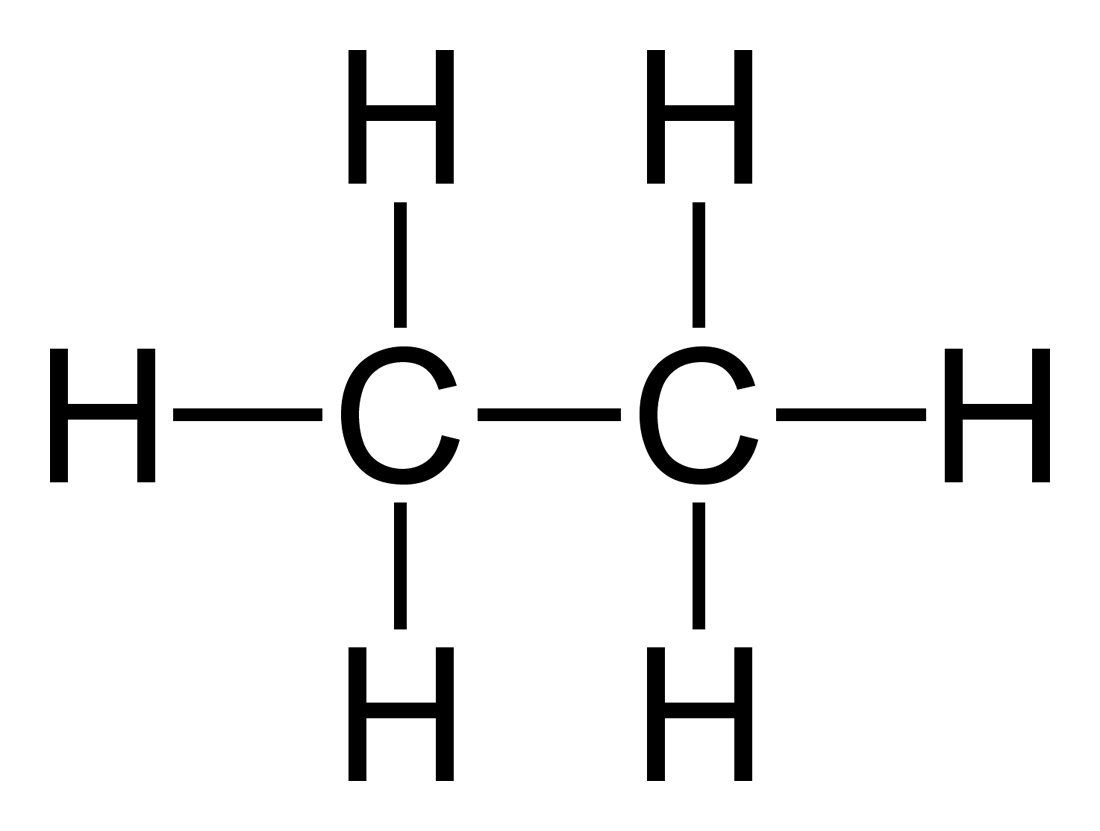
Name this alkane
a)
Methane
b)
Ethane
c)
Propane
d)
Butane
50.
How many carbon atoms are in methane?
a)
1
b)
2
c)
3
d)
4
51.
How many carbon atoms are in propane
a)
1
b)
2
c)
3
d)
4
52.
What is the suffix for single bonded hydrocarbons?
a)
-yne
b)
-ene
c)
-ane
d)
-one
53.

Which of the following is the functional group of an alkene?

a)

C-C

b)

C=C

c)

-OH

d)

-COOH

54.

The representation by which lines depict two-electron bonds between atoms.

a)

Molecular Formula

b)

Chemical Formula

c)

Structural Formula

d)

Condensed Fornula

55.

It is written in a way the subscript of the element symbol depicts the number of atoms present in the compound?

a)

Chemical Formula

b)

Condensed Formula

c)

Molecular Formula

d)

Structural Formula