wayground logo

Free Printable Worksheets

Font size

S
M
L
XL
Worksheets

IIT-JEE & NEET LEVEL - 13 (9-O)

Total questions: 100

Worksheet time: 2hrs 40mins

Name
Class
Date
1.
What is the main purpose of the immune system?
a)
support the body through bones and muscles
b)
get rid of waste from the body
c)
protect the body from pathogens
d)
move blood through the body
2.
What do antibodies attach to on the pathogen?
a)
Anti inflammatory
b)
Antigens
c)
Antiseptic
d)
Antibodies
3.
Which one is a way the body defends against a pathogen?
a)
Fever
b)
Stomach Acid digesting
c)
White Blood Cells fighing
d)
All of these are correct
4.
Pathogens are recognized by their...
a)
antigens
b)
antibodies
c)
killer t-cells
d)
B-cells
5.
Cells that ingest pathogens are
a)
plasma cells
b)
phagocytic cells
c)
helper T cells
d)
antibodies
6.
A person can contract HIV by:
a)
Sharing needles with an infected person
b)
Kissing an infected person
c)
Hugging an infected person
d)
Swimming with an infected person
7.
Which of the following is not a way to prevent or treat viruses?
a)
antibiotics
b)
antiviral medications
c)
vaccines
d)
wash your hands
8.
Which of the following is not caused by a virus?
a)
Common Cold
b)
Norovirus
c)
Strep Throat
d)
AIDS
9.
Which of the following is trait that a virus shares with a living organism?
a)
They use oxygen
b)
They have genetic material
c)
They grow
d)
They digest food
10.
Which body system coordinates activities for all other systems?
a)
Respiratory
b)
Nervous
c)
Digestive
d)
Excretory
11.
Which system works with the circulatory system to make sure all of your cells get nutrients?
a)
Respiratory
b)
Digestive
c)
Nervous
d)
Excretory
12.
Which body system works with the circulatory system to make sure that oxygen is delivered to all of your cells?
a)
Respiratory
b)
Digestive
c)
Excretory
d)
Nervous
13.
What type of pathogen is most likely found in warm, moist environments?
a)
virus
b)
bacteria
c)
fungi
d)
protist
14.

Deficiency of __________ causes Night blindness.

a)

Vitamin B1

b)

Vitamin D

c)

Vitamin A

15.

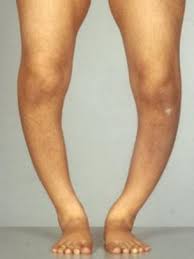
Deficiency of which nutrient leads to this disease?

a)

Vitamin A

b)

Vitamin D

c)

Vitamin C

16.

Having iodized salt regularly in your food will help in the prevention of __________.

a)

Goitre

b)

Anaemia

c)

Rickets

17.

Infection and bleeding of gums can be prevented by having foods rich in ___________.

a)

Iron

b)

Calcium

c)

Vitamin C

18.

________ are disease-causing organisms that are so small you need a microscope to see them. Think "fancy word for germs".

a)

Virus

b)

Disease

c)

Communicable

d)

Pathogen

19.
Mosquitoes and Ticks are examples of organisms that can spread disease.  These types of organisms are refereed to as?
a)
Vectors
b)
Fungi
c)
Pathogens
20.
The __________ period is how long the disease can spread from one person to another.
a)
Sickness
b)
Bed rest
c)
Contagious
21.
What is at the center of every atom?
a)
An electron
b)
A compound
c)
A molecule
d)
A nucleus
22.

There may be a maximum of ____ p orbitals at a given energy level.

a)

2

b)

6

c)

3

d)

8

23.

This shape is that of a...

a)

s orbital

b)

d orbital

c)

p orbital

d)

f orbital

24.

The spin of an electron is represented by this variable:

a)

n

b)

m

c)

L

d)

s, ms

25.

This is a ____ orbital

a)

s

b)

d

c)

p

d)

d

26.

The principle quantum number, n, represents the:

a)

spin value

b)

suborbital value

c)

energy level

d)

magnetic value

27.

Orbital sublevels, or L, represents:

a)

orbital color

b)

orbital shape

c)

electron spin

d)

energy level

28.

How many electrons total are found in the f orbital?

a)

2

b)

6

c)

10

d)

14

29.

What is the correct representation for an orbital which has an "n" value of 4 and an "L" value of 2?

a)

4d

b)

4s

c)

4f

d)

4p

30.

For a p sublevel, "L" equals ____.

a)

0

b)

1

c)

2

d)

3

31.
What is the correct representation for an orbital which has an "n" value of 3 and an "l" value of 1?  
a)
3s
b)
3p
c)
3d
d)
3f
32.

What quantum number describes the energy level of an orbital?

a)

l

b)

m

c)

s

d)

n

33.
Electrons occupy orbitals of lowest energy first is part of what electron configuration rule?
a)
Hund’s Rule
b)
Aufbau Principle
c)
Pauli Exclusion Principle
34.

Which of the following sets of quantum numbers (n, l, ml, and ms) describes the valence electron of Na?

a)

2, 1, 0, -½

b)

2, 0, 0, -½

c)

3, 1, 1, +½

d)

3, 0, 0, +½

35.
What atom matches this electron configuration?
1s22s22p63s2
a)
Neon
b)
Magnesium
c)
Aluminum
d)
Potassium
36.
What is the correct representation for an orbital which has an "n" value of 4 and an "l" value of 2?  
a)
4d
b)
4s
c)
4f
d)
4p
37.
How many electrons can the first energy level hold?
a)
1
b)
2
c)
8
d)
0
38.
How many total electrons can the f orbitals in a sublevel hold?
a)
2
b)
14
c)
6
d)
10
39.

Which values can (n) be?

a)

only 0

b)

0, 1, 2, 3...

c)

1,2,3,4...

d)

-2 < n < +2

40.

The principle quantum number, n, represents the:

a)

spin value

b)

suborbital value

c)

energy level

d)

magnetic value

41.
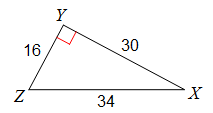
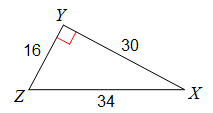
What is the length of the hypotenuse?
a)
16
b)
30
c)
34
42.
What is the length of the side opposite ∠X?
a)
16
b)
30
c)
34
43.
What is the ratio for Sine?
a)
Hyp/Opp
b)
Opp/Hyp
c)
Opp/Adj
d)
Adj/Opp
44.

What is the ratio for Tangent

a)

Opp/Adj

b)

Adj/Opp

c)

Opp/Hyp

d)

Hyp/Opp

45.
What is the ratio for Cosine?
a)
Opp/Hyp
b)
Opp/Adj
c)
Adj/Opp
d)
Adj/Hyp
46.
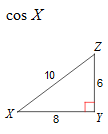
What is the correct ratio?
a)
6/10
b)
6/8
c)
8/10
d)
8/6
47.
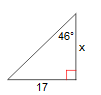
What is the correct equation to solve for x ?
a)
tan( 46 ) = 17/x
b)
sin ( 46 ) = x/17
c)
tan (46 ) = x/17
d)
cos (46) = x/17
48.
What is the correct equation to solve for x?
a)
tan (45) = x/13
b)
cos (45) = x/13
c)
sin (45) = 13/x
d)
sin (45) = x/13
49.
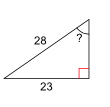
Find the measure of the indicated angle (?) round to the nearest tenth.
a)
9.4
b)
55.2
c)
20.15
d)
19.4
50.
a)
18.9
b)
19.5
c)
47
d)
27.5
51.

Find h1

a)

6.69 ft

b)

11.11 ft

c)

9.00 ft

d)

7.43 ft

52.

Find h2

a)

16.73 ft

b)

22.51 ft

c)

18.59 ft

d)

20.79 ft

53.
Solve for the missing angle
a)
50
b)
0.053
c)
36.9
d)
95
54.
sin A = ?
a)
7/25
b)
24/25
c)
7/24
d)
25/7
55.
m∠A = ?
a)
16.3⁰
b)
73.8⁰
c)
15.6⁰
d)
17.0⁰
56.
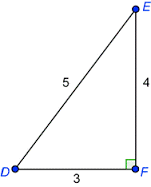
What is the opposite side to <E?
a)
EF
b)
DF
c)
DE
57.
What is the adjacent side to <D?
a)
EF
b)
DF
c)
DE
58.
What is the ratio of tan <E?
a)
tan<E = 5/4 =1.25
b)
tan<E = 3/5 =.6 
c)
tan<E = 4/5 =.8 
d)
tan<E = 3/4 =.75
59.
What is the ratio of tan <B?
a)
tan<B = 3/2 =1.5
b)
tan<B = 2/3 =.6 
c)
tan<B = 2/3.6 =.55
d)
tan<B = 3.6/3 =1.2
60.
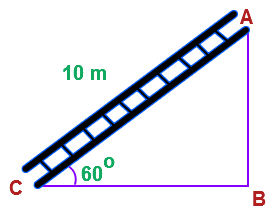
 Find side AB?
a)
20 m
b)
5 m
c)
11.54 m
d)
8.66 m
61.
(x+3)(x+1)
a)
x2+3x+3
b)
2x+4x+3
c)
x2+4x+3
d)
5x + 3
62.
5x(2x + 3)
a)
10x+ 15x
b)
7x + 15x
c)
7x2 + 8x
d)
25x2
63.
Factor the polynomial. 
x2-4x-32
a)
(x-8)(x+4)
b)
(x-4)(x-32)
c)
(x+3)(x-4)
d)
x+2)(x+5)
64.
Find the product.
(x + 7)2
a)
x+ 7x + 7x + 49
b)
x+ 7x + 7
c)
7x+ x + 7
d)
x2 + 14x + 49
65.
Factor:
x2 - 49
a)
(x + 7)(x - 7)
b)
(x + 7)2
c)
(x - 7)2
d)
(x+7)(x-1)
66.
4x- 3x2
a)
7x2
b)
2x2
c)
x2
d)
-7x2
67.

Give the correct name for

3x

a)

Cubic Monomial

b)

Linear Binomial

c)

Linear Monomial

d)

Cubic Binomial

68.
Give the correct name for 
3x2+4x-7
a)
Quadratic trinomial
b)
linear binomial
c)
Quartic trinomail
d)
Linear Trinomail
69.
Classify by the DEGREE:
3x - 2
a)
1
b)
2
c)
3
d)
4
70.
Polynomial or not?
a)
polynomial
b)
not a polynomial
71.
Identify the degree of the following monomial:
3
a)
2
b)
1
c)
0
d)
x
72.
Classify by the DEGREE:
4x3 - 5x2 + 2x - 1
a)
1
b)
2
c)
3
d)
4
73.
What is the degree of the monomial?
a)
2
b)
4
c)
6
d)
7
74.
A polynomial that has two terms is a:
a)
polynomial
b)
monomial
c)
binomial
75.
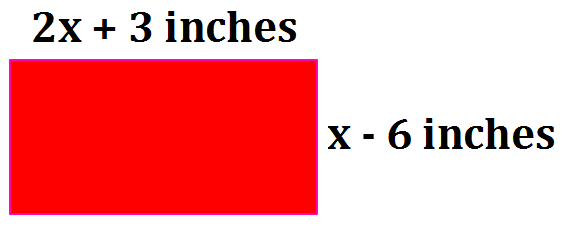
What is the Perimeter?
a)
3x - 3 inches
b)
6x - 6 inches
c)
3x - 6 inches
d)
6x - 3 inches
76.
Classify the polynomial by its degree.
x2 + 2x3 - 4
a)
A
binomial
b)
B
trinomial
c)
C
quadratic
d)
D
cubic
77.
Classify the polynomial by its number of terms.
 4x² - 2
a)
A
monomial
b)
B
binomial
c)
C
trinomial
d)
D
polynomial
78.
Which is an example of a cubic monomial?
a)
A
x³ + 5
b)
B
x² + 3
c)
C
x² + 5x - 6
d)
D
5x³
79.
Simplify:
5(3x+2)
a)
3x+10
b)
15x+10
c)
15x-10
d)
3x-10
80.
Find the sum.
(2x2 + 5x - 7) + ( 3 - 4x2 + 6x)
a)
2x+ 3x +1
b)
-2x- 11x -4
c)
2x2 + 5x -7
d)
-2x2 + 11x -4
81.
The imaginary line perpendicular to a reflecting surface is called _____.
a)
crooked line
b)
parallel line
c)
angular line
d)
normal line
82.
Why can you see most objects? 
a)
they emit light
b)
light refracts through them
c)
light reflects off them
d)
They absorb light
83.
Law of reflection state that - The angle of incidence is .................. to the angle of reflection.
a)
equal
b)
double
c)
half
84.

Images in a plane mirror are

a)

real

b)

larger

c)

same size

d)

smaller

85.
What is an image called that forms when light rays actually meet
a)
virtual image
b)
real image
c)
diffuse reflection
d)
regular reflection
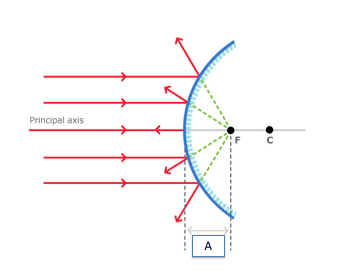
86.

In the image, all the rays meet at F, What is F

a)

focal length

b)

focal point

c)

center of curvature

d)

reflection

87.
Convex Mirrors produce...
a)
only virtual images
b)
virtual or real images
c)
only real images
d)
inverted images
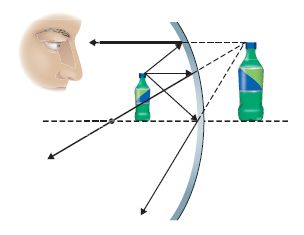
88.
Which terms describe the reflection seen in this image?
a)
virtual, upright
b)
virtual, inverted
c)
real, upright
d)
real, inverted
89.

If 'R' is radius of curvature and 'f' is focal length of a spherical mirror then the correct relation between the two is

a)

R = f

b)

R = f/2

c)

f = 2R

d)

f = R/2

90.

Through which point on principal axis shall reflected ray pass in the following diagram of incident ray ?

a)

point F

b)

point C

c)

point P

d)

none of the above

91.

A mirror always form diminished image irrespective of the position of the object in-front of it , then the mirror is :-

a)

Plane mirror

b)

concave mirror

c)

convex mirror

d)

not possible

92.

When distance of object from a mirror is gradually increased then image formed by it becomes inverted which was erect in the beginning. Which type of mirror is this ?

a)

Plane mirror

b)

Concave mirror

c)

Convex mirror

d)

none of the above

93.

Which mirror is used as a make-up mirror ?

a)

Convex mirror

b)

plane mirror

c)

concave mirror

d)

plano-concave

94.

What shall be the position of image , if an object is place in-front of a concave mirror as shown ?

a)

At C

b)

between F & C

c)

between F & P

d)

at F

95.

The diagram shows

a)

refraction of light.

b)

absorption of light.

c)

reflection of light.

d)

scatter of light.

96.

Which is the reflected ray?

a)

A

b)

B

c)

C

d)

D

97.

Which is the reflected ray?

a)

A

b)

B

c)

C

d)

D

98.

Which is the reflected ray?

a)

A

b)

B

c)

C

d)

D

99.

Which is the reflected ray?

a)

A

b)

B

c)

C

d)

D

100.

Which is the reflected ray?

a)

A

b)

B

c)

C

d)

D