wayground logo

Free Printable Worksheets

Font size

S
M
L
XL
Worksheets

Unit 3: Triangle Relationships

Total questions: 95

Worksheet time: 3hrs 11mins

Name
Class
Date
1.

Determine the value of x

a)

130

b)

50

c)

25

d)

not enough information to determine

2.

Determine the value of x

a)

x = 7.67

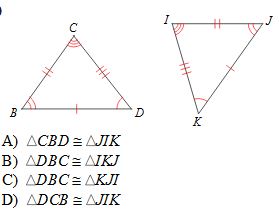
b)

x = 6

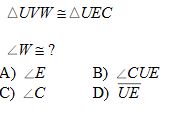
c)

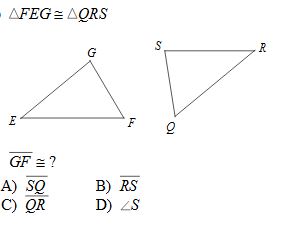
x = 8

d)

x = 10

3.

Determine the value of the base angle

a)

14

b)

56

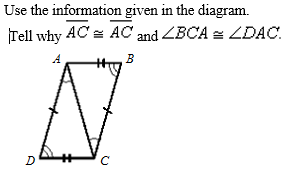
c)

62

d)

60

4.

Determine the measure of the exterior angle

a)

12

b)

68

c)

20

d)

48

5.

Find the measure of the exterior angle

a)

45

b)

92

c)

46

d)

47

6.
Find x.
a)
x = 118
b)
x = 31
c)
x = 23
d)
x = 62
7.
Which pair of angles are alternate interior angles?
a)
Angle 7 and Angle 4
b)
Angle 3 and Angle 6
c)
Angle 8 and Angle 1
d)
Angle 2 and Angle 8
8.
Which pair of angles are corresponding?
a)
Angle 7 and Angle 4
b)
Angle 3 and Angle 6
c)
Angle 8 and Angle 1
d)
Angle 4 and Angle 8
9.
Which pair of angles are alternate exterior angles?
a)
Angle 7 and Angle 4
b)
Angle 2 and Angle 6
c)
Angle 8 and Angle 1
d)
Angle 2 and Angle 8
10.
The Triangle Sum Theorem states that the sum of all angles in a triangle is ______. 
a)
45°
b)
90°
c)
180°
d)
360°
11.
These angles are congruent.
a)
All of these
b)
Corresponding
c)
Alternate Interior
d)
Vertical
12.
Find the measure of the indicated angle. 
a)
145 degrees
b)
24 degrees
c)
20 degrees 
d)
21 degrees
13.
Which of the following terms best describes Angle d?
a)
Remote interior angle
b)
Corresponding angle
c)
Exterior angle
d)
Interior angle
14.

Which two angles are the remote interior angles to Angle W?

a)

Angle X and Angle Y

b)

Angle X and Angle Z

c)

Angle Y and Angle Z

d)

Angle Z and Angle W

15.
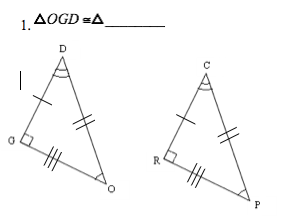
What is the correct congruence statement?  ΔDEC ≅________
a)
ΔAEB
b)
ΔEAB
c)
ΔBEA
d)
Not Congruent
16.
Figures that have the same _____ and size are congruent triangles. 
a)
corresponding
b)
corners
c)
angles
d)
shape
17.
Find the measure of the indicated angle. 
a)
34°
b)
46°
c)
62°
d)
36°
18.
a)
A
b)
B
c)
C
d)
D
19.
a)
A
b)
B
c)
C
d)
D
20.
a)
A
b)
B
c)
C
d)
D
21.
a)
A
b)
B
c)
C
d)
D
22.
a)
A
b)
B
c)
C
d)
D
23.
a)
A
b)
B
c)
C
d)
D
24.
a)
A
b)
B
c)
C
d)
D
25.
a)
A
b)
B
c)
C
d)
D
26.
a)
A
b)
B
c)
C
d)
D
27.
a)
A
b)
B
c)
C
d)
D
28.
Which is a correct congruence statement.
a)
A
b)
B
c)
C
d)
D
29.
Which is a correct congruence statement.
a)
A
b)
B
c)
C
d)
D
30.
Name the corresponding angle or side.
a)
A
b)
B
c)
C
d)
D
31.
Name the corresponding angle or side.
a)
A
b)
B
c)
C
d)
D
32.
Name the corresponding angle or side.
a)
A
b)
B
c)
C
d)
D
33.
State if the two triangles are congruent.  If they are, state how you know.
a)
A
b)
B
c)
C
d)
D
34.
State if the two triangles are congruent.  If they are, state how you know.
a)
A
b)
B
c)
C
d)
D
35.
State if the two triangles are congruent.  If they are, state how you know.
a)
A
b)
B
c)
C
d)
D
36.
Vertical angles are congruent.
a)
True
b)
False
37.
Which of the following is not a valid reason to prove congruent triangles?
a)
ASA
b)
SAS
c)
SSS
d)
AAA
38.
Which is NOT a test to prove triangles congruent?
a)
SAA
b)
SSS
c)
SSA
d)
SAS
39.
What are the five ways to prove triangles congruent?
a)
SSS, ASA, AAS, SAS, HL
b)
SSS, SSA, HL, AAS, SAS
c)
SAS, SSA, HL, AAS, SSS
d)
HL, SAS, SSA, SSS, ASA
40.
Fill in the blank.
a)
Given
b)
Reflexive Property
c)
Transitive Property
d)
They're the same side!!!!!! 
41.
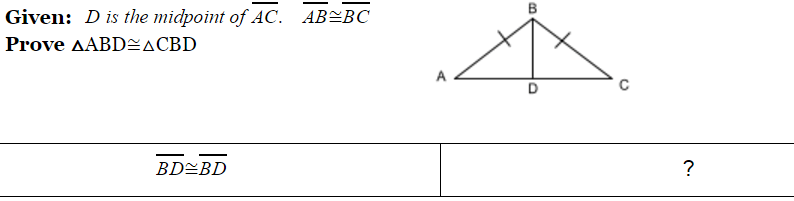
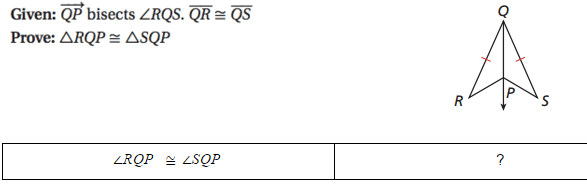
What is the reason?
a)
Definition of Angle
b)
Definition of Congruence
c)
Definition of bisects
d)
Definition of midpoint
42.
Fill in the missing proofs.
a)
Transitive Property, SAS(Side-Angle-Side)
b)
Reflexive Property, SAS(Side-Angle-Side)
c)
Reflexive Property, Vertical Angles Thm.
d)
Transitive Property, SSS(Side-Side-Side)
43.

Congruent figures...

a)

Have the same dimensions (side lengths and angle measures)

b)

Are the same shape and size

c)

Can be mapped onto one another using rigid motions

d)

All of the above

44.
a)

Reflexive Property, Given

b)

Transitive Property, Reflexive Property

c)

Given, Reflexive Property

d)

Reflexive Property, Transitive Property
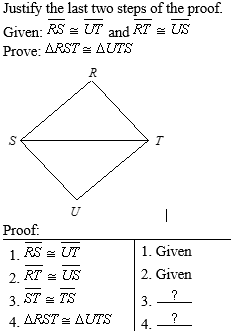
45.
a)

Symmetric Property of ≅ ; SSS

b)

Reflexive Property of ≅ ; SAS

c)

Reflexive Property of ≅ ; SSS

d)

Symmetric Property of ≅; SAS

46.

Which of the following is a correct statement and reason for the proof shown?

a)

JKJK\overline{JK}\cong\overline{JK} ; Reflexive

b)

ML\angle M\cong\angle L ; Reflexive

c)

MJLK\overline{MJ}\cong\overline{LK} ; Midpoint Theorem

d)

MKLJ\overline{MK}\cong\overline{LJ} ; Hypotenuse Congruence

47.

Which of the following is a correct statement and reason for the proof shown?

a)

FGFG\overline{FG}\cong\overline{FG} ; Reflexive

b)

FGFG\overline{FG}\cong\overline{FG} ; Midpoint Theorem

c)

\overline{DG}\cong\overline{DG} ; Reflexive

d)

DFFE\overline{DF}\cong\overline{FE} ; Midpoint Theorem

48.

Which of the following is a correct statement and reason for the proof shown?

a)

GEQNEW\angle GEQ\cong\angle NEW Vertical

b)

WNGQ\overline{WN}\cong\overline{GQ} ; Prove

c)

GN\angle G\cong\angle N ; Alternate Interior

d)

WQ\angle W\cong\angle Q ; Alternate Interior

49.

Which of the following is a correct statement and reason for the proof shown?

a)

APBCPD\angle APB\cong\angle CPD ; Vertical

b)

AD\angle A\approx\angle D ; Alternate Interior

c)

CB\angle C\cong\angle B ; Alternate Interior

d)

ABCD\overline{AB}\cong\overline{CD} ; Prove

50.

Identify the missing statement or reason

a)

Reflexive Property

b)

Definition of Midpoint

c)

Given

d)

Vertical Angles Theorem

51.
Identify the  missing statement or reason
a)
Given
b)
Vertical Angles Theorem
c)
Definition of Angle Bisector
d)
Alternate Interior Angles Theorem
52.
What is the "reason" for step 3 of the proof?
a)
Proof
b)
Def. of Midpoint
c)
Reflexive Property
d)
Vertical angle Theorem
53.
What is the correct choice for Reason 3?
a)
Vertical Angles are Congruent
b)
Definition of Congruence
c)
Given
d)
Reflexive Property
54.
An angle bisector cuts an angle into two congruent _________
a)
Angles!
b)
Segments
c)
Mysteries
55.
A segment bisector cuts a segment into two congruent
a)
Segments!
b)
Angles
c)
Mysteries
56.
What does CPCTC stand for?
a)
Congruent parts of congruent triangles are congruent
b)
Corresponding parts of congruent triangles are congruent
c)
Corresponding parts of corresponding triangles are corresponding
d)
Corresponding parts of congruent triangles are Canadian.
57.
Complete the congruence statement.
a)
CRP
b)
PCR
c)
RPC
d)
PRC
58.
∆ABC≅∆XYZ
which is true?
a)
AB≅XY
b)
AB≅YX
c)
AB≅XZ
d)
BC≅CB
59.
If ΔDEF ≅ ΔRST, then we can conclude that DE = what?
a)
ST
b)
RS
c)
DF
d)
RT
60.
When do you use "CPCTC in a proof?
a)
ALWAYS at the beginning
b)
ALWAYS at the end
c)
It's optional
d)
NEver
61.
When does one use CPCTC?
a)
Before triangles are congruent
b)
After triangles are congruent
c)
Whenever one wants, there are no restrictions
d)
There is no such thing as CPCTC
62.

In a proof, we must first _______________________ before we can use CPCTC.

a)

make sure angles correspond

b)

color code corresponding parts

c)

fill all the reasons

d)

prove two triangles are congruent

63.

We are able to prove the two triangles in the image are congruent by AAS. Which of the congruence statements below is only possible AFTER we prove the triangles are congruent?

a)

GHHG\overline{GH}\cong\overline{HG}

b)

FGHEHG\angle FGH\cong\angle EHG

c)

EGHFHG\angle EGH\cong\angle FHG

d)

GFHE\overline{GF}\cong\overline{HE}

64.

Fill in the Reason#6.

a)

Opposite sides of a parallelogram are congruent.

b)

definition of parallelogram

c)

Prove

d)

CPCTC

65.

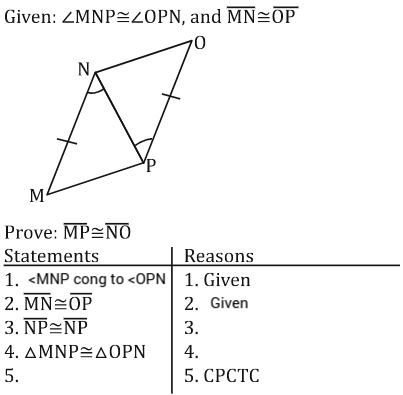
Determine the correct response for #5 in the proof.

a)

All right angles are congruent

b)

Reflexive Property

c)

Triangle HEF is congruent to Triangle GFE

d)

Corresponding Parts of Congruent Triangles are Congruent

66.
What is the "reason" for step 5 of the proof?
a)
Angle Bisector Theorem
b)
Reflexive property
c)
CPCTC Theorem
d)
Proof
67.
What is the "reason" for step 5 of the proof?
a)
Angle Bisector Theorem
b)
Reflexive property
c)
CPCTC Theorem
d)
Proof
68.

What is the value of x?

a)

17

b)

34

c)

68

d)

Impossible to determine from the information given.

69.

What is the value of x?

a)

1

b)

2

c)

4

d)

Impossible to determine from the information given.

70.

What is the value of x?

a)

25.5

b)

43

c)

78

d)

Impossible to determine from the information given.

71.

What is the value of x?

a)

3

b)

6

c)

9

d)

Impossible to determine from the information given.

72.
Use the Perp Bisector Theorem to find HG
a)
28
b)
14
c)
41
d)
7
73.

Which of the following special segments is shown?

a)

median

b)

angle bisector

c)

perpendicular bisector

d)

altitude

74.

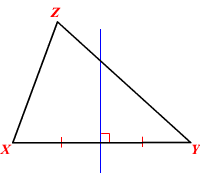
What is the blue line shown?

a)

median

b)

angle bisector

c)

perpendicular bisector

d)

altitude

75.
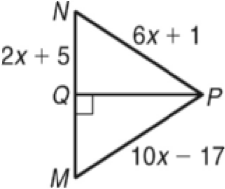
1.  PQ  is the perpendicular bisector of MN. What is QN?
a)
7
b)
14
c)
10.5
d)
28
76.
The figure is an example of a(n) ...
a)
median
b)
altitude
c)
midsegment
d)
sangle bisector
77.
Which of the following segments represents a median?
a)
Segment BX
b)
Segment AZ
c)
Segment AC
d)
Segment BZ
78.
Which of the following segments represents an altitude?
a)
Segment BX
b)
Segment AZ
c)
Segment AC
d)
Segment BZ
79.
The figure is an example of a(n) ...
a)
angle bisector
b)
perpendicular bisector
c)
median
d)
midsegment
80.
The figure is an example of a(n) ...
a)
angle bisector
b)
midsegment
c)
altitude
d)
median
81.
Which of the following describes a perpendicular bisector of a triangle?
a)
A segment that is perpendicular to the side of a triangle at its midpoint.
b)
A segment with endpoints at the vertex and midpoint of the opposite side.
c)
A segment that connects two midpoints of two sides.
d)
A segment that connects the vertex and the opposite side at 90 degrees. 
82.
a)
m∠SQP=29, m∠PQR=58
b)
m∠SQP=29, m∠PQR=29
c)
m∠SQP=58, m∠PQR=58
d)
m∠SQP=58, m∠PQR=29
83.
Find the length of AD
a)
2
b)
4
c)
6
d)
8
84.
What is the length of DC
a)
4
b)
1
c)
2
d)
3
85.

What is the only special triangle segment that does not have to go through a vertex?

a)

Median

b)

Altitude

c)

Angle Bisector

d)

Perpendicular Bisector

86.
Which of the following describes a median of a triangle?
a)
A segment that passes through the middle of the triangle.
b)
A segment with endpoints at the vertex and midpoint of the opposite side.
c)
A segment that connects two midpoints of two sides.
d)
A segment that connects the vertex and the opposite side at 90 degrees. 
87.
A ray that divides an angle into two congruent angles.
a)
Segment Bisector
b)
Midpoint
c)
Angle Bisector
d)
Sunshine
88.
Which of the following describes a median of a triangle?
a)
A segment that is perpendicular to the side of a triangle at its midpoint.
b)
A segment with endpoints at the vertex and midpoint of the opposite side.
c)
A segment that connects two midpoints of two sides.
d)
A segment that connects the vertex and the opposite side at 90 degrees. 
89.
What is true about a perpendicular bisector?
a)
Cuts the side of a triangle into 2 congruent parts.
b)
It is perpendicular to the side of a triangle.
c)
It passes through the midpoint of the side of the triangle.
d)
All of the above
90.
Which of the following describes an altitude of a triangle?
a)
A segment that passes through the middle of the triangle.
b)
A segment with endpoints at the vertex and midpoint of the opposite side.
c)
A segment that connects two midpoints of two sides.
d)
A segment that connects the vertex and the opposite side at 90 degrees. 
91.

What does an angle bisector do?

a)

Makes two 90 degree angles

b)

splits a 90 degree angle in half

c)

splits an angle in half

d)

splits 2 sides in half

92.

____ is a perpendicular segment from a vertex to the opposite side.

a)

Altitude

b)

Angle Bisector

c)

Perpendicular Bisector

d)

Median

93.

____ is a perpendicular segment that divides a segment into two equal parts.

a)

Angle Bisector

b)

Median

c)

Altitude

d)

Perpendicular Bisector

94.

____ is a segment that cuts an angle into two equal parts.

a)

Perpendicular Bisector

b)

Angle Bisector

c)

Median

d)

Altitude

95.

Out of the 4 types of special segments in triangles, all but one must go through a vertex of a triangle. Which one does not have to go through a vertex of a triangle?

a)

Angle Bisector

b)

Altitude

c)

Perpendicular Bisector

d)

Median