
 Worksheets
Final Exam Review
Total questions: 100
Worksheet time: 9hrs 40mins
Describe the transformation that occurred
p(x) = f(x + 3)
Right 3 units
Vertical Stretch
Up 3 units
Left 3 units
Describe the transformation that occurred.
h(x) = f(x) + 2
up 2 units
left 2 units
Vertical Strech
right 2 units
Describe the transformation that occurred
g(x) =2f(x)
Up 2 units
vertical compression
vertical stretch
Right 2 Units
-f(x) - 2
reflection over y-axis, shift down 2
reflection over y-axis, shift right 2
reflection over x-axis, shift right 2
reflection over x-axis, shift down 2
Write in function form: translation 3 units right
g(x) = f(x − 3)
g(x) = f(x) − 3
g(x) = -3f(x)
g(x) = f(-3x)
vertical reflection, horizontal stretch
g(x) = ½f(-x)
g(x) = -f(¼x)
g(x) = -3f(x)
g(x) = -f(4x)

What is the range of the graph?
[-7, 5)
(-3, 1]
[-3, 1)
(-7, 5]

What is the domain?
(−∞, −3]
[3, −∞)
(−∞,3]
(−∞,∞)
None of the answer choices

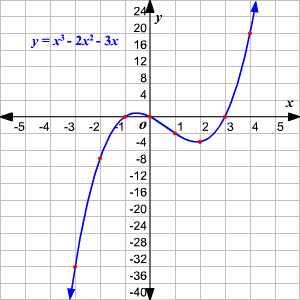

x < 8

Describe the end behavior of the graph.
x → -∞, f(x) → ∞ and x→∞, f(x) →⁻∞
x → -∞, f(x) → ∞ and x→∞, f(x) →∞
x → -∞, f(x) → ∞ and x→∞, f(x) → 0
x → -∞,f(x) → -∞and x→ ∞, f(x) → ∞


y = 2(x + 3)2 - 8?

(2i)(3i)
y = x2 - 6x + 11?

k2 -2k - 24
x2 + 13x + 12 = 0

3x3 – 6x
(3x3+3x2–4x+5) + (x3–2x2+x–4)
(4n4-8n+4) - (8n2+4n4+1)
(4x+1)(5x−2)
(4x2 - 24x + 35) / (2x - 5)
(2x3 - 5x - 7) ÷ (x - 2)
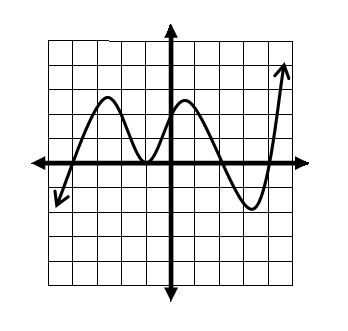
Even Multiplicities have which of the following effects on the x-axis?
touches and bounces back
wiggle
crosses the x-axis
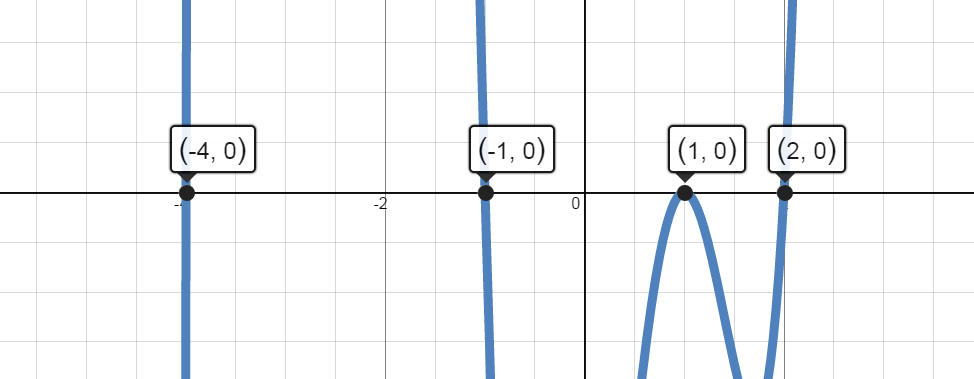
y = x(x - 6)(x + 5)
f(x)= x3(x + 3)2(x – 5)
f(x) = (x+2)(x-3)2(x-4)
Which choice best describes the zeros?
-2, 3 (multiplicity 2), 4
-2 (multiplicity 2), 3, 4
2, -3 (multiplicity 2), -4
2 (multiplicity 2), -3, -4
If the graph of a function crosses the x-axis, what does that mean about the multiplicity of that zero?
Even
Odd
None
Which one of these are not a zero of f(x)=−2x(3x+1)2(x+7)7
-2
0
−31
-7
What is the multiplicity of the zero x=-5 for the function f(x)=x2(x−1)4(x+5) ?
1
2
3
4
If f(x)=x+5, what is f-1(x)?
(x + 5)2
x - 5
(x + 5)-1
undefined
Determine f-1(2) given the following information about f(x) f(1) = -3 f(2) = -2 f(-1) = 2 f(3) = -1

Use the horizontal line test to determine if the function has an inverse function.
yes
no

Is the relation shown a function?
If the decay rate is 20%, which of the following represent the decay factor?
0.2
0.8
1.2
1.8
If the growth rate is 80%, what is the growth factor?
0.2
0.8
1.2
1.8
A flea medicine breaks down at a rate of 20% per hour. This is the rate of decay of the medicine. The initial dose is 60 milligrams. Which of the following represent the equation the models the amount of flea medicine left in an animal?
y=60(.2)x
y=20(60)x
y=60(.8)x
y=60(1.2)x
Select all the equations that represent exponential decay.
y=21(4)x
y=4(21)x
y=80(1.4)x
y=60(0.7)x
y=3(0.6)x
Jack invest $600 earning 5% interest rate. How much will he have after 5 years?
$630
$729.30
$765.77
$4556.25
∛x2
361/2


Evaluate the following logarithm:
log327
3
2
-3
1/3
Evaluate the following logarithm:
log55
1
0
-1
1/2
log6(1/216)
Rewrite log28 = 3 in exponential form
28 = 3
23 = 8
32 = 8
83 = 2
Solve for x: log2 5x= 3
40
8/5
30
6/5
Write the logarithm expression as a single logarithm
log54 + log53
log57
log512
log75
3log54
Write the logarithm expression as a single logarithm
log625 - log65
log6125
log520
log65
log630
Write as one logarithm. Simplify, if possible.
(log 3 - log 6) + log 2
log 4
log 2
log 1
log 6


What is the reference angle for 1115π ?
4π
114π
117π


Determine the value of x.
x = 10√2
x = 10
x = 5√3
x = 5√6
Which angle is coterminal with 110°
-250
70
20
-70
What is cos 60° ?
1
√3/2
√2/2
1/2
In right triangle ABC,<C is a right angle and sinB=54 .
Find cosB
1/5
3/5
3/4
4/3
What is reference angle for 280°
10
100
80
40
What is tan 210° ?
√3
1
-√3/3
√3/3
What is cos 0 ?
0
1
-1
1/2
If sin A is negative and cos A is positive, what quadrant does the terminal side of <A lie?
I
II
III
IV
What is the tan 2π ?
0
1
undefined
-1
The tan 300° must be:
positive
negative
If cosθ = √2/2, which could be the measure of θ?
30
45
60
90
What is the sin270?
0
1
-1
undefined
63x - 3 = 56
(hint you must use logarithms!)
s(t) = –16t2 + 64t + 80.
What will be the object's maximum height?

