wayground logo

Free Printable Worksheets

Font size

S
M
L
XL
Worksheets

Geometric Terms, Concepts, & Formulas EOC Review

Total questions: 100

Worksheet time: 1hrs 14mins

Name
Class
Date
1.

Line A and Line B are parallel. Select all the statements that apply.

a)

Line A and Line B have the same slope.

b)

Line A and Line B never intersect.

c)

Line A and Line B lie in the same plane.

d)

Line A and Line B intersect at a 90o angle.

e)

Line A and Line B will be close together.

2.

∠O is shown in the image. Select all the statements that apply.

a)

The two rays that form ∠O are ray OA and ray OB.

b)

∠O can also be named ∠AOB.

c)

∠O can also be named ∠BOA.

d)

∠ can also be names ∠OAB.

e)

The two rays that form ∠O are ray AO and ray BO.

3.

Consider Circle A in the image. Select all the statements that apply.

a)

Circle A has center at point A.

b)

Circle A consists of all the points equidistant to point A on the same plane.

c)

Circle A consists of all the points equidistant to point A.

d)

The diameter consists of the points on a chord with endpoints on the circle passing through point A.

e)

The radius consists of the points on a chord with endpoints on the circle passing through point A.

4.

Line AB and Line MN are perpendicular. Select all the statements that apply.

a)

Line AB and Line MN form four right angles.

b)

The products of the slopes of Line AB and Line MN is 1.

c)

If the slope of line AB is 23-\frac{2}{3} , then the slope of line MN is 32\frac{3}{2} .

d)

If the slope of line AB is 23-\frac{2}{3} , then the slope of line MN is 32-\frac{3}{2}

e)

Line AB and Line MN will never intersect.

5.

Consider line segment XY. Select all the statements that apply. 

a)

 xy\overline{xy}  

b)

 xy\overrightarrow{xy}  

c)

The line segment is a portion of a line. 

d)

There are no endpoints on the segment.

e)

Line segment consists of all the points on a directed segment between points X and Y. 

6.

To determine the perimeter of the triangle in the figure, select all the formulas and relationships that can be used.

a)

Sum the length of all the sides of the triangle.

b)

A=bh2A=\frac{bh}{2}

c)

trigonometric functions

d)

Distance: d=(x2x1)2+(y2y1)2d=\sqrt{\left(x_2-x_1\right)^2+\left(y_2-y_1\right)^2}

e)

Pythagorean\ Theorem: a2+b2=c2a^2+b^2=c^2

7.

Determine the circumference of a circle.

a)

C=2πrC=2\pi r

b)

Perimeter of a Circle

c)

Area of a Circle

d)

C=πr2C=\pi r^2

e)

C=πdC=\pi d

8.

Consider the image on the geometric construction and select all the statements that apply.

a)

Copying a line segment

b)

Copying an angle

c)

Bisecting a Segment

d)

PQRSPQ\cong RS

e)

PQ2RSPQ\cong2RS

9.

Consider the image of a geometric construction. Select the construction that best describes the image.

a)

Copying a Line Segment

b)

Copying an angle

c)

Bisecting an angle

d)

Bisecting an angle

e)

Perpendicular bisector

10.

Consider the image of the geometric construction. Select all the statements that apply.

a)

Copying a line segment

b)

Perpendicular Bisector of line segment

c)

AMMBAM\cong MB

d)

ACBCAC\cong BC

e)

2(AM)=AB2\left(\overline{AM}\right)=\overline{AB}

11.

 The equation of a line is y=7x+2y=7x+2  . Determine the slope of the line.


(a)  

12.

 The equation of a line is y=25x+2y=\frac{2}{5}x+2  . Determine the slope of the line.


(a)  

13.

 Determine the formula: πr2\pi r^2 


a)

Area of a Circle

b)

Circumference of a Circle

c)

Area of Sector

d)

Arc Length

e)

Segment of a Circle

14.

 Determine the formula: πr2x360 ;x=central angle\frac{\pi r^2x}{360}\ ;x=central\ angle 


a)

Area of a Circle

b)

Circumference of a Circle

c)

Area of Sector

d)

Arc Length

e)

Segment of a Circle

15.

 Determine the formula: 2πrx360 ;x=central angle\frac{2\pi rx}{360}\ ;x=central\ angle 


a)

Area of a Circle

b)

Circumference of a Circle

c)

Area of Sector

d)

Arc Length

e)

Segment of a Circle

16.

 Determine the formula: bh2; b=base and h=height\frac{bh}{2};\ b=base\ and\ h=height 


a)

Area of a Circle

b)

Area of a trapezoid

c)

Area of Sector

d)

Area of parallelogram

e)

Area of triangle

17.

 Determine the formula: 43πr3\frac{4}{3}\pi r^3 


a)

Area of a Circle

b)

Volume of Pyramid

c)

Volume of Cone

d)

Volume of Cylinder

e)

Volume of Sphere

18.

 Determine the formula: V=Bh; B=area of base and h=heightV=Bh;\ B=area\ of\ base\ and\ h=height 


a)

Volume of Prism

b)

Volume of Pyramid

c)

Volume of Cone

d)

Volume of Cylinder

e)

Volume of Sphere

19.

 Determine the formula: V=13Bh; B=area of base and h=heightV=\frac{1}{3}Bh;\ B=area\ of\ base\ and\ h=height 


a)

Volume of Prism

b)

Volume of Pyramid

c)

Volume of Cone

d)

Volume of Cylinder

e)

Volume of Sphere

20.

How can you determine the scale of the dilation of ABC to A'B'C'?

a)

k=imagepreimagek=\frac{image}{preimage}

b)

k=preimageimagek=\frac{preimage}{image}

c)

k=ABABk=\frac{AB}{A'B'}

d)

k=ABABk=\frac{A'B'}{AB}

e)

k=BCBCk=\frac{B'C'}{BC}

21.

What is the default rotation?

a)

Clockwise (+)

b)

Clockwise (-)

c)

Counterclockwise(+)

d)

Counterclockwise(-)

22.

Which angle pair relationships are congruent when a transversal intersects a set of parallel lines?

a)

Alternate Interior Angles

b)

Corresponding Angles

c)

Same-Side Interior Angles

d)

Linear Pair

e)

Vertical Angles

23.

Which angle pair relationships are supplementary when a transversal intersects a set of parallel lines?

a)

Alternate Interior Angles

b)

Corresponding Angles

c)

Same-Side Interior Angles

d)

Linear Pair

e)

Consecutive Angles

24.

The sum of interior angles of any triangle is (a)   .

25.

The sum of interior angles of any convex quadrilateral is (a)   .

26.

 π\pi  radians is equivalent to (a)   degrees.

27.

Select all the statements that apply to an isosceles triangle.

a)

base angles are congruent

b)

two sides are congruent

c)

all sides are always congruent

d)

all interior angles sum to 180 degrees

e)

scalene triangle

28.

Determine the best description of a bisector.

a)

divides something into two equal parts.

b)

perpendicular to a segment

c)

parallel to each other

d)

multiplies a segment twice

29.
Are these angles an example of complementary, supplementary, or neither?
a)
Complementary
b)
Supplementary
c)
Neither
30.
What are supplementary angles?
a)
Angles that add up to 180°
b)
Angles that add up to 90°
c)
Angles that are equal to each other
d)
Angles that are opposite of each other when lines intersect
31.
What are vertical angles?
a)
Angles that are adjacent to each other
b)
Angles that add up to 180°
c)
Angles that are opposite of each other when lines intersect
d)
Angles that add up to 90°
32.
a)
27/36
b)
27/45
c)
45/36
d)
45/27
33.
a)
18/30
b)
24/30
c)
18/24
d)
24/18
34.
a)
14/48
b)
48/50
c)
14/50
d)
48/14
35.
Determine the postulate or theorem you would use to prove each pair of triangles congruent.
a)
SSS
b)
SAS
c)
ASA
d)
Not Enough Information
36.
Determine the postulate or theorem you would use to prove each pair of triangles congruent.
a)
SSS
b)
SAS
c)
HL
d)
Not Enough Information
37.
Determine the postulate or theorem you would use to prove each pair of triangles congruent.
a)
SSS
b)
SAS
c)
HL
d)
Not Enough Information
38.
Determine the postulate or theorem you would use to prove each pair of triangles congruent.
a)
ASA
b)
AAA
c)
SAS
d)
Not Enough Information
39.
Determine the postulate or theorem you would use to prove each pair of triangles congruent.
a)
SAS
b)
AAS
c)
ASA
d)
Not Enough Information
40.
Determine the postulate or theorem you would use to prove each pair of triangles congruent.
a)
ASA
b)
SSS
c)
AAS
d)
Not Enough Information
41.
Segment BD ≅ BD by which property?
a)
Reflexive Property
b)
SSS
c)
Corresponding Angles Theorem
d)
Vertical Angles
42.
∠JKN≅∠LKM by which property/theorem?
a)
CPCTC
b)
Corresponding Angles Theorem
c)
Alternate Interior Angles
d)
Vertical Angles Theorem
43.
Which of the following describes a median of a triangle?
a)
A segment that passes through the middle of the triangle.
b)
A segment with endpoints at the vertex and midpoint of the opposite side.
c)
A segment that connects two midpoints of two sides.
d)
A segment that connects the vertex and the opposite side at 90 degrees. 
44.
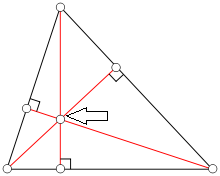
Which of the following words describes the point shown in the figure?
a)
Centerpoint
b)
Orthocenter
c)
Centroid
d)
Midpoint
45.
Which of the following words describes the point shown in the figure?
a)
Centerpoint
b)
Orthocenter
c)
Centroid
d)
Altitude-point
46.
A ray that divides an angle into two congruent angles.
a)
Segment Bisector
b)
Midpoint
c)
Angle Bisector
d)
Sunshine
47.
The figure is an example of a(n) ...
a)
median
b)
altitude
c)
midsegment
d)
angle bisector
48.
The figure is an example of a(n) ...
a)
altitude 
b)
perpendicular bisector
c)
midsegment
d)
angle bisector
49.
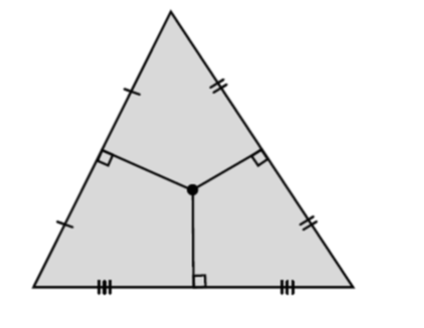
Which point is equidistant from the sides?
a)
Circumcenter
b)
Incenter
c)
Neither
d)
Bilateral
50.
Name the point of concurrency shown.
a)
Circumcenter
b)
Incenter
c)
Supercenter
d)
Neither
51.
An angle in a circle with vertex on the circle itself
a)
Angle
b)
Central angle
c)
Inscribed angle
d)
Chord
52.
The intercepted arc of an inscribed angle  is ___________________ the measure of the inscribed angle.
a)
congruent to
b)
half
c)
double
d)
supplementary to 
53.

Which number best represents an inscribed angle?

a)

1

b)

4

c)

5

d)

7

e)

9

54.
What type of construction do you see?
a)
Copy of an angle
b)
Angle Bisector
c)
Bisecting a Line Segment
d)
Parallel Lines
55.
Name the image
a)
Line
b)
Ray
c)
Line segment
d)
Angle
56.
A plane is named by...
a)
Any 1 point on the plane.
b)
Any 3 collinear points on the plane or a lowercase script letter.
c)
Any 3 non-collinear points on the plane or an uppercase script letter.
d)
All points on the plane that aren't part of a line.
57.

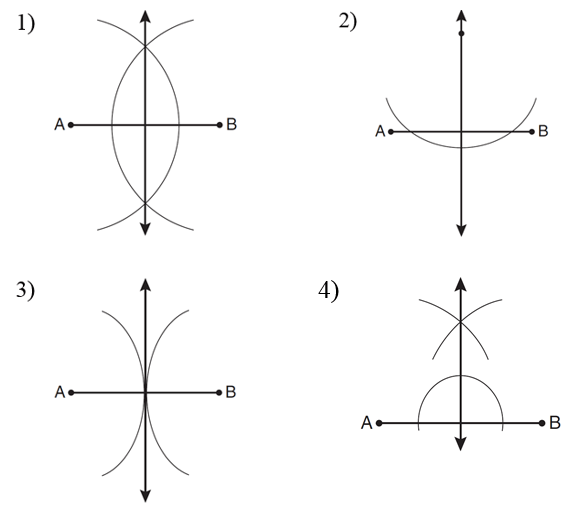
Which one is the correct construction for a perpendicular bisector?

a)

1

b)

2

c)

3

d)

4

58.
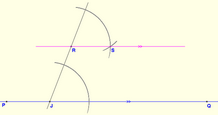
In the image, line RS is _______ to line JQ.
a)
parallel
b)
congruent
c)
similar
d)
perpendicular
59.
Name that shape.
a)
quadrilateral, rectangle
b)
quadrilateral, rectangle, square
c)
quadrilateral, parallelogram, rectangle
d)
quadrilateral, parallelogram, rectangle, square
60.
Name that shape. 
a)
square
b)
square
rhombus
c)
quadrilateral
parallelogram
rhombus
d)
quadrilateral
parallelogram
square
61.
A __________________ is always a rhombus, but a rhombus is not always a _______________. 
a)
rhombus
b)
parallelogram
c)
square
d)
rectangle
62.
A _______________ is a quadrilateral with two sets of parallel sides.
a)
trapezoid
b)
parallelogram
c)
kite
d)
triangle
63.
A line from the center of a regular polygon at right angles to any of its sides.
a)
apothem
b)
radius
c)
permimeter
d)
area
64.
A ___________ polygon is a polygon that is equiangular (all angles are equal in measure) and equilateral (all sides have the same length). 
a)
plain
b)
perfect
c)
regular
d)
magical
65.
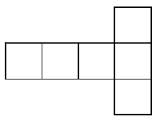
What do we call this object below?
a)
Net 
b)
Triangle
c)
Geometry
d)
y = mx + b
66.

Line AB contains ___________ point(s) and has ________ endpoint (s).

a)

infinite, no

b)

infinite, one

c)

infinite, two

d)

no, no

e)

one, one

67.

Ray AB contains ___________ point(s) and has ________ endpoint (s).

a)

infinite, no

b)

infinite, one

c)

infinite, two

d)

no, no

e)

one, one

68.

Segment AB contains ___________ point(s) and has ________ endpoint (s).

a)

infinite, no

b)

infinite, one

c)

infinite, two

d)

no, no

e)

one, one

69.

Which of the following describes line AB?

a)

 AB\overline{AB}  

b)

 ABAB  

c)

 AB\overrightarrow{AB}  

d)

 AB\overleftarrow{A}\overrightarrow{B}  

70.

Which of the following describes ray AB?

a)

 AB\overline{AB}  

b)

 ABAB  

c)

 AB\overrightarrow{AB}  

d)

 AB\overleftarrow{A}\overrightarrow{B}  

71.

Which of the following describes segment AB?

a)

 AB\overline{AB}  

b)

 ABAB  

c)

 AB\overrightarrow{AB}  

d)

 AB\overleftarrow{A}\overrightarrow{B}  

72.

Parallel Lines ___________ intersect.

a)

always

b)

sometimes

c)

never

73.

Two segments ___________ intersect.

a)

always

b)

sometimes

c)

never

74.

Two lines that do not intersect are ____________ skew.

a)

always

b)

sometimes

c)

never

75.

Skew lines are ________ coplanar.

a)

always

b)

sometimes

c)

never

76.

Perpendicular lines are ________ skew.

a)

always

b)

sometimes

c)

never

77.

Through any two points there is _______ a line.

a)

always

b)

sometimes

c)

never

78.

Determine of the lines are parallel, perpendicular, or neither.

a)

parallel

b)

perpendicular

c)

neither

79.
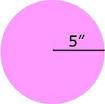
What is the diameter?
a)
5 in
b)
10 in
c)
3.14 in
d)
15.84 in
80.
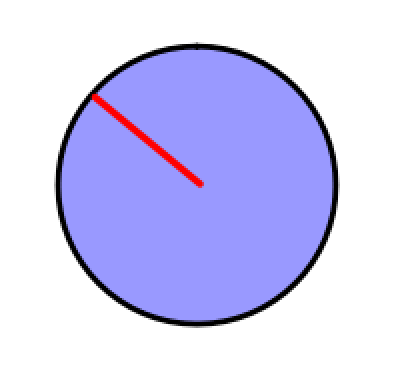
Is the red line a radius or diameter of the circle?
a)
Radius
b)
Diameter
81.
A slide is also called a _________.
a)
Translation
b)
Reflection
c)
Rotation
d)
Transformation
82.
A turn is also called a ___________.
a)
Translation
b)
Reflection
c)
Rotation
d)
Transformation
83.

Translations, reflections and rotations are all known as ________________________.

a)

Non-Rigid Transformations

b)

Rigid Transformations

84.
Round 2,648 to the nearest hundreds place.
a)
3,000
b)
2,650
c)
2,640
d)
2,600
85.
Round 23.542 to the nearest tenth.
a)
23.5
b)
23.6
c)
23.54
d)
23
86.
Which of the following is 9.029 rounded to the nearest hundredth?
a)
9.0
b)
9.02
c)
9.03
d)
9.029
87.

Round 1.823 to the nearest whole number.

a)

1

b)

1.8

c)

2

d)

2.8

88.
Round 72.178 to the nearest hundredth.
a)
72.2
b)
72.18
c)
72
d)
73.18
89.
Round 47.941 to the nearest tenth.
a)
47.9
b)
48
c)
47.91
d)
48.1
90.
Round to the nearest whole number.
75.109
a)
70
b)
80
c)
75
d)
75.1
91.
Round 43.827 to the nearest hundredth.
a)
43.82
b)
43.83
c)
43.87
d)
44
92.

Round 0.879 to the nearest whole number.

a)

0.1

b)

1

c)

0

d)

0.88

93.
Round to the nearest tenth.  
8.54
a)
8.5
b)
8.6
c)
9
d)
8.4
94.
Round to the nearest whole number.
99.95
a)
99.5
b)
99.6
c)
100
d)
109
95.
Round to the nearest tenth.
310.286
a)
310
b)
310.29
c)
310.3
d)
310.4
96.
Write the equation of a circle with center (h,k) and radius r.
a)
x2 + y2  = r2
b)
(x + h)2 +  (y + h)2 = r2
c)
(x - h)2 + (y - k)2 = r2
d)
(x - h)2 - (h - k)2 = r
97.
What is the center of a circle with equation (x-4)2 + y2 = 5?
a)
(-4, 0)
b)
(4, 0)
c)
(4, 1)
d)
(-4, 1)
98.
In the equation (x-4)2+(x-3)2=25, the radius is
a)
4
b)
3
c)
5
d)
25
99.
In the equation (x+2)2+(y-3)2=4, the radius of the circle is...
a)
4
b)
2
c)
3
d)
16
100.
What is the center of the circle with this equation is (x+2)²+(y-4)²=41?
a)
(2,-5)
b)
(-2,4)
c)
(2,-4)
d)
(-2, -4)