
 Worksheets
Atomic Structure and the Periodic Table
Total questions: 53
Worksheet time: 30mins
What do we call protons, electrons, and neutrons as a group?
components
subatomic particles
bonds
periodic table of the elements


The mass # tells us the mass of the atom. Which two subatomic particles make up the mass of the atom?
protons and electrons
neutrons and electrons
Kyrontrons and Kytrons
protons and neutrons
What can you do to find the number of neutrons in an atom?
It's the same as the atomic #.
Ask Sierra!
Subtract the atomic # (protons) from the mass # (protons and neutrons)
Multiply the mass # (protons and neutrons) and the atomic # (protons)

What is the atomic number for an element with three protons?
6
1
3

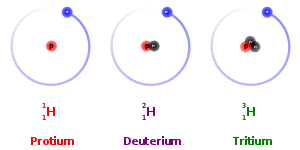
Different isotopes have...
different masses
different protons
different electrons

Which number here is the atomic number?
5
10.811
Isotopes are atoms that have the same number of protons but a different number of _____________.
neutrons
electrons
atoms
Number of protons
Atomic Number
Charge
Nucleus Stability
Atomic Mass
Number of protons and neutrons
Atomic Number
Charge
Nucleus Stability
Atomic Mass
Number of electrons
Atomic Number
Charge
Nucleus Stability
Atomic Mass
Number of neutrons
Atomic Number
Charge
Nucleus Stability
Atomic Mass
who discovered the first scientific and systematic periodic table
Henry Mosley
Dmitri Mendeleev
John Dalton
sir Isaac Newton
choose the correct statement
the vertical column in the periodic table is called period
the vertical column in the periodic table is called group
the horizontal row in the periodic table is not called period
none of the above
how many groups are there in modern periodic table
8
9
18
17
a unique number for each element that equals the number of protons in an atom of that element
element name
element symbol
atomic number
atomic mass
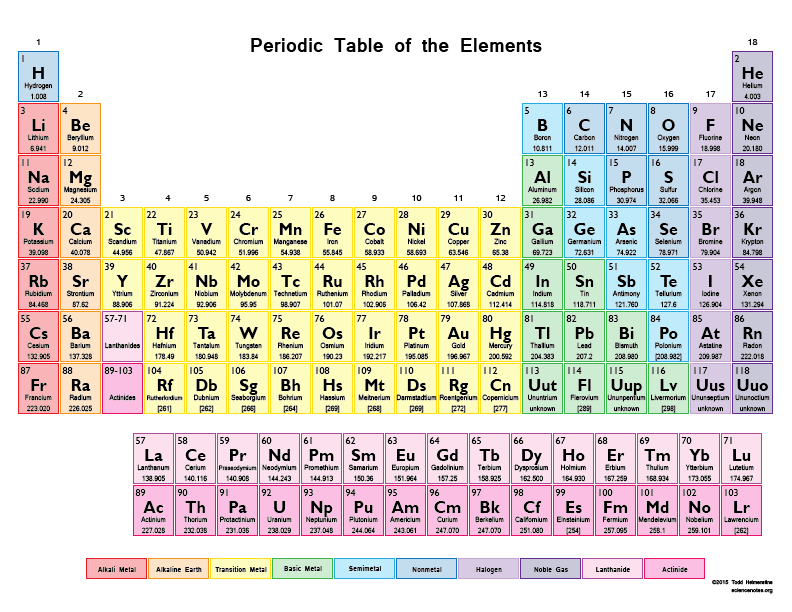
What is the atomic number of Barium, Ba? (enlarge the periodic table)
20
38
56
88
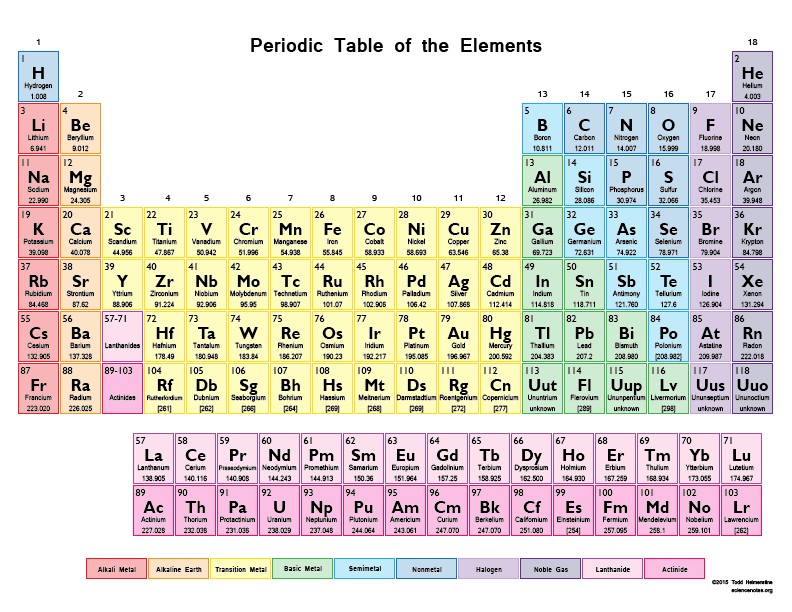
How many protons are in a sodium atom, Na? (tap to enlarge the periodic table)
Sodium has 1 proton.
Sodium has 3 protons.
Sodium has 11 protons
An element has the mass number 12 and atomic number 6. The number of neutrons in it is:
6
10
4
8
If an atom has 10 electrons, how many protons does it have?
0
1
10
5
As you move left to right on a row or period what happens?
Atomic number increases by 1
Electrons decrease
Number of shells decrease
Nothing
The first energy shell can hold ______ electrons.
2
8
18
All elements in the same row have the same number of shells.
True
False
Sometimes
Mendeleev's genius was his ability to
predict elements that were not discovered yet
organize elements by their mass
had an element named after himself
organize elements by properties

Elements in the same group or column have the same ...
# of valence electrons
# of shells
# of protons
Mass Number

Rows on the periodic table are called ___________.
Periods
Sentences
Fences

The columns in the periodic table are called ___________.
Towers
Herds
Groups
Elements in the same group have __________
Similar Properties
Same number of shells
Similar Mass
What do all elements in the same period have?
same number of shells
same number of electrons
belong in the same family

The number of valence shell electrons increases across the...
group
period
cluster
periodic table


Which of the following is a conclusion of Rutherford's gold foil experiment?
The nucleus is negatively charged
The atom is dense solid and is indivisible
The mass is conserved when atoms react chemically
The nucleus is very small and the atom is mostly empty space
The most reactive metals are the
alkali metals
alkali earth metals
transition metals
metalloids
The elements with largest atomic radii are found
across the top of the periodic table
on the far right side of the periodic table
the bottom left corner
the top right corner

On the periodic table, Periods are
Horizontal rows
Vertical columns

