Wayground logo

Free Printable Worksheets

Font size

S
M
L
XL
Worksheets

phase changes graphs and math

Total questions: 27

Worksheet time: 51mins

Name
Class
Date
1.

During a phase change what happens to temperature?

a)

it increases

b)

it decreases

c)

depends; if being heated it increases, if being cooled it decreases

d)

stays constant

2.
All changes in the state of matter of a substance requires a change in 
a)
mass
b)
temperature
c)
permission
d)
energy
3.
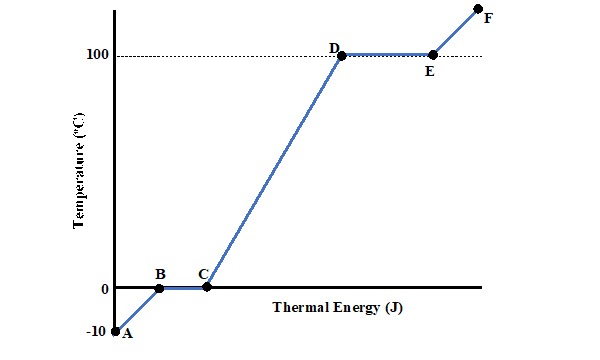
What line segment represents only the solid state?
a)
A-B
b)
B-C
c)
C-D
d)
D-E
4.

Between which two points is Heat of Fusion?

a)

A <----> B

b)

B <----> C

c)

C <----> D

d)

D <----> E

e)

E <----> F

5.

Between which two points is Heat of Vaporization?

a)

A <----> B

b)

B <----> C

c)

C <----> D

d)

D <----> E

e)

E <----> F

6.
A substance's heating curve is shown in the graph.  What is its boiling point?
a)
100 C
b)
60 C
c)
80 C
d)
20 C
7.
The graph shows a cooling curve for an unknown substance.  What is happening during segment DE?
a)
boiling
b)
condensation
c)
freezing
d)
melting
8.

Which equation do you use to solve for segment B-C?

a)

q=mCΔT

b)

q= Hv*m

c)

q= Hf*m

d)

PV=nRT

9.

The energy of which segments can be found using the equation q=mCΔT?

a)

A-B, D-E, E-F

b)

B-C, D-E ,E-F

c)

B-C, C-D, E-F

d)

A-B, C-D, E-F

10.

Which equation do you use to solve for the energy of segment C-D?

a)

q=mCΔT

b)

q= Hv*m

c)

q= Hf*m

d)

PV=nRT

11.

Which equation would you use to solve the following: Calculate the heat necessary to change 10 g of ice(s) at 0°C to 10 g of water(l) at 0°C.

a)

q=mCΔT

b)

q= Hv*m

c)

q= Hf*m

d)

PV=nRT

12.
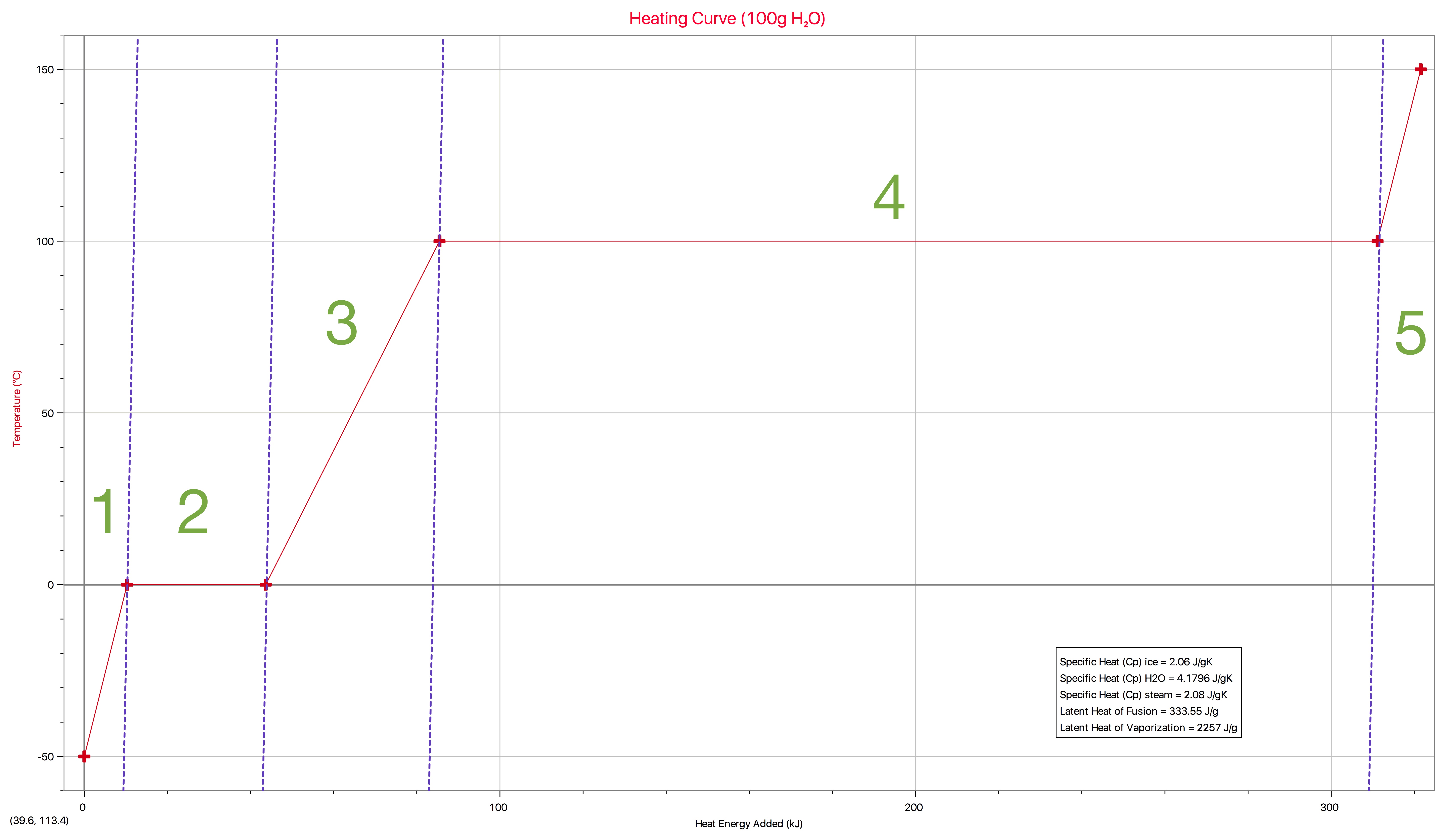
In which region(s) of the graph does a phase change occur?
a)
Region 1, 3, & 5
b)
Region 2 & 4
c)
Region 1 only
d)
Region 1 & 2
13.
At higher temperatures
a)
particles in an object have less energy
b)
particles in an object move faster
c)
a gas contracts
14.
In which region(s) of the graph would the substance only be in one phase?
a)
Region 1, 3, & 5
b)
Region 2 & 4
c)
Region 1 only
d)
Region 1 & 2
15.

Given the heating curve of a solid being heated at a constant rate, what is the boiling point of this substance?

a)

20°C

b)

50°C

c)

110°C

d)

170°C

16.

How many Joules of energy are required to make 50.0 grams of ice at 0 οC completely melt? The Heat of fusion for water is 334 J/g.

a)

334 J

b)

0 J

c)

33,400 J

d)

16,700 J

17.

The temperature of a 6.0 g sample of glass changed from 20.0°C to 45.0°C when it absorbed 550 J of heat. What is the specific heat of this glass?

a)

2291 J/g °C

b)

3.7 J/g °C

c)

130 J/g °C

d)

12 J/g °C

18.
Specific heat of water is  4.18 J/g°C. Specific heat of wood is 1.760 J/g°C What material needs more heat energy to raise the temperature?
a)
Water
b)
Wood
c)
Both are same
19.

Calculate the energy needed to completely boil away 30 g of water at 100 ⁰C . The heat of vaporization of water is 2260 J/g.

a)

67,800 J

b)

2260 J

c)

226,000 J

d)

100 J

20.
The amount of energy required to raise the temperature 1ºC for every kilogram is called____?
a)
Thermal Energy
b)
Specific Heat
c)
Temperature
d)
Kinetic Energy
21.
If a 8.50g ice cube at -10o C sits out on the counter, completely melts, and then warms to room temperature (25o C) how much energy did the ice cube absorb? Use C = 2.108 J/goC for ice, C = 4.184 J/goC for water, and Hf = 334 J/g.
a)
179.18 J
b)
2839 J
c)
889.1 J
d)
3907.3 J
22.
When water is heated from 10°C to 15°C What is the change in temperature?
a)
10 °C
b)
5 °C
c)
15 °C
d)
25 °C
23.

When a piece of aluminum foil is taken out of the oven and cools from 100°C to 50°C.

What is the change in temperature?

a)

- 50°C

b)

0°C

c)

100°C

d)

50°C

24.

In an endothermic reaction, energy is _________.

a)

absorbed

b)

released

25.

Exo means out or ________.

a)

absorbed

b)

released

26.
Endothermic phase changes include
a)
conduction, convection and radiation
b)
freezing and condensation
c)
vaporization and condensation
d)
melting, boiling, evaporation and sublimation
27.
Exothermic phase changes include
a)
conduction, convection and radiation
b)
freezing and condensation
c)
vaporization and condensation
d)
melting, boiling, evaporation and sublimation