
 Worksheets
Review for Summative #2 (Conceptual)
Total questions: 15
Worksheet time: 9mins
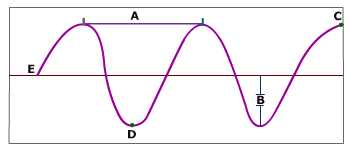
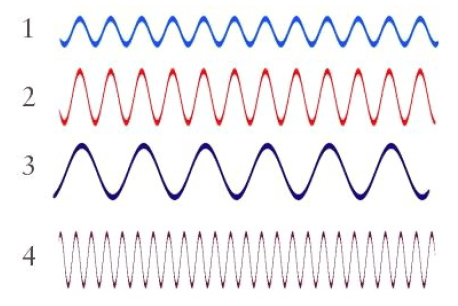
Which wave in the diagram has the highest frequency?
1
2
3
4

What is the frequency of this wave?
0.4 Hz
0.6 Hz
2.5 Hz
0.5 Hz

Waves can transfer ________ from one place to another.
Matter
Mass
Energy
Molecules

What is the speed of a wave with a wavelength of 2m and a period of 10 seconds?
20 m/s
20 Hz
0.2 m/s
0.2 Hz

Which type of medium do sound waves travel the fastest through?
A solid, like wood.
A liquid, like water.
A gas, like air.

What wave phenomenon is shown here?
Destructive interference
Constructive interference
Diffraction
Resonance

Which of the following statements are true about induction? Check all that apply.
Moving a magnet in and out of a wire coil induces a current in the wire coil.
Induction relates electricity to magnetism.
Current flowing through a wire coil induces a magnetic field around the wire coil.
Moving a magnet near a second magnet induces an electric current between the magnets.

How can you increase the magnetic field strength in an electromagnet?
Increase the number of coils and add a metal core.
Decrease the number of coils and add a metal core.
Increase the number of coils and remove the metal core.
Decrease the number of coils and remove the metal core.

A positive charge approaches a magnetic field from the left as shown. What direction will the magnetic force push the charge?
Up
Down
Into the screen
Out of the screen
Motors are devices that convert _____ energy into _____ energy.
chemical; mechanical
mechanical; electrical
electrical; mechanical
potential; kinetic

How does an electric motor work?
Current induces an electric field around a coil of wire that is then attracted or repelled by the permanent magnet, causing rotation.
Current induces a magnetic field around a coil of wire that is then attracted or repelled by the permanent magnet, causing rotation.
Permanent magnets in the motor attract and repel the coil of wire, causing rotation.

A positive charge of 7E−6 C is placed a distance of 0.01 m from a negative charge of -8E−6 C. Will the two charges attract or repel?
Attract
Repel
Neither attract or repel

