
 Worksheets
Evolution Practice
Total questions: 10
Worksheet time: 7mins
Name
Class
Date
1.
Natural selection is best described as
a)
a change in an organism in response to a need of that organism
b)
a process of nearly constant improvement that leads to an organism that is nearly perfect
c)
differences in survival rates as a result of different inherited characteristics
d)
inheritance of characteristics acquired during the life of an organism
2.
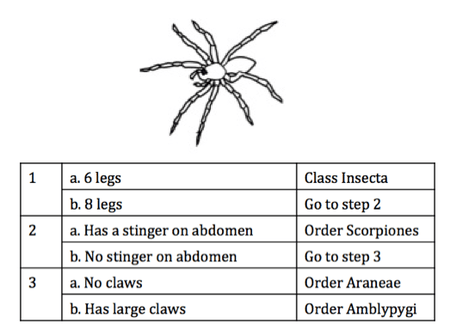
An illustration and a dichotomous key are given. What is the correct classification for this organism?
a)
Class Insecta
b)
Order Amblygygi
c)
Order Araneae
d)
Order Scorpiones
3.
The environment around Manchester, England, changed during the Industrial Revolution. How did this change affect peppered moths living in the area?
a)
Natural selection favored moths with dark wings because predators could not see them on the soot-colored trees.
b)
Natural selection favored moths with white wings that were easy for predators to see.
c)
Natural selection favored moths with white wings because predators could not see them on the soot-colored trees.
d)
Natural selection caused moths with white wings to become extinct.
4.

The pelvic bone of whales is not needed for movement within the water. This is an example of a(n) ______________ structure.
a)
vestigial
b)
analogous
c)
homologous
5.
When an organism completely dies out, it is called.....
a)
Adaption
b)
Extinction
c)
Fossilization
d)
Mutation
6.

Scientists are studying the evolutionary history of a group of plants in the United States, and they developed an evolutionary tree, as shown below.Which statement can be inferred from the evolutionary tree?
a)
Species 1 is most closely related to Species 8.
b)
Species 2 is most closely related to Species 3.
c)
Species 3 is most closely related to Species 7.
d)
Species 5 is most closely related to Species 6.
7.

On this evolutionary tree, which organism is the closest relative of the human?
a)
Frog
b)
Hare
c)
Caiman
d)
Parrot
8.

Many different groups of organisms have wings, even though they do not share a recent common ancestor. This is because they evolved in environments with similar selective pressures. Wings are an example of a(n) ______________ structure.
a)
vestigial
b)
analogous
c)
homologous
9.
Differences that exist naturally among members of a population or species___?
a)
mutation
b)
adaptation
c)
variations
d)
evolution
10.

The forelimbs of mammals have similar anatomy because these groups descended from a recent common ancestor. Their bone structure is an example of a(n) ______________ structure.
a)
vestigial
b)
analogous
c)
homologous
100 %

