
Font size
 Worksheets
Gravitation
Total questions: 17
Worksheet time: 29mins

The picture shows the gravitational field in the space surrounding the Earth. What is creating this gravitational field?
The gravitational force.
The mass of the Earth.
The distance of the Earth.
The universal gravitational constant.
Two factors affecting the magnitude of the force of gravity between 2 objects are...
mass and distance
mass and matter
distance and weight
weight and mass

If the mass of either m1 or m2 is increased then the force of gravitation between them will...
increase
decrease
stay the same

How is the gravitational force between objects related to their mass
They are directly proportional
They are inversely proportional
They do not affect each other
They are equal
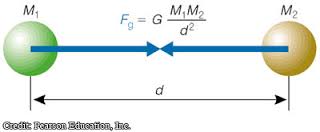
If the distance between two objects is doubled, what happens to their gravitational force?
4x bigger
4x smaller
2x bigger
2x smaller

The gravitational force between two masses is 40N. The distance between the two masses changes from 6m to 2m. Determine the new gravitational force.
360 N
40 N
0 N
120 N
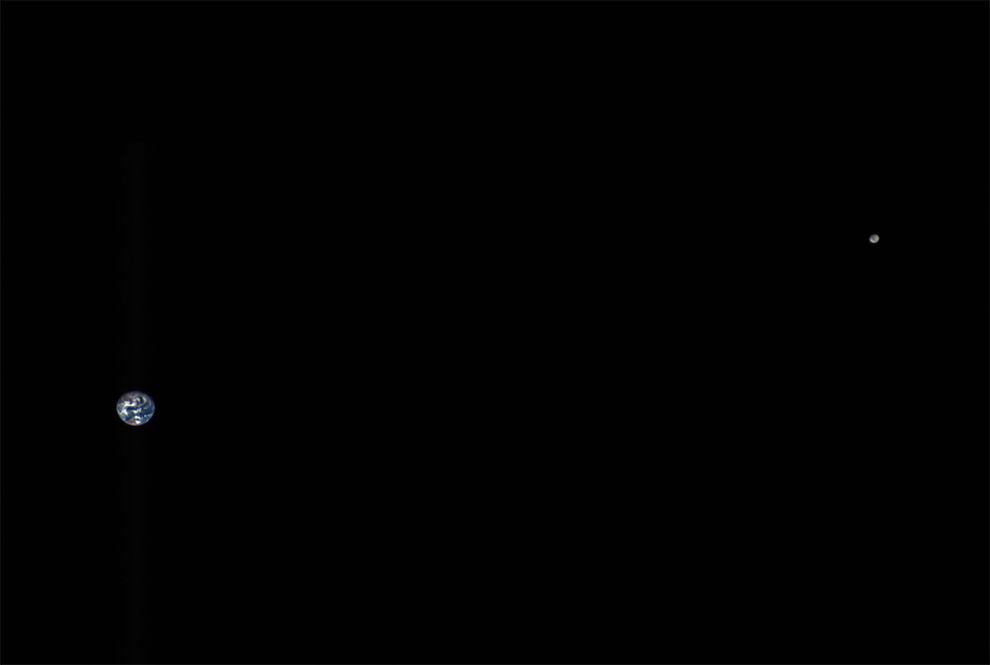
According to Newton's law of gravitation, the Earth and the Moon are gravitationally attracted to each other. The more massive Earth attracts the Moon with...
a stronger force than the Moon attracts the Earth.
a weaker force than the Moon attracts the Earth.
the same force as the Moon attracts the Earth.
a force that is sometimes stronger and other times weaker than the Moon attracts the Earth.

Calculate the gravitational force between a 15-kg chinchilla and a 65-kg dog which are separated by 0.30 m. (G = 6.67 x10^-11 Nkg^-2m^2)
Fg = 3.7*10-8 N
Fg = 1.3*1012 N
Fg = 1.1*105 N
Fg = 7.2*10-7 N
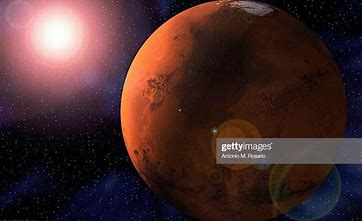
What would the gravitational force be between the Sun and Mars if they were 2.3*1011 m apart? The masses for the Sun and Mars are 1.99*1030 kg and 6.42*1023kg, respectively. (G = 6.67 x10^-11 Nkg^-2m^2)
Fg = 3.8*1015 N
Fg = 2.8*10-42 N
Fg = 1.6*1021 N
Fg = 4.6*10-75 N
Which of the following is true about geostationary satellite?
Above different geographical location.
The orbital period is longer than 24 hours.
It does not experience any gravitational pull
Its period of rotation is one day.
A satellite orbits Earth at an altitude of 400 km above the planet’s surface. What is its linear speed in m s^-1?
(G = 6.67 x10^-11 Nkg^-2m^2, radius of Earth = 6.37x10^6 m, mass of Earth = 5.97x10^24 kg)
Round your answer to three significant digits.
(a)

The diagram shows planets Jupiter and Venus orbiting the Sun with R1 and R2 respectively. What is the ratio of the orbital period of Jupiter and Venus if the ratio of their radius orbit is 9:4?
64: 729
16: 81
27: 8
8: 27

