
 Worksheets
WEEK 6-3.3 ELECTROLYTIC CELL
Total questions: 10
Worksheet time: 14mins
Name
Class
Date
1.
In an electrolytic cell, the positive electrode is the
a)
anode, where oxidation occurs
b)
anode where reduction occurs
c)
cathode where oxidation occurs
d)
cathode where reduction occurs
2.
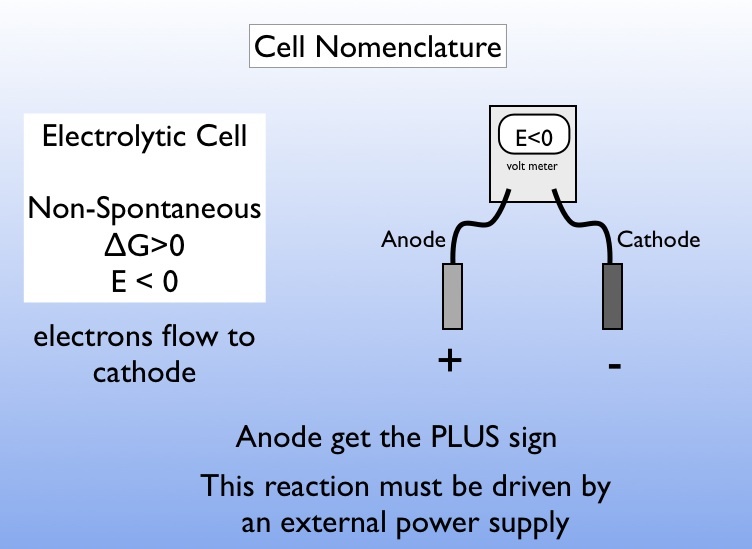
What is an electrolytic cell?
a)
a cell that converts chemical energy into electrical energy
b)
a cell that converts electrical energy into electrical energy
c)
a cell that converts electrical energy into chemical energy
d)
A cell that converts kinetic energy into potential energy.
3.

Which factors affect amount of metal formed during electrolysis?
a)
I and II
b)
I and III
c)
II and III
d)
I, II and III
4.

Object is electroplated with copper using copper(II) sulfate. Which statement is correct?
a)
Positive electrode increases in mass
b)
Concentration of Cu2+ ions in solution decreases
c)
Reduction occurs at positive electrode
d)
Reaction at negative electrode is Cu2+ + 2e– → Cu
5.
In electrolytic cell which its electrolyte is copper (II) sulphate, copper are used as electrodes. What is the product at the anode?
a)
Oxygen gas and water
b)
Copper metal
c)
Copper (II) ions
d)
Hydrogen gas
6.

A student decided to silver-plate a locker key using the apparatus shown. In this cell, the key is the
a)
anode and is connected to the positive terminal of the power supply
b)
anode and is connected to the negative terminal of the power supply
c)
cathode and is connected to the positive terminal of the power supply
d)
cathode and is connected to the negative terminal of the power supply
7.
What is the product formed at the cathode during the electrolysis of molten magnesium fluoride?
a)
magnesium
b)
hydrogen
c)
fluorine
d)
oxygen
8.
96.5 C of electricity is used to completely deposit silver metal (Ag) from an aqueous solution in which the silver ion is present as Ag+(aq). Another 96.5 C is used to completely deposit copper (Cu) from an aqueous solution in which the copper ion is present as Cu2+(aq). The silver metal deposited would
a)
have half the mass of the copper deposited
b)
have twice the mass of the copper deposited
c)
be half the mole of the copper deposited
d)
be twice the mole of the copper deposited
9.

An experiment is set up as shown in the diagram below. Both electrodes P and Q are made of graphite. Which of the following gives the correct results as electrolysis proceeds?
a)
Electrolytes: Aqueous sodium chloride; Mass of P: Remains
unchanged; Mass of Q: Increase
b)
Electrolytes: Aqueous sodium chloride; Mass of P: Increase; Mass of Q: Remains
unchanged
c)
Electrolytes: Aqueous copper(II) sulfate; Mass of P: Remains
unchanged; Mass of Q: Increase
d)
Electrolytes: Aqueous copper(II) sulfate; Mass of P: Increase; Mass of Q: Remains
unchanged
10.
Dilute aqueous zinc chloride is electrolysed using platinum electrodes. What are the products at the electrodes?
a)
anode: chlorine
cathode: hydrogen
cathode: hydrogen
b)
anode: hydrogen
cathode: oxygen
cathode: oxygen
c)
anode: oxygen
cathode: hydrogen
cathode: hydrogen
d)
cathode: zinc
cathode: oxygen
cathode: oxygen
100 %

