
 Worksheets
CS IGCSE Unit 7. Low and high level programming - recap
Total questions: 76
Worksheet time: 43mins
What is a MNEMONIC?
A single action that can be performed by a computer.
A symbol that represents an instruction in assembly code.
A high level language keyword.
A register used inside a CPU A register used inside a CPU.
Which of the following is NOT a translator?
Assembler
Compiler
Interpreter
Executable
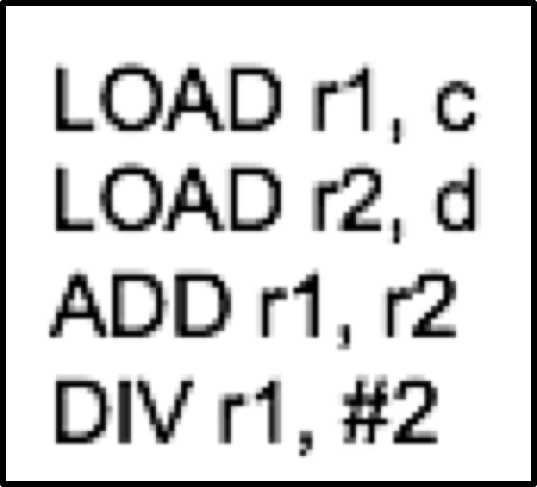
LOAD r2,
ADD r1,
DIV r1, #2
What generation of programming language is Machine Code
1st Generation
2nd Generation
4th Generation
3rd Generation
Program is translated line by line as the program is running
Assembler
Compiler
Interpreter

Select all the High-level programming languages ...
Python
C#
PHP
Assembly

Select all the Low-level programming code ...


Select all the types of program translator ...
Compiler
Interpreter
Assembler
Parser

What is another name for the original untranslated program code?
Source code
Object code
Machine code
Assembly code

Choose the BEST word to complete this sentence:
Assembly code uses short, simple codes called ___________ to represent the instructions of a processor's instruction set.
mnemonics
opcodes
acronyms
abbreviations

Choose all the examples of high-level language code ...


Select all the TRUE statements about high-level languages ...
They use recognisable English language keywords
They provide libraries of built-in functions for the programmer
Code must be translated into binary machine code before it can be executed
They are difficult to learn

Select all the statements that are FALSE about programming in low-level languages ...
It is easy to learn to program
There are good debugging tools available
Code runs very quickly
You need a good knowledge of the processor architecture
Which level of a programming language is Machine Code?
Low
High
Which level of a programming language is Assembly Code?
Low
High
Which level would create the fastest code to execute?
Low
Assembly
High
Which level would create the easiest code for humans to understand?
Low
Assembly
High
Python is an example of a High Level programming language
True
False

Which generation?
Machine Code - Low
Assembly Code - Low
High Level
Which generation?
Machine Code - Low
Assembly Code - Low
High Level

Which generation?
Machine Code - Low
Assembly Code - Low
High Level
Binary is the only language a computer can understand
True
False
Computers must translate everything into binary
True
False
High Level Code is easier for humans to understand as it is written in English
True
False
What is the only thing that computers understand?
Machine Code
Low Level Language
High Level Language
Algorithm
Before a computer can understand a program it must be...
Translated into its machine code.
Translated into a high level language.
Translated into a low level language.
Java, Python, PHP, and C++ are examples of
low level languages
Graphic arts languages
medium level languages
high level languages
Which of these is the set of rules that must be followed when typing code using a programming language?
Syntax
Value
Expression
Statement
Which of these is the process of typing a series of instructions to have a computer perform a task?
programming
computing
composing
creating
Machine code is written using...
Binary/hexadecimal
English-like key words
Plain English
Abbreviated mnemonic keywords
Assembly langauge is written using...
Binary/hexadecimal
English-like key words
Plain English
Abbreviated mnemonic keywords
Advantages of low-level languages include...
Direct access to the CPU
Programs written will often be more efficient than high-level programs
Easier to remember programming commands
Can use subroutines and advanced data structures
Assembly language is better than machine code because...
it is easier for humans to read
it is easier to remember the instructions
a person is less likely to make mistakes in assembly language
it is written using English-like keywords

Which of these is machine code?
A
B
This is where the code is written.
Translator
Run time environment
Editor
Error diagnostics
Notepad
Uses Mnemonics as command words (for example LDA, STA and ADD)
High level code
Low level code
Assembly language
What generation of programming language is Machine Code
1st Generation
2nd Generation
4th Generation
3rd Generation
What type of language translator is needed for the 1st Generation to the CPU
Compiler
No translator needed
Assembler
Interpreter
2nd generation to 1st Generation language needs what type of translator.
An assembler
Interpreter
No translator needed
Compiler
Which generation is the fastest code to execute.
3rd Generation
2nd Generation
4th Generation
1st Generation
What is the easiest to program for a programmer.
1st Generation
2nd Generation
4th Generation
3rd Generation
Why would you program in a low level language.
Easier to understand
Uses less code
Makes programs with small file sizes
Simple to de-bug
Select all the High-level programming languages ...
Python
C#
PHP
Assembly
Select all the Low-level programming code ...
What is another name for the original untranslated program code?
Source code
Object code
Machine code
Assembly code
Choose the BEST word to complete this sentence:
Assembly code uses short, simple codes called ___________ to represent the instructions of a processor's instruction set.
mnemonics
opcodes
acronyms
abbreviations
A logic error
is when the program is coded correctly, but an error occurs because of a problem while the program is being executed (not because of a mistake in the code)
is when incorrect words or punctuation is used, or when correct words and punctuation are used in the wrong order
is when the stars don't line up properly and a cosmic ray changes a true value to a false value
is when the program is coded incorrectly to produce an incorrect result, but with correct statements. The only way to know there was an error is to notice that the result is wrong
IDE's contain a ________ environment which allows you to execute the program
runtime
outtime
walktime
linetime
Text area used to enter code in an IDE.
Breakpoints
Code Editor
Error Diagnostics
Run time environment

