wayground logo

Free Printable Worksheets

NEW

Font size

S
M
L
XL
Worksheets

CH 2 Weather Review

Total questions: 75

Worksheet time: 1hrs 11mins

Name
Class
Date
1.

A ________________ is an intense storm with strong winds, heavy rain, lightning, and thunder.

a)

tornado

b)

hurricane

c)

thunderstorm

2.

Electricity may flow within the cloud also flow between the cloud and the ground. These electrical currents are _________________.

a)

thunder

b)

particles

c)

lightning

3.

When lightning moves through the air, the air gets very hot. The hot air expands rapidly. As it expands, it makes the air vibrate. These vibrations release energy in the form of sound waves called ______________.

a)

thunder

b)

particles

c)

lightning

4.

A _________ can from when a rapidly spinning column of low pressure air, called a funnel cloud touches the ground.

a)

thunderstorm

b)

hurricane

c)

tornado

5.

A _____________ is a large, rotating low-pressure system that forms over the warm waters of oceans near the equator.

a)

tornado

b)

hurricane

c)

thunderstorm

d)

flooding

6.

Most hurricanes

a)

cannot be seen from space

b)

cross exposed land

c)

become dangerous category 5 storms

d)

lose their power when they move into cooler waters or moves over land

7.

Thunderstorms form along a cold front

a)

True

b)

False

8.

Thunderstorm clouds are known as _____.

a)

cirrus clouds

b)

stratus clouds

c)

cumulonimbus clouds

d)

cumulus clouds

9.

The calm area in the center of a hurricane is called the _____.

a)

draft

b)

funnel

c)

eye

d)

squall

10.

About 75% of the world's tornadoes happen in the United States during Springs and early Summer when cold, dry from Canada meets warm, moist air from the Gulf of Mexico. This relatively flat part of the country is known as ________________.

a)

Tornado Paradise

b)

Thunderstorm Lane

c)

Tornado Alley

d)

Hurricane Row

11.
Which of the following is a large snowstorm with high winds?
a)
Tsunami
b)
Cold front
c)
Blizzard
d)
Hurricane
12.
Which of the following is a large snowstorm with high winds?
a)
Tsunami
b)
Cold front
c)
Blizzard
d)
Hurricane
13.
What is a front?
a)
A place where air masses meet
b)
the front part of a storm
c)
An area of very high wind
d)
an area that has fair weather
14.
rapidly moving cold air  mass runs into a warm air mass the cold air slides under the warm air. This is called a  .....
a)
cold front
b)
warm front
c)
stationary front
15.
When a cold front is approaching, what happens?
a)
warm air is pushing under cold air causing humid weather and lower temperatures
b)
warm air is pushing under cold air causing humid weather and higher temperatures
c)
warm air rises, cools, and causes rain and thunderstorms
d)
cold air is pushed over warm air causing rain and thunderstorms
16.
This is the symbol for which type of front?
a)
cold front
b)
warm front
c)
occluded front
d)
stationary front
17.
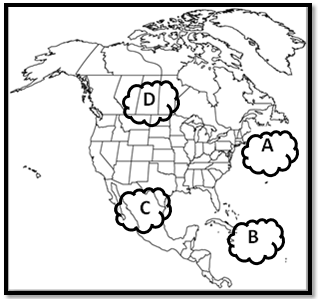
Which type of air would you find at air mass D?
a)
cold, dry
b)
warm, humid
c)
warm, dry
d)
cold, humid
18.
What characteristics are used to classify air masses?
a)
temperature and humidity
b)
pressure and temperature
c)
latitude and longitude
d)
wind speed and location 
19.
What type of weather would you expect to see after a cold front has passed through an area?
a)
cool and clear skies
b)
warm and humid
c)
thunderstorms
d)
foggy
20.
Where would you find a tropical maritime air mass?
a)
over the ocean, near the equator
b)
over the ocean, near the poles
c)
over a continent, near the equator
d)
over a continent, near the poles
21.

An air mass is

a)

a large body of air with about the same temperature and humidity throughout

b)

the amount of moisture in the air

c)

a place where two different air masses meet

d)

a cold air mass that bumps against a warm air mass

22.

What is humidity?

a)

cold air

b)

hot air

c)

the amount of moisture in the air

d)

direction of a front

23.

What is a warm front?

a)

a cold air mass bumps against a warm air mass

b)

a warm air mass meets a colder air mass and slowly rises over it

c)

two air masses meet and stop moving

d)

warm air mass gets caught between 2 cold air masses

24.

What kind of front is this?

a)

warm

b)

cold

c)

occluded

d)

stationary

25.

What kind of front is: A warm air mass gets caught between 2 cold air masses, warm air rises up between the 2

a)

warm front

b)

occluded front

c)

warm front

d)

cold front

26.

If an air mass forms above land, it will be

a)

wet

b)

dry

c)

cold

d)

hot

27.

If an air mass forms over an ocean it will be

a)

wet

b)

dry

c)

cold

d)

warm

28.

What kind of pressure system is light and rises bringing wet, cloudy weather

a)

High pressure system

b)

Low pressure system

29.

What weather instrument measures air pressure?

a)

hygrometer

b)

anemometer

c)

thermometer

d)

barometer

30.

Air pressure is measured with a ______________.

a)

thermometer

b)

barometer

c)

meter

d)

hydrometer

31.

A strong thunderstorm followed by clear skies and a drop in temperature is the result of a _____________ moving through.

a)

warm front

b)

cold front

c)

air mass

d)

pressure front

32.

On a summer day, a barometer reading shows an increase in air pressure. What type of weather should be expected?

a)

Clear and sunny

b)

Cloudy and rainy

c)

Rainy and windy

d)

Cloudy and cold

33.

What kind of weather is a low-pressure system most likely to bring?

a)

Clear weather

b)

Hot, sunny weather

c)

Precipitation (rain or snow)

d)

Light breezes

34.

Which instrument measures air pressure?

a)

sling psychrometer

b)

hygrometer

c)

barometer

d)

anemometer

35.

Which instrument measures temperature?

a)

sling psychrometer

b)

thermometer

c)

barometer

d)

anemometer

36.

What kind of weather is a high-pressure system most likely to bring?

a)

Clear, sunny weather

b)

Hot, sunny weather

c)

Precipitation (rain and snow)

d)

Light breezes

37.

Which instrument measures wind speed?

a)

sling psychrometer

b)

hygrometer

c)

barometer

d)

anemometer

38.

Which of the following tools measures wind speed?

a)
b)
c)
d)
39.

In general, clear skies come with a high-pressure area and cloudier conditions in areas of low pressure.


Which city on the map is most likely experiencing CLOUDS but will see CLEAR SKIES soon?

a)

Omaha

b)

Atlanta

c)

Cleveland

d)

Los Angeles

40.
What is the name of this tool?
a)
Barometer
b)
Hygrometer
c)
Rain Gauge
d)
Thermometer
41.
What instrument is shown in the picture?
a)
anemometer
b)
wind vane
c)
thermometer
d)
barometer
42.
What instrument is shown in the picture?
a)
barometer
b)
hygrometer
c)
sling psychrometer
d)
thermometer
43.
What instrument is shown in the picture?
a)
anemometer
b)
sling psychrometer
c)
thermometer
d)
barometer
44.
What instrument is shown in the picture?
a)
anemometer
b)
wind vane
c)
barometer
d)
sling psychrometer
45.
Which city is experiencing thunderstorms?
a)
Denver
b)
New York 
c)
Miami 
d)
Boise
46.
Which city is currently experiencing a snow storm?
a)
Seattle
b)
Los Angeles
c)
Chicago
d)
New York
47.
A cold front is approaching Minneapolis. What will happen to the air temperature?
a)
stay the same
b)
increase
c)
decrease
48.
Which city has partly cloudy skies?
a)
Boise
b)
New York
c)
Atlanta 
d)
Dallas
49.

What is this weather instrument?

a)

Wind Vane

b)

Barometer

c)

Wind Sock

d)

Wind Flag

50.
What is the water cycle?
a)
the 3 forms of water
b)
the movement of water on, above, or below the surface of the Earth
c)
when water melts
d)
when clouds form
51.
Which is the opposite of condensation?
a)
runoff
b)
evaporation
c)
precipitation
d)
transpiration
52.
What part of the water cycle does this picture show?
a)
condensation
b)
precipitation
c)
evaporation
53.
Snow, sleet, hail, and rain are all examples of  ________________. 
a)
evaporation
b)
condensation
c)
accumulation
d)
precipitation
54.
When water _________, dew forms.
a)
Melts
b)
Evaporates
c)
Condenses
d)
Precipitates
55.
What is the energy source for the water cycle?
a)
the sun
b)
the earth
c)
water
d)
the moon
56.
What is A?
a)
Evaporation
b)
Condensation
c)
Precipitation
d)
Runoff
57.
What is B?
a)
Evaporation
b)
Condensation
c)
Precipitation
d)
Runoff
58.
What is water that flows in rivers and streams into the oceans and lakes?
a)
evaporating
b)
condensing
c)
precipitating
d)
runoff
59.

What is C?

a)

Evaporation

b)

Condensation

c)

Precipitation

d)

Runoff

60.

The amount of water vapor in the air is known as ___.

a)

dew point

b)

humidty

c)

relative humidity

d)

rain

61.

Which will hold more water, warm air or cold air?

a)

Warm Air

b)

Cold AIr

62.
The amount of water vapor in the atmosphere compared to how much it could hold.
a)
Saturation
b)
Vaporicity
c)
Absolute Humidity
d)
Relative Humidity
63.

Humidity can be found by comparing the temperatures of _________________.

a)

barometers

b)

wet-bulb and dry-bulb thermometers

c)

Hydrometers

d)

Anemometers

64.
Dew Point is the
a)
temperature air cools down to reach condensation (or turn into a liquid)
b)
temperature where ice melts to liquid water
c)
temperature where ice turns directly into water vapor
d)
time of day when dew on the ground disappears
65.
This type of cloud is thin, wispy, and made of ice crystals
a)
cumulus cloud
b)
stratus cloud
c)
cirrus cloud
d)
cumulonimbus cloud
66.

Clouds form during the process of...

a)

evaporation

b)

condensation

c)

precipitation

d)

runoff

67.
What type of clouds are called "fair weather clouds" and look like floating cotton?
a)
Cumulus
b)
Stratus
c)
Nimbus
d)
Cumulonimbus
68.
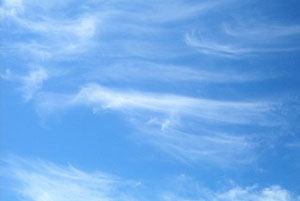
what type of cloud is shown?
a)
cumulus
b)
cirrus
c)
stratus
69.
what type of cloud is shown?
a)
cumulus
b)
cirrus
c)
stratus
70.
Fog is what type of cloud?
a)
Stratus
b)
Cumulus
c)
Cirrus
d)
Cumulonimbus
71.

What kind of precipitation is formed when water falls from the clouds and lands on the ground as liquid water?

a)

Hail

b)

Rain

c)

Sleet

d)

Snow

72.

True or False: Hail is formed in the clouds; then falls to the ground.

a)

True

b)

False

73.

Which type of cloud often indicates that a storm is on the way?

a)

cirrus

b)

cumulonimbus

c)

cumulus

d)

stratus

74.

Which of the following is NOT a type of precipitation?

a)

Rain

b)

Grass

c)

Snow

d)

Hail

75.

Which type of precipitation is this picture showing?

a)

Rain

b)

Snow

c)

Sleet

d)

Hail