
 Worksheets
LS: T7 L1-5 Review
Total questions: 35
Worksheet time: 1hrs 9mins
Name
Class
Date
1.
What did Gregor Mendel use to discover the principles that rule heredity?
a)
Pea Plant
b)
Pigeons
c)
Pear trees
d)
Photosynthesis
2.
Gregor Mendel is known as the father of _________
a)
Modern Medicine
b)
Father of the Green Revolution
c)
Father of Genitics
d)
The Pea Plant Man
3.

What allele combination should go in the missing box?
a)
AA
b)
Aa
c)
aa
d)
none of these
4.
G = green, g = yellow
The genotype for a yellow plant is...
The genotype for a yellow plant is...
a)
GG
b)
Gg
c)
gg
d)
all of the choices result in yellow
5.

A ________________________ is used to predict the possible genotype from certain parents
a)
Mendel Grid
b)
Genetic Tic Tac Toe
c)
Punnett Square
d)
Pedigree Plot
6.
What is a phenotype
a)
The genetic make up (code)
b)
The physical trait
7.
Which of the following genotypes is homozygous dominant?
a)
A
b)
Aa
c)
AA
d)
aa
8.
How many daughter cells are produced from meiosis ?
a)
10
b)
6
c)
4
d)
2
9.
How many cells are produced during telophase I ?
a)
4
b)
8
c)
2
d)
0
10.
The female sex cell is called
a)
zygote
b)
sperm
c)
fertilization
d)
egg
11.

The male sex cell is called
a)
egg
b)
zygote
c)
sperm
d)
mitosis
12.
Humans have how may chromosomes ?
a)
112
b)
46
c)
8
d)
67
13.
Mitosis produces how many daughter cells ?
a)
6
b)
4
c)
8
d)
2
14.
Name the growth phase of the cell cycle.
a)
metaphase
b)
telophase
c)
interphase
d)
anaophase
15.

Crossing over occurs in which phase ?
a)
metaphase I
b)
anaphaseII
c)
telophaseII
d)
prohase I
16.
A fertilized egg is called
a)
egg
b)
lettuce
c)
zygote
d)
sperm
17.

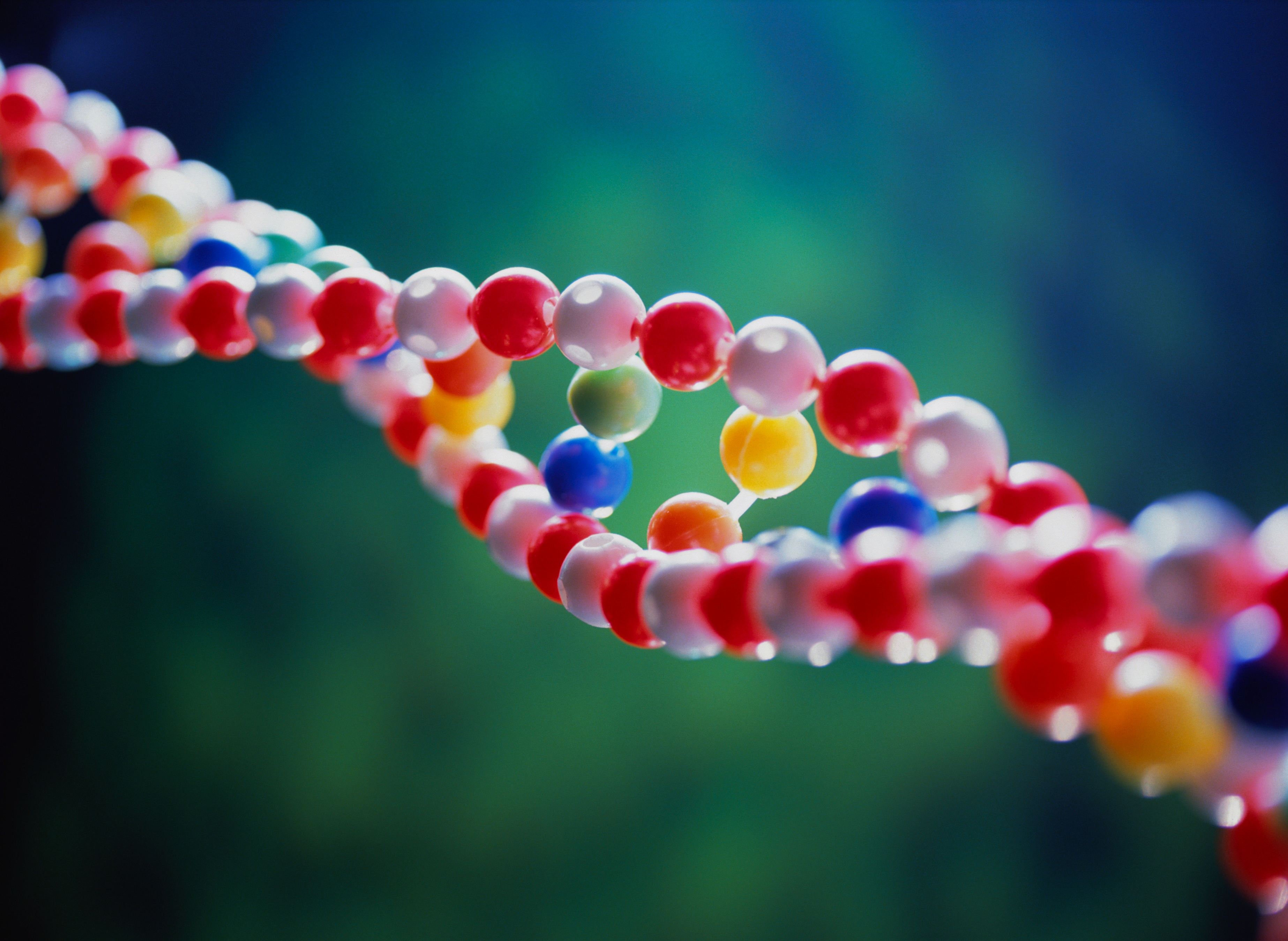
Which of the following best describes a DNA molecule?
a)
double helix
b)
contains ribose
c)
made of amino acids
d)
contains Uracil
18.
Why is DNA important?
a)
it is very small and very complicated
b)
it's in everything
c)
it serves as the blueprint for traits of all living things
d)
because we eat it every day for energy
19.
What are the 4 nitrogen bases?
a)
adenine, thymine, cytoplasm, and guanine
b)
adenine, thymine cytosine, and guanine
c)
adenine, thymine, cytosine, and gylcerol
d)
adenine, thymine, cytosine, and glucose
20.
Which organelle is DNA usually found in?
a)
cell membrane
b)
vacuole
c)
chloroplast
d)
nucleus
21.
Which shows the correct complementary base pairing for DNA?
a)
C-A, T-G
b)
A-G, C-T
c)
C-G, U-A
d)
T-A, G-C
22.
What does DNA stand for?
a)
Deoxyribonucleic acid
b)
Denitrogenous acid
c)
Deribonucleic acid
d)
Diribonucleic acid
23.

What is a gene?
a)
A bundle (like a hot dog bun) that the DNA is packed into
b)
something inside the nucleus
c)
a piece of DNA
d)
all of your DNA
24.

What type of sugar makes up RNA?
a)
deoxyribose
b)
glucose
c)
fructose
d)
ribose
25.

What shape is RNA?
a)
single helix
b)
double helix
26.

What base does RNA have that DNA does not?
a)
uracil
b)
thymine
c)
cytosine
d)
guanine
27.

What are proteins composed of?
a)
nitrogen bases
b)
amino acids
28.
If a DNA strand reads ATT CGT CTA, what would the mRNA strand read?
a)
TAA GCA GAT
b)
CGA TGA GUT
c)
UAA GCA GAU
d)
TAA GCA GUT
29.
Which of the following statements is true?
a)
Your set of DNA is the same as your siblings'
b)
Your set of DNA is the same as your mother's
c)
Your set of DNA is the same as your father's
d)
Your set of DNA is unique to you
30.
The transfer of a gene from the DNA of one organism into another organism, in order to produce an organism with desired traits.
a)
genetic engineering
b)
electrophoresis
c)
gene therapy
d)
GMO
31.
The process of replacing an absent or faulty gene with a normal working gene to treat a medical disease or disorder.
a)
Gene therapy
b)
Gene modification
c)
Selective breeding
d)
animal husbandry
32.
Choosing which organisms can have offspring is_____.
a)
Selective Breeding
b)
Gene Modification
c)
Gene Therapy
d)
Animal Husbandry
33.

What number is in the circle?
a)
1
b)
7
c)
2
d)
4
e)
None of the above.
34.
Women are more likely to get color blind.
a)
True
b)
False
35.
How many nucleotides make up a codon?
a)
1
b)
3
c)
5
d)
15
100 %

