
 Worksheets
Continental Drift & Plate Tectonics
Total questions: 14
Worksheet time: 4hrs 30mins
Fossil evidence that supported Wegener’s idea of continental drift included:
Ocean plants
Ocean animals
Seafloor spreading
Land-dwelling reptiles
Most scientists at the time rejected Wegener’s hypothesis of continental drift because he
Had collected little evidence to support his hypothesis
Would not state his hypothesis publicly
Insisted that Earth’s axis of rotation had changed
Couldn’t explain how or why the continents moved
Which of the following is evidence for the accepted theory of plate tectonics?
continents fit together like a puzzle
solar flares
paleomagnetic reversals
fossils found on multiple continents
What is the Theory of Continental Drift?
New continents are continually being created and destroyed.
The layout of the continents is the same today as it has always been
The continents have always been separate but may one day drift together to form a single continent
All the continents were once one continent that broke up and drifted apart over hundreds of millions of years
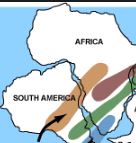
What do these color strips show between South America and Africa with the Theory of Continental Drift?
Similar cultures
Similar fossils
Similar languages
Similar weather
Alfred Wegener proposed the Theory of Continental Drift. Which one of these does NOT support the theory Wegener proposed?
Fossils that were similar were found on different continents.
Bacteria was found all over the world.
Shape of continents fit together to form a supercontinent called Pangea
Climate seen as glacial or ice sharring are found all over the world.
Which of the following evidence was used to support theory of continental drift?
A) Continents fit together like a puzzle
B) Similar fossils were found on separate continents
C) Different types of rock, mountain structures, landforms are found all over the world.
D) All of the above
E) Only A and B
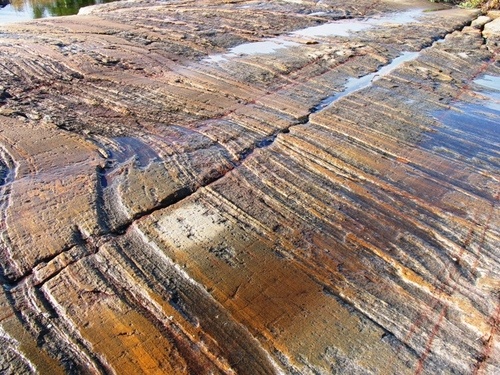
Present day fossils of similar organisms are found on different continents. This supports the theory of continental drift how?
The environment of these organisms was once connected when continents were joined
The organisms were avian and could live in a wide range
The organisms often migrated
The organisms had a large population that was widespread
What are the large pieces of Earth's lithosphere that move around called?
Sections
Land Masses
Plates
Faults
Which statement best compares the theories of plate tectonics and continental drift?
Plate tectonics and continental drift are two names for the same theory
Continental drift proposes that the continents move; plate tectonics proposes the mechanism for how the continents move.
Plate tectonics proposes that the continents move; continental drift proposes the mechanism for how the continents move.
Continental drift proposes that the continents move; plate tectonics proposes that the continents are stationary.

