
 Worksheets
Additional Asexual and Sexual Reproduction Review
Total questions: 20
Worksheet time: 5hrs 0mins
Which of the following is NOT an example of a clone?
the two new worms that result when a planaria (flat worm) is cut into two pieces.
a group of rooted plant cuttings from a single plant
the cells produced by the asexual reproduction of a single- celled organism
the offspring produced by two parents
How many parents are required for asexual reproduction?
none
1
2
4
What is one advantage of asexual reproduction?
offspring are different from parents
diseases are not passed from parent to offspring
it takes a longer time
it takes less time
How many parents are involved with sexual reproduction?
none
1
2
4
What is an advantage of sexual reproduction?
it is a faster process
negative traits of parents may not always be passed to offspring
it takes more energy and time
finding a mate is necessary

___________________ is a type of asexual reproduction in which a piece of a parent organism breaks off to form an new organism (ex. Planaria).
fission
budding
fragmentation
fertiliztion
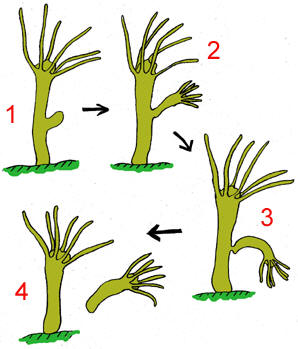
When an offspring grows off from the body of a parent organism it is called __________________.
budding
fission
fragmentation
sporulation
What are some advantages of asexual reproduction are: (select all that apply - there are 3)
it only requires one organism
it takes less energy than sexual reproduction
offspring are already well-adapted for the environment
there is a lot of genetic variety
Some advantages of sexual reproduction include: (select all that apply - there are 3)
genetic variation
improves chances of adapting to the environment
helps species survive catastrophes
it doesn't take as much energy as asexual reproduction
Male and female reproductive cells are collectively known as:
spores
pollen
gametes
offspring
Genetically identical offspring are _____________ the parent organism.
opposite of
clones of
superior to
inferior to
____________________ occurs when a male gamete (sperm) combines with a female gamete (egg).
sporulation
fertilization
fission
regeneration
Genetically identical offspring are _____________ the parent organism.
opposite of
clones of
superior to
inferior to

What is the type of nuclear division associated with sexual reproduction?
Mitosis
Meiosis

All of the offspring of an organism have the same genetic material, which is identical to the parent organism. From this, we can conclude that this organism -
makes its own food
is unicellular
live in a marine habitat
reproduces asexually
onto future generations

California blackworms, also known as mudworms, are able to break apart. Each body section that broke apart is able to become an identical new worm. What type of reproduction does this example represent?
Sexual reproduction
Asexual reproduction

Penguins lay 1-2 fertilized eggs that the male and female take turns incubating on their feet. What type of reproduction does this example represent?
Sexual reproduction
Asexual reproduction

