
NEW
Font size
 Worksheets
3rd 9 weeks Exam Classwork Review
Total questions: 25
Worksheet time: 26mins
Calculate the work done to a 2 kg cat lifted 10 meters above the ground.
-20 J
-200 J
-2.04 J
200 W
Energy is not lost or created. This is the
Conservation of Energy Creation
Law of Conservation of Energy
Energy Law
Energy's First Principle

Where does this coaster have the greatest amount of PE?
At the top of the highest hill
At ground level
At the top of the loop
At the start of the ride
Where does this coaster have the greatest amount of KE?
At the top of the highest hill
At ground level
At the top of the loop
At the start of the ride
Why can the coaster complete the loop?
The loop is below the the highest point at the beginning of the coaster
The loop's shape
The loop is taller than the first hill
It will never complete the loop
Which of the following has the MOST momentum?
rolling ping-pong ball
rolling bowling ball
rolling soccer ball
rolling basketball
If an object has a mass of 20 kg and a velocity of 4 m/s, what is the momentum of the object?
80 kgm/s
4 kgm/s
5 kgm/s
.2 kgm/s
A boy kicks a football with a force of 20 N west, the time the force acts for is 0.3 s.
Calculate the impulse on the ball.
1 N.s west
6 N.s west
66 N.s east
None of these
A car that has a mass of 500 kg is moving at 20 m/s. There is a total of 3,000 J of work done on the car, what is the final velocity of the car?
17 m/s
50 m/s
23 m/s
25 m/s
The momentum of an object depends upon the object's ___________&_____________.
size and shape
mass and speed
mass and veloctiy
mass and energy
How do airbags reduce your chance of getting hurt during an accident?
Airbags increase momentum before collision
Airbags reduce momentum during a collision
Airbags increase the time it takes a person to stop moving
Airbags cause friction which reduced the chance of getting hurt
If a collision is elastic which of the following must be true?
Momentum is not conserved
The objects are in an open system
The total momentum is equal to 0
Kinetic Energy is conserved
If a collision is inelastic which of the following must be true?
the total momentum of the system is conserved
The total momentum of the system is not conserved
The total momentum of the system is 0
The total kinetic energy of the system is conserved


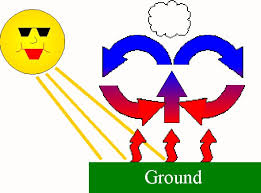
Warm air rises and the cool air sinks.
conduction
convection
radiation
momentum

At which point of this roller coaster is the energy 1/2 kinetic and 1/2 potential?
A
B
C
D

If there is no friction on this track, at which point would the coaster have the most kinetic energy?
A
B
C
D

Where is the roller coaster gaining potential energy?
A to B
B to C
C to D
The roller coaster is always losing potential energy

