wayground logo

Free Printable Worksheets

Font size

S
M
L
XL
Worksheets

OnRamps Unit 3: Depression, The New Deal, and WWII

Total questions: 103

Worksheet time: 2hrs 34mins

Name
Class
Date
1.

He was president during the start of the Great Depression. However, he did not really cause it himself but he may have help to cause it to last longer.

a)

Warren Harding

b)

Herbert Hoover

c)

Teddy Roosevelt

d)

Franklin D. Roosevelt

2.
President Franklin Roosevelt won the election of 1932. The country was in the Great Depression, and Roosevelt introduced the New Deal. Which was the MOST important goal of President Franklin Roosevelt's New Deal programs?
a)
to strengthen the economy 
b)
to avoid going to war 
c)
to improve public education 
d)
to end racial discrimination 
3.

What was the "New Deal" of the 1930s?

a)

a government program that gave free land to homesteaders

b)

a government program that helped women get the vote

c)

a government program that spread civil rights throughout the country

d)

a government program designed to help people during the depression

4.
President Franklin Roosevelt asked Congress to pass a series of acts called the New Deal. Which is one way the New Deal helped people during the Great Depression?
a)
It gave all people the right to vote. 
b)
It created programs to put people back to work.    
c)
It let all new immigrants become American citizens. 
d)
It let people travel around the country freely. 
5.
Which of the following was NOT a cause of the Great Depression?
a)
25% of Americans were unemployed.
b)
People overspeculated on stocks, using money they borrowed and could not pay back.
c)
The Federal Reserve failed to prevent the collapse of the banking system.
d)
High tariffs discouraged international trade.
6.
Which of the following is NOT an impact of the Great Depression?
a)
People were hungry and homeless.
b)
25% of Americans lost their jobs.
c)
Many businesses and banks failed.
d)
High tariffs discouraged international trade.
7.
Which President created the New Deal, a plan to get the U.S. out of the Great Depression?
a)
Franklin Roosevelt 
b)
Herbert Hoover
c)
Harry Truman
d)
Woodrow Wilson 
8.

conversational-type radio addresses by FDR during the Great Depression to help restore public confidence

a)

fireside chats

b)

nightly news

c)

New Deal

d)

court-packing scheme

9.

What is the First Hundred Days?

a)

an insurance system to help support disabled people

and retired people

b)

the programs that Franklin D. Roosevelt set up to end

the Depression

c)

a time when Franklin D. Roosevelt worked with

Congress to pass many new laws

10.
When FDR closed all the banks and did not allow them to reopen until they were stable 
a)
Bank closures
b)
Bank retreats
c)
Bank Holiday
d)
Margin Holiday 
11.
Why did President Roosevelt declare a "bank holiday" on his second day of office?
a)
Bank failures during Hoover's administration had left finance officials in need of rest
b)
He helped to stimulate a day of consumer spending
c)
He wanted to stop the run on banks that threatened even the healthiest financial institutions 
d)
It was part of an overall effort to restructure the nation's business hpurs
12.
What was one basic purpose shared by the Emergency Banking Act, the Glass-Segal Act, and President Roosevelt's fireside chats?
a)
to heighten Americans' awareness of economic threats 
b)
to promote a sense of pride in American banking
c)
to educate the public about economic theories 
d)
to increase the public's confidence 
13.
What was the most important result of the Emergency Banking Act?
a)
Ordinary people began closing their bank accounts
b)
the public lost confidence in the nation's banking system
c)
Banks reopened with government assurances that they were on sound financial footing
d)
banks expanded their hours to stay open on holidays and weekends 
14.
Which New Deal program was chiefly designed to correct abuses in the stock market?
a)
Civilian Conservation Corps
b)
Works Progress Administration
c)
Securities and Exchange Commission
15.
What were the major goals of the New Deal?
a)
no gold standard and free coinage of silver
b)
abolition and suffrage
c)
relief, recovery, and reform
d)
expanding the size and economic influence of the United States
16.
The New Deal program which primarily employed single, young men and worked to preserve parks and forests
a)
Works Progress Administration
b)
Tennessee Valley Authority
c)
Civilian Conservation Corps
d)
Bureau of Land Management
17.
Which New Deal law restricted crop production to reduce crop surplus and was ruled unconstitutional by the Supreme Court?
a)
The Agricultural Adjustment Act
b)
The Glass-Steagall Act
c)
The Pure Food and Drug Act
d)
The Truth-in-Labelling Act
18.
The New Deal pulled America out of its economic mess!  Several New Deal agencies, such as the CCC, WPA, and the TVA, were important because ____________________.
a)
they built bridges, dams, and other useful projects
b)
they helped create jobs and put Americans back to work
c)
they offered assistance to farmers
d)
they provided electricity to a poor region
19.
The National Industrial Recovery Act and the National Labor Relations Act are often cited as evidence that New Deal legislation
a)
sympathized with the interests of workers
b)
blamed unions for slowing economic recovery
c)
tried to keep the costs of labor down
20.
The election of Franklin D. Roosevelt to the Presidency in 1932 reflected the desire of many Americans to
a)
have government take an active role in solving economic problems
b)
return to a policy of laissez-faire capitalism
c)
continue the domestic policies of the Hoover administration
21.
In the 1930’s, the enactment of New Deal programs demonstrated a belief that
a)
corporations were best left to operate without government interference
b)
state governments should give up control over commerce inside their states
c)
the government should be more involved in regulating economy
22.
What was the culminating event that brought the country out of the Great Depression?
a)
the Bonus Army
b)
the building of the Hoover Dam
c)
going off of the gold standard
d)
World War II
23.
Which of the following is the most valid statement regarding the long-term economic effects of  the Great Depression? 
a)
The government placed fewer restrictions on large corporations
b)
The role of the federal government was expanded
c)
The government reduced its dependence on foreign trade
d)
The American people had greater confidence in the nation’s economic leadership
24.
What was the name given to President Roosevelt's plan to alter the Supreme Court to increase his power in having his New Deal legislation passed instead of having it struck down on constitutional grounds? 
a)
The New Deal
b)
The Great Depression
c)
Court Packing 
d)
Second New Deal 
25.
Program created to provide the elderly with an income (still exists)
a)
Medicare
b)
Social Security
c)
Medicaid
d)
SNAP
26.
His program to help the poor during the Great Depression was known as the "Share the Wealth" program.
a)
Herbert Hoover
b)
Franklin D. Roosevelt
c)
Clark Gable
d)
Huey Long
27.

What New Deal program provided workers with unemployment insurance and old age pensions?

a)

The Federal Emergency Relief Act

b)

Federal Depositors Insurance Corporation

c)

Securities and Exchange Commission

d)

Social Security Act

28.
What problem were both the Civilian Conservation Corps and the Works Progress Administration developed to address?
a)
Excessive stock market speculation
b)
High unemployment
c)
Increased use of credit
29.
A major reason for creating the Tennessee Valley Authority in 1933 was to-
a)
Provide health care benefits to southerners
b)
Improve economic conditions in a poor rural region
c)
Evacuate farmers from the impoverished region
30.
One difference between the administrations of President Roosevelt and President Hoover was that Roosevelt was-
a)
more willing to use government intervention to solve economic problems
b)
unwilling to allow government agencies to establish jobs
c)
opposed to any type of government regulation of financial institutions
31.
What was the primary reason that President Roosevelt attempted to increase the number of justices on the Supreme Court?
a)
to make the Court more supportive of New Deal Programs
b)
to force the Court to hear cases involving women’s rights
c)
to speed up the Court’s review of cases
32.
Franklin Roosevelt's "court-packing plan" was a serious mistake because-
a)
Many Americans opposed the idea of forced retirement
b)
The angry judges reacted by striking down much of the New Deal legislation
c)
It appeared to interfere with the Constitution's separation of powers
33.
Government spending, in excess of revenue, of funds raised by borrowing rather than from taxation.
a)
Deficit Spending
b)
Margin
c)
Stock Market
d)
Bank Crisis 
34.
What dream did Eleanor and Franklin Roosevelt share and work towards?
a)
to begin an organization to promote peace throughout the world
b)
to find a cure for polio
c)
to become dictators
d)
to become citizens
35.
Which American leader was head of the United Nations Human Rights Commission?
a)
Lyndon B. Johnson
b)
Thurgood Marshall
c)
Eleanor Roosevelt
d)
Franklin Roosevelt
36.
The Great Depression that began in 1929 hit farmers especially hard. Farmers had not been doing well in the 1920s and several years of severe drought turned the land into a "dust bowl." What was an immediate result of this?
a)
Many farmers decided to grow crops that did not use as much water. 
b)
The government built large dams in the West for irrigation. 
c)
Many farmers and their families lost their farms and moved west. 
d)
The government helped farmers by buying their land and equipment. 
37.
This natural disaster served to worsen the effects of the Great Depression on Farmers in the Midwest 
a)
Tornados
b)
Dust Bowl
c)
Black Tuesday 
d)
Hurricanes
38.
What caused the Dust Bowl?
a)
farmers added too much fertilizer to their soil
b)
farmers didn't know they needed to rotate their crops
c)
farms experienced severe draught and static electricity caused a dust storm
d)
farms in Missouri experienced a freak F-5 tornado
39.
Which of these men is the author of books set during the Great Depression, including OF MICE AND MEN and THE GRAPES OF WRATH?
a)
John Steinbeck
b)
Alfred Knopf
c)
Thomas Nelson
d)
Douglas Peebles
40.
What was one HUMAN cause of "the Dust Bowl"?
a)
plowing up millions of acres of grass to plant wheat
b)
allowing cattle to overgraze the midwestern U.S.
c)
overproduction of cotton and wheat crops
d)
ALL of these were human causes of "the Dust Bowl"
41.
Which event is known as “Black Tuesday”?
a)
The storming of the Bastille
b)
Armistice day
c)
The stock market crash of 1929
d)
The assassination of Archduke Ferdinand
42.
Why did the Hawley-Smoot tariff not work to prevent the Great Depression?
a)
Americans did not want the tariff
b)
Congress refused to pass the tariff
c)
Other countries passed tariffs on American goods in retaliation
43.
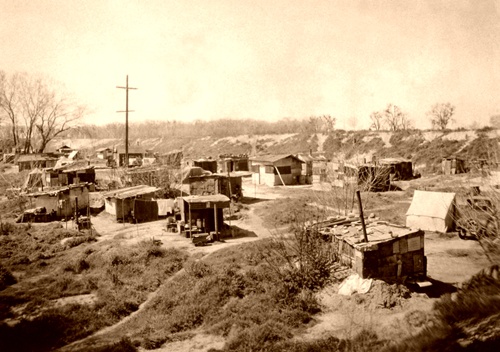
Shantytowns for the homeless
a)
Depression
b)
Hoovervilles
c)
reconstruction Finance corproation
d)
Speculation
44.
How did the 1929 stock market crash affect the United States economy in the 1930s?
a)
Unemployment reached its highest level in United States history. 
b)
Congress voted to reject New Deal policies. 
c)
 Stock prices were higher than investors could afford.    
d)
Agriculture replaced manufacturing as the primary industry. 
45.
Which of the following DID NOT cause the Dust Bowl?
a)
overproduction
b)
windstorms
c)
drought
d)
tornadoes
46.
Which of the following was NOT a cause of the Great Depression?
a)
Hawley-Smoot Tariff
b)
Easy Credit
c)
Mistakes of the Federal Reserve
d)
high farm prices
47.
Which was NOT a LONG-TERM cause of the Great Depression?
a)
Buying stock on margin
b)
Stock market crash (Black Tuesday)
c)
too much production and consumer spending
d)
Laisezz-faire economic policies
48.
What were the villages full of shacks located in cities filled with unemployed Americans called?
a)
Hoovervilles
b)
Okies
c)
Bonus Army Bases
d)
Rooseveltowns
49.
What is a good title for this list?
a)
Culture of the 1920s
b)
The Great Migration
c)
Impact of the Great Depression
d)
Features of the New Deal
50.
While many of the agencies that were part of the New Deal were known as Alphabet Agencies, President Roosevelt’s overall plan to get the country out of the Great Depression was known as the New Deal and could be summed up by the 3 R’s which stood for:
a)
Reduction, Re-usage, Recycling
b)
Reading, Riding, Re-spending
c)
Roosevelt, Roosevelt, Roosevelt
d)
Relief, Recovery, Reform
51.
What was Roosevelt’s goal in creating the Securities and Exchange Commission and the Federal Deposit Insurance Corporation?
a)
Restore the public’s faith in financial institutions
b)
Stimulate demand for manufactured goods
c)
Provide jobs for the unemployed
d)
Help farmers pay back their loans
52.

Based on the cartoon, how did President Roosevelt want to ease the Great Depression?

a)

by regulating the stock purchases by individual investors

b)

by restricting the spending by government domestic projects

c)

by expanding the role of government in citizen's lives

d)

by expanding the authority of legislative representatives

53.
Aerial battle fought over England. 
a)
Blitzkrieg
b)
Battle of the Bulge
c)
Stalingrad
d)
Battle of Britain
54.
U.S. isolationism was ended when?
a)
German Invasion of Poland
b)
Pearl Harbor was attacked
c)
Battle of Iwo Jima
d)
Sinking of the USS Maine 
55.
The genocide of approximately 6 million Jews
a)
Holocaust
b)
Kristallnach
c)
Anti-semitism
d)
Nuremberg Laws
56.
Which of the following statements best summarizes the Supreme Court’s ruling in Korematsu v. US?
a)
The US Constitution cannot be used to check the power of the military in a time of war  
b)
Segregation in the military is unconstitutional  
c)
While Japanese citizens can be sent to internment camps, US citizens of Japanese ancestry cannot 
d)
Any person of Japanese ancestry is considered a national security risk and is subject to internment  
57.
To keep America focused on the war effort ____________________ was used extensively on the home front.
a)
propaganda
b)
intimidation
c)
spot checking citizens to make sure they were following the rules
d)
a curfew
58.
What did the US do to try and make Japan stop attacking China?
a)
bombed them
b)
cut off supplies of food
c)
cut off supplies of iron, steel, and oil
d)
nothing
59.
To pay for the War the federal government sold? 
a)
Stocks 
b)
War bonds 
c)
Land 
d)
Silver/Gold 
60.

Regulating the amount of goods a consumer can obtain in order to ensure the fair distribution of scarce goods

a)

Office of War Information

b)

Bataan Death March

c)

rationing

d)

war bonds

61.

Home project raising about one third of the nation’s vegetables during World War II


Helped reduce demand for commercially grown food

a)

anti-Semitism

b)

carpet bombing

c)

rationing

d)

victory gardens

62.

-Commanded the invasion of Normandy known as D-Day


-Led the Allied forces in Europe


-Later was elected President of the United States

a)

Douglas MacArthur

b)

Vernon Baker

c)

Dwight Eisenhower

d)

Harry Truman

63.

President who decided to drop the atomic bomb on Japan


Decided to drop the bomb in hopes of saving lives as opposed to invading Japan.

a)

Omar Bradley

b)

Harry Truman

c)

Neville Chamberlain

d)

John J. Pershing

64.

General who helped U.S. troops retake the Pacific using a strategy of island-hopping (used for establishing military bases to use in further attacks)

a)

Douglas MacArthur

b)

George Patton

c)

Erwin Rommel

d)

John J. Pershing

65.

African American awarded the medal of honor 52 years after he had heroically faced combat in Europe. He was the only living African American veteran of WWII to ever receive the medal.

a)

John J. Pershing

b)

George Marshall

c)

Vernon Baker

d)

Neville Chamberlain

66.

Developed the atomic bomb


Represents how science helped win the war

a)

Manhattan Project

b)

Geneva Convention

c)

Holocaust

d)

appeasement

67.
The Battle of __?__ was a 1942 battle in the Pacific during which American planes sunk four Japanese aircraft carriers.
a)
Bulge
b)
Midway
c)
Britain
d)
Normandy
68.
The Battle of Coral Sea was significant because ______________.
a)
It was the first time Allied forces had stopped a Japanese advance
b)
It represented the first time that Allied naval strength exceeded Japanese naval strength
c)
It was the first time that the Allies fought a land, sea, and air battle
d)
It represented the first major Allied defeat in the Pacific
69.

Which battle is considered to be the turning point in the Pacific because of the loss of 4 aircraft carriers and stopping Japanese advancement?

a)

Iwo Jima

b)

Midway

c)

Okinawa

d)

Guadalcanal

70.
The two deadliest battles of the war in the Pacific as the US neared the mainland? 
a)
Pelilu and Saipan
b)
Leyte Gulf and Saipan
c)
Midway and Okinawa
d)
Iwo Jima and Okinawa
71.
Why was the Battle of Midway the turning point in the Pacific War?
a)
Germans never won any battles after it
b)
U.S. lost its entire fleet
c)
Japanese never won after it
d)
U.S. now could launch planes to bomb mainland Japan
72.

Group of Americans who played a key role in the Pacific campaign by encoding military communications

a)

Manhattan Project

b)

Tuskegee Airmen

c)

Flying Tigers

d)

Navajo Code Talkers

73.
Which 3 countries made up the Axis Powers?
a)
American, England, and Russia
b)
Sweden, Germany, and Denmark
c)
Italy, Russia, and Austria
d)
Italy, Germany, and Japan
74.
Who did Hitler blame for most of the Germany's problems?
a)
Americans
b)
Christians
c)
Muslims
d)
Jews
75.

Dictator of the Soviet Union during WW2


Became an ally of the U.S. against Hitler

a)

Mussolini

b)

Stalin

c)

Hirohito

d)

Churchill

76.
The Act that allowed the U.S. to give War supplies to Britain in early WW2?
a)
United Nations
b)
Lend-Lease Act
c)
Manhattan Act
d)
New Deal
77.
Permitted military commanders to require Japanese Americans to relocate to interior internment camps with primitive and crowded conditions away from Western coastal regions
a)
anti-Semitism
b)
Executive Order 9066
c)
war bonds
d)
rationing
78.
______were the first to liberate concentration camp prisoners in the final stages of the war. On July 23, 1944, they entered the Majdanek camp in Poland. 
a)
Italy
b)
Germany
c)
United States
d)
Russia (Soviet Union)
79.

Approximately 75,000 Filipino and American troops on were forced to make an arduous 65-mile (105 km) march to prison camps with many dying along the way. This event was known as....

a)

Bataan Death March

b)

Philippines Death March

c)

Bataan Death Walk

d)

WWII Death March

80.

The most famous group of black Americans to fight in WWII were the _________________. They helped create momentum towards a desegregated armed forces.

a)

Tiger Tank Battalion

b)

442nd Combat Regiment Team

c)

Fighting Seabees

d)

Tuskegee Airmen

81.

This organization was created to make propaganda for the war & censor any anti-American speech.


Tried to sell the war to Americans and to encourage them not to leak information to spies.

a)

Office of Price Administration

b)

War Production Board

c)

Office of War Information

d)

Office of Scientific Research & Development

82.
On what date did the attack on Pearl Harbor occur?
a)
December 7, 2016
b)
December 7, 1916
c)
December 7, 1941
d)
December 14, 1971
83.
Between 1936 and 1938, Hitler re militarized this area.
a)
Alsace-Lorraine
b)
Versailles
c)
Rhineland
d)
Normandy
84.
In September of 1938, Hitler demanded this land from Czechoslovakia
a)
Rhineland
b)
Sudentenland
c)
Versailles
d)
Belgium
85.
Who met with Hitler and arranged the Munich Agreement
a)
Winston Churchill
b)
Franklin Delano Roosevelt
c)
Woodrow WIlson
d)
Neville Chamberlain
86.
In the Munich Agreement, Hitler agreed he would not take any more land from which country?
a)
Czechoslovakia
b)
Britain
c)
Sudetenland
d)
France
87.
In order to keep the peace, Britain (and other European countries) pursued this policy with Hitler. (It didn't work)
a)
atonement
b)
mediation
c)
appeasement
d)
nationalism
88.
On September 1, 1939 Hitler invaded this country and effectively initiated WWII
a)
France
b)
Poland
c)
Austria
d)
Britain
89.
By 1938, Hitler rebuilt his military in Germany.  What treaty did he violate with this action?
a)
The Munich Agreement
b)
Treaty of Versailles
c)
Treaty of Brest-Litovsk
d)
Treaty of Paris
90.
Which of the following did NOT occur in the U.S. as a result of WWII?
a)
Increased volunteerism 
b)
Purchasing of War Bonds
c)
Growing of "Victory Gardens" by citizens
d)
Reduction of job opportunities for minorities
91.
American pilots who volunteered to fight for China
a)
kamikaze
b)
Flying Tigers
c)
R. A. F.
d)
troops
92.
Commander of the U.S. Army in the Pacific - led Island hopping
a)
Omar Bradley
b)
Dwight Eisenhower
c)
George Patton
d)
Douglas MacArthur
93.
Commander of the U.S. Navy and Allied land and sea forces in the Pacific; Commands at Battle of Midway; he's from Texas!
a)
Admiral Chester Nimitz
b)
General George Patton
c)
General Douglas MacArthur
d)
General George Marshall
94.
Character who represented the women who worked during WWII
a)
Uncle Sam
b)
Axle Rose
c)
Rosie the Riveter
d)
Betty Boop
95.
WORLD WAR 2
When did it happen? 
a)
1914-1918
b)
1962- 1967
c)
1939-1945
d)
1950-1953
96.
What was the Bataan Death March?
a)
The march by U.S. soldiers on Bataan to liberate the island
b)
The traditional march held by by Filipinos to celebrate deceased ancestors
c)
The march made by U.S. troops inland from their landing point in Bataan
d)
The forced march of captured American and Filipino soldiers by the Japanese 
97.
What happened on June 6, 1944, D-Day?
a)
The Allied invasion of Normandy, France
b)
The end of the World War II in Europe
c)
Operation "Market Garden"
d)
The dropping of the first atomic bomb on Hiroshima, Japan occurred
98.
Which famous scientist wrote the letter alerting the U.S. President, FDR, about the German's discovery of nuclear fission?
a)
Marie Curie
b)
Albert Einstein
c)
Robert Oppenheimer
d)
Katherine Johnson
99.

Why was the U.S. actively pursuing women to enlist in programs like the Nurse Corps?

a)

growing demand for equal pay for equal work

b)

growing demand for personnel to support the war effort

c)

lack of women with the skills necessary to join the labor force

d)

lack of women able to serve in combat

100.

Which of the following best explains how WWII helped end the Great Depression

a)

military production created jobs

b)

relaxation of production standards increased productivity

c)

Reduced immigration led to higher wages

d)

Government rationing created a surplus of supplies

101.

Which of the following were reasons the United States tried not to enter the war against the Germans?

a)

Isolationism

b)

Public opinion against the war

c)

Memory of WWI

d)

Fear of losing to Hitler

102.

What is one of the reasons Pearl Harbor was attacked by the Japanese?

a)

Island hopping was messing up trade routes

b)

Japanese defeat at the island of Midway

c)

The relocation of Japanese Americans to internment camps

d)

A trade embargo that created shortages of oil, gas, and rubber.

103.

How did WWII change the position of the U.S. in the world?

a)

The US became a superpower and the most powerful nation in the world.

b)

The US became a huge empire by claiming land

c)

The US became isolated from other nations

d)

The US was overrun by foreign nations following defeat.