

wayground logo

Free Printable Worksheets

NEW

Font size

S
M
L
XL
Worksheets

DA1 - Gov - Spring 2021

Total questions: 57

Worksheet time: 58mins

Name
Class
Date
1.
In a representative government people do what?
a)
Elect delegates to create laws and run government.
b)
Elect delegates to create laws and run schools.
c)
Elect laws and run government.
d)
Elect delegates to run government.
2.

Government authority is based on the consent of the governed.

a)

Anarchy

b)

Monarchy

c)

Democracy

d)

Dictatorship

3.
The Force Theory suggests which of the following about government?
a)
Government is made up of weak, ineffectual leaders.
b)
Government has both weak and strong leaders.
c)
Government originated from strong leaders who used force to maintain order.
d)
Government was created simply by accident, some having weak and others having strong leaders.
4.
Powers that both the national government and the states have.
a)
Concurrent Powers
b)
Reserved Powers
c)
Delegated Powers
d)
Implied Powers
5.
One weakness of the Articles of the Confederation was ____________. 
a)
The ability of Congress to tax.
b)
The inability of Congress to tax.
c)
The ability of Congress to declare war.
d)
The ability of Congress to create courts.
6.

Under the Articles of Confederation, most of the power was where?

a)

Legislative branch

b)

the president

c)

the states

d)

national government

7.

Anti-Federalists were afraid that without that, they would lose their _______, so they wanted a _______.

a)

sense of self, declaration of independence

b)

individual rights, bill of rights

c)

connection to the King, magna carta

d)

democratic government, declaration of independence

8.

What was the position of the group known as the Federalists?

a)

they supported a new Constitution

b)

they questioned the justice of slavery

c)

the feared the power of the national government

d)

the believed that states should have equal representation

9.
What is the name of the first government of the United States?
a)
U.S. Constitution
b)
Articles of Confederation
c)
Northwest Ordinance
d)
Declaration of Independence
10.
The three branches of government are ________________
a)
Executive, Legislative, and Judicial
b)
Legislative, Judicial, and National
c)
Executive, Principle, and Judicial
d)
Judicial, National, and Legislative
11.

When one person or a small group claims control over an area and forces all within it to submit to their rule, this is known as ......

a)

the Force Theory

b)

the Evolutionary Theory

c)

the Divine Right theory

d)

the Social Contract Theory

12.

People voluntarily came together and created the state.

a)

Social Contract Theory

b)

Evolutionary Theory

c)

Divine Right Theory

d)

Chaos Theory

13.

A government in which a single person holds unlimited political power

a)

Democracy

b)

Autocracy (Dictatorship, Absolute Monarchy)

c)

Oligarchy

d)

Paliamentary

14.

The supreme political authority rest with the people and the citizens themselves

a)

Democracy

b)

Autocracy

c)

Oligarchy

d)

Confederation

15.

An alliance of independent states

a)

Presidential

b)

Unitary

c)

Presidential

d)

Confederation

16.

Government

a)

Provides order

b)

Prevents chaos

c)

Is an institution through which a society makes and enforces public policies

d)

All of the above

17.
All of the following are characteristics of the state EXCEPT;
a)
population
b)
territory
c)
sovereignty
d)
religion
18.
What is an agreement between people and the government?
a)
Consent
b)
Natural Rights
c)
Social Contract
d)
Voting
19.

God created the state and gave rulers the right to rule -

a)

Divine Right Theory

b)

Evolutionary Theory

c)

Force Theory

d)

Social Contract Theory

20.
This is another word for state.  
a)
country
b)
county
c)
municipality
d)
region
21.
organization of territories with permanent population, defined, territory, and a government
a)
state
b)
nation
c)
country
d)
region
22.

The Articles of Confederation created a _________________ central government.

a)

strong

b)

average

c)

weak

d)

federal

23.
Who was the main author of the Declaration of Independence?
a)
Benjamin Franklin
b)
Samuel Adams
c)
Thomas Jefferson
d)
Paul Revere
24.

The Preamble to the Constitution

a)

states the purposes of government

b)

states the laws of government

c)

declares that we have rights

d)

declares war

25.

According to the Declaration of Independence, why do we have government?

a)

to create a monarchy

b)

to protect individual rights

c)

to state the purposes of government

d)

to overthrow it

26.
The List of Grievances were the part of the Declaration that
a)
detailed the colonists' complaints with King George.
b)
listed a man's natural rights.
c)
introduced the Declaration.
d)
concluded the Declaration, declaring America a free country.
27.

According to the Declaration of Independence, where does government get its power?

a)

From the King (or Queen or Emperor)

b)

From the Supreme Court

c)

From God (Divine right)

d)

From the people (consent of the governed)

28.

The Great Compromise created a bicameral legislature in order to

a)

appoint Supreme Court Justices

b)

confuse us

c)

3/5 compromise

d)

create representation in the House and Senate

29.
Rebellion of farmers in Massachusetts, protesting mortgage foreclosure. It highlighted need for a stronger central government
a)
American Revolution
b)
Shays' Rebellion
c)
Protests of Farmers
d)
Massachusetts Convention
30.

Which statement below describes the 3/5 Compromise?

a)

3 of 5 slaves will be counted towards representation AND taxation in all states

b)

3 out of 5 slaves could vote in Northern states

c)

All slaves would be counted towards representation AND taxation in Southern states

d)

3 out of 5 slaves would be counted towards representation but NOT taxation in all states

31.

Montesquieu is most known for his ideas on? (Spirit of the Laws)

a)

Social Contract

b)

Separation of Powers

c)

Natural Rights

d)

Protection of life, liberty and property
32.
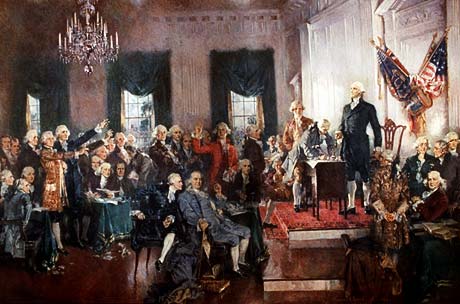
What solves the issue of "can slaves be counted?"
a)
The 3/5ths Compromise
b)
The 1/2 Compromise
c)
The 3/4ths Compromise
d)
The 4/4 Compromise
33.
A plan for government is called what?
a)
Bill of Rights
b)
Constitution
c)
Magna Carta
d)
Compact
34.
The Federalist Papers were a series of newspaper articles published in 1787 and 1788 to win support for the
a)
right of the colonies to rebel against Great Britain
b)
right of a state to secede from the Union
c)
ratification of the United States Constitution
d)
construction of an interstate canal system
35.
The Bill of Rights was added to the United States Constitution to
a)
provide the president with the power to enforce the laws
b)
protect individuals’ civil liberties
c)
establish a presidential cabinet
d)
guarantee voting privileges to all citizens
36.
Antifederalists criticized the United States Constitution primarily because governing power was concentrated in the
a)
State legislatures
b)
President’s Cabinet
c)
delegates to the Constitutional Convention
d)
National Government
37.
Which group would have made the following statement?
The system of checks and balances included in the Constitution would keep the national government from becoming too powerful.
a)
Loyalists
b)
Anti-Federalists
c)
Patriots
d)
Federalists
38.
The English and American governments have a legislative (law-making) branch that is made up of two- houses. 
a)
Executive
b)
White House
c)
Limited House
d)
Bi-cameral
39.
Who rules in a monarchy?
a)
The people
b)
King or Queen
c)
A single person
d)
One or more religious groups
40.
The government has some control over the economy and provides basic services like health care and housing.
a)
Capitalism
b)
Socialism
c)
Communism
41.
The division (splitting) of power between a central government and state governments is called
a)
unitary government
b)
monarchy
c)
the American colonies
d)
federalism
42.

This origin theory is what most dictatorships and totalitarian governments were begun with.

a)

Force theory

b)

Divine Right theory

c)

Evolutionary theory

d)

Social Contract theory

43.
What answer best represent what John Locke believed?
a)
All people are born with inalienable, natural, rights
b)
Tyranny is okay if the king is just
c)
Colonists are rebels
d)
Divine right is the only real source of power
44.
What are our natural rights according to Jefferson?  (He got the idea from John Locke, but he changed the last right.)
a)
Freedom of speech, religion, and press
b)
Life, liberty, and property
c)
Life, liberty, and the pursuit of happiness
d)
Voting, rebelling, and health
45.
According to the Declaration of Independence, where does government get its power?
a)
From the King
b)
From the Supreme Court
c)
From God
d)
From the people
46.
The Declaration of Independence states the purpose of government is 
a)
to tax and control finances
b)
to provide rules for the people
c)
to regulate trade 
d)
to serve the people
47.
which amendment gave women the right to vote?
a)
22nd
b)
18th
c)
19th
d)
20th
48.

Which amendment says that you must be 18 in order to vote? ("If a person is old enough to be drafted, they should be allowed to vote!")

a)

20th

b)

16th

c)

26th

d)

18th

49.
Which amendment guaranteed the right to vote for black men?
a)
13th
b)
14th
c)
15th
d)
16th
50.
The vocabulary term that guarantees your right to communicate with your government.
a)
Assembly
b)
Petition
c)
Suffrage
d)
Due Process
51.
Americans were afraid that a __?__ would lead to tyranny, or oppressive rule.
a)
strong state government
b)
weak government
c)
strong central government
d)
legslature
52.
Supported the Constitution.  favored stronger central government.  Wanted weaker state government.  All describe
a)
Federalists
b)
Anti-Federalists
c)
demigods
d)
Senate
53.
The existence of 3 separated, but co-equal branches of government represent which Constitutional principle?
a)
federallism
b)
individual rights
c)
separation of powers
d)
checks and balances
54.

The ability of one branch of government to limit the power of the other branches of government is known as what?

a)

Executive Order

b)

Checks and balances

c)

Amendment Process

55.

Totalitarian governments

a)

allow political opposition (people to run against the people in power)

b)

do not allow political opposition (people to run against the people in power)

c)

always allow any book to be published

56.

Democratic governments

a)

allow political opposition (people to run against the people in power)

b)

do not allow political opposition (people to run against the people in power)

57.

The first amendment guarantees your right to...

a)

vote

b)

education

c)

petition

d)

break laws
