
 Worksheets
Unit 8 Light Review
Total questions: 41
Worksheet time: 1hrs 22mins
Convert this number to standard notation: 7.1 x 10⁴
(a)
Convert this number into scientific notation: 0.068
6.9 x 10⁶
6.8 x 10⁻⁹
6.8 x 10⁻²
None of the above

Which of the following has the most energy?
Red
Blue
Green
Yellow

Which of the following has the most energy?
X-rays
The color green
Microwaves
Infrared
Which travels fastest in a vacuum?
Red Light
Xrays
Gamma Rays
All the same

How are rods different from cones?
Rods are sensitive to light, while cones can detect color.
Cones are sensitive to light, while rods can detect color.
Cones send images to the brain, while rods do not.
Rods send images to the brain, while cones do not.
Additive colors are made of
light
pigment or paint
nothing
Subtractive colors are made of
light
pigment or paint
nothing
Mark the primary colors for additives.
Cyan
Red
Green
Blue
Mark the primary colors for subtractives.
Cyan
Yellow
Green
Magenta
Which primary color of light is ABSORBED by a magenta object?
red
blue
green
magenta
cyan
Which primary colors of light REFLECT off of a yellow object?
red
green
yellow
cyan
magenta
Which primary colors of pigment are used to color an object blue?
cyan
magenta
yellow

What color do you get when you shine green light on yellow pigment?
red
yellow
green
magenta
cyan

What color do you get when you shine red light on blue paper?
red
black
green
blue
magenta
What color do you get when you mix red, blue, and green light?
white
black
yellow
cyan
magenta

The speed of light is:
300,000,000 m/s
343 m/s
3.00e10 m/s
3,000,000 m/s

Different colors of light correspond to different light:
Frequencies
Intensities
Amplitudes
Velocities
What color(s) of light is absorbed by a piece of red glass?
red
cyan
blue
green
Material that allows light to pass through allowing you to see "clearly" to the other side.
opaque
translucent
transparent
Wax paper or a foggy window is an example of what type of material?
transparent
translucent
opaque
Why does an apple look red?
because it absorbs red light and reflects white light
because it absorbs red light waves and reflects the others
because it absorbs all colors of light
because it reflects red light waves and absorbs the others
Black absorbs all light.
True
False

The ray of light that strikes a mirror
Reflected Ray
Incidence Ray
Angle of Incidence
Angle of Reflection

The angle between the incident ray and the normal. (X on the diagram)
Angle of X-Ray
Angle of Reflection
Angle of Incidence
Angle of Normal

An imaginary line that is drawn at a right angle (90 degrees) to a mirror (Green line)
Reflection Ray
Normal
Incidence Ray
Light Ray

If the angle of incidence in the diagram is 80°, the angle of reflection will be:
10°
100°
90°
80°

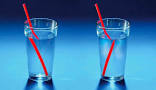
Which lens represents the path light takes through a diverging lens?


what is A on the diagram?
center of curviture
focal length
reflected ray
focal point
Which figure represents the path light takes through a converging lens?
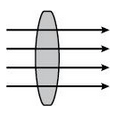
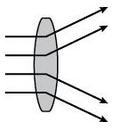
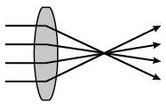
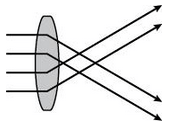

Which diagram represents diffuse reflection?
A
B
C
D

Which diagram represents specular reflection?
A
B

