wayground logo

Free Printable Worksheets

Font size

S
M
L
XL
Worksheets

PSB Final Exam Review

Total questions: 51

Worksheet time: 39mins

Name
Class
Date
1.
Particles in this state of matter are moving the fastest.
a)
solid
b)
liquid
c)
gas
2.

This state of matter takes ONLY the shape of its container.

a)

liquid

b)

gas

c)

solid

3.
This state of matter keeps its shape and volume.
a)
gas
b)
solid
c)
liquid
4.
In this state of matter, there is a strong attraction between molecules and they cannot break away from each other. 
a)
solid
b)
liquid
c)
gas
5.

In this state of matter, the molecules have enough energy to completely separate from each other.

a)

gas

b)

solid

c)

liquid

6.
When boiling water creates steam.
a)
condensation
b)
melting 
c)
freezing
d)
vaporization
7.

When a solid changes straight to a gas.

a)

condensation

b)

sublimation

c)

deposition

d)

freezing

8.
Which of the following would increase the (gas) pressure of a system?
a)
Increase the Temperature
b)
Pump in more gas
c)
Decrease the volume
d)
All of these
9.

If the temperature of a gas decreases, the pressure...

a)

Decreases

b)

Increases

c)

Does not change

10.

The kinetic molecular theory of matter states that all of the particles that make up matter are constantly

a)

growing

b)

shrinking

c)

crying

d)

moving

11.
At higher temperatures...
a)
particles in an object have less energy
b)
particles in an object move faster
c)
a gas contracts
12.

When volume increases, pressure must...

a)

Increase

b)

Decrease

13.
2. A change of state from a liquid to a solid is called....
a)
Melting
b)
Freezing
c)
Evaporation
14.
7. All phase changes (changing states) requires energy to be added or taken away.
a)
True
b)
False
15.

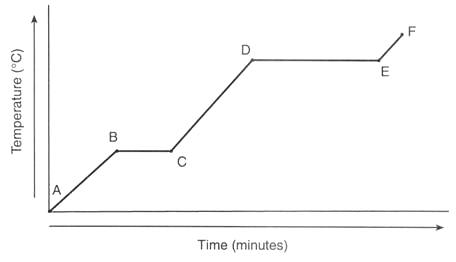
Between which two points is the gas heating up?

a)

A ----> B

b)

B <---- C

c)

C ----> D

d)

D ----> E

e)

E ----> F

16.

Between which two points is the solid cooling?

a)

A <---- B

b)

B <----> C

c)

C <---- D

d)

D <----> E

e)

E <---- F

17.
Between which points is the temperature of the substance remaining constant?
a)
A-B only. 
b)
A-B, C-D, E-F
c)
B-C only. 
d)
B-C, D-E
18.
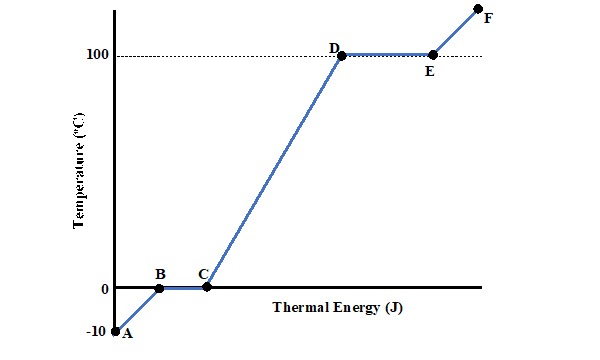
A substance's heating curve is shown in the graph.  What is its boiling point?
a)
100 C
b)
60 C
c)
80 C
d)
20 C
19.

Where on the graph are phase changes taking place?

a)

1

b)

2

c)

3

d)

4

e)

5

20.
Which one of the following would you use to separate sand from iron filings?
a)
a bar magnet
b)
filter paper
c)
chromatography paper
d)
alum
21.
Separating mixtures based on boiling points.
a)
Desalination
b)
Distillation
c)
Decantation
d)
Condensation
22.
a)
element
b)
compound
c)
mixture of elements
d)
mixture of compounds
23.

This diagram represents...

a)

An element

b)

A molecule

c)

A compound

d)

A mixture of elements and compounds

24.
a)
element
b)
compound
c)
mixture of elements
d)
mixture of compounds
25.
a)
element
b)
compound
c)
mixture of elements and compounds
d)
mixture of compounds
26.

The positive particles of an atom are

a)

electrons

b)

positrons

c)

neutrons

d)

protons

27.

The central region of an atom where its neutrons and protons are is its

a)

nucleus

b)

electron cloud

c)

core

d)

center

28.

In the modern periodic table, elements are arranged by:

a)

atomic mass

b)

atomic number

c)

valence electrons

d)

number of isotopes

29.

An atom with atomic number 6 would have how many protons

a)

6

b)

12

c)

3

d)

cannot be determined

30.

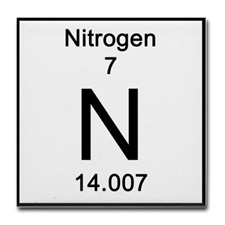
What is the number of protons that the element in this image contain?

a)

14

b)

7

c)

15

d)

18

31.

The number of neutrons in an atom =

a)

protons - neutrons

b)

mass number - protons

c)

protons - neutrons

d)

mass number - electrons

32.

What is the mass number of this Carbon atom?

a)

8

b)

12

c)

6

d)

15

33.
How many electrons does the pictured krypton atom contain?
a)
84
b)
36
c)
48
d)
120
34.
How many electrons on in this atom of nitrogen?
a)
15
b)
7
c)
3
d)
10
35.
What element is this?
a)
Sodium
b)
Magnesium
c)
Carbon
d)
Oxygen
36.
An atom has 16 protons and 18 electrons.  What is the charge on the atom?
a)
0 (neutral)
b)
+2
c)
-2
d)
-18
37.
What is an isotope?
a)
An atom with a charge
b)
The same elements that have different masses
c)
An atom with more protons than electrons
d)
Two elements with the same number of neutrons
38.
Which subatomic particle was discovered by Thomson?
a)
Electrons
b)
Protons
c)
Neutrons
d)
Quarks
39.
What is the charge for the atom in the diagram?
a)
0 (neutral)
b)
+3
c)
-3
d)
-10
40.
How many valance electrons does Aluminum have?
a)
1
b)
2
c)
3
d)
4
41.
What types of substances are brittle?
a)
Metals
b)
Nonmetals
c)
Metalloids
42.
What types of substances conduct heat and electricity well?
a)
Metals
b)
Nonmetals
c)
Metalloids
43.
Each column in the periodic table is called a 
a)
period
b)
group
c)
cluster
d)
unit
44.

Which element is not a metal?

a)

Ca

b)

Re

c)

Al

d)

B

45.
Which is a halogen?
a)
Helium
b)
Chlorine
c)
Oxygen
d)
Neptune
46.
Which is an alkali metal?
a)
Magnesium
b)
Iron
c)
Sodium
d)
Europium
47.
A horizontal row of elements in the periodic table.
a)
column
b)
group
c)
period
48.

Which color on the image of the periodic table corresponds with the halogens.

a)

red

b)

black

c)

blue

d)

orange

49.

Which color on the image of the periodic table corresponds with the noble gases.

a)

red

b)

black

c)

blue

d)

orange

50.

Which color on the image of the periodic table corresponds with the metalloids.

a)

bright yellow

b)

gold

c)

teal

d)

light blue

51.

Which color on the image of the periodic table corresponds with the transition metals.

a)

red

b)

black

c)

blue

d)

orange