
 Worksheets
Solutions Acids and Bases
Total questions: 50
Worksheet time: 50mins


At what temperature can you fully dissolve 140g of NaNO3?
62
73
81
You cannot determine this

The sugar solution needs ___ grams of solute dissolved in 100ml of water at 60⁰ C to make the solution supersaturated
200 grams
350 grams
500 grams
300 grams
Oil does not dissolve in water. Which term would best describe a mixture of oil and water?
miscible
immiscible
saturated
unsaturated

What term is used to describe two liquids that will mix and dissolve in each other?
miscible
liquid
immiscible
gas

How much KNO3 solute is saturated at 40 degrees?
75
55
65
85
What type of a solution is 60g NaNO3 at 40ºC in 100g H2O?
Saturated
Unsaturated
Supersaturated
If 2.5 L of a 4M solution of FeCl3 is diluted to a volume of 6 L by the addition of water, what is the molarity of the diluted solution?
2.5 M
4.17 M
6.25 M
1.67 M
What is the molarity of a solution made by diluting 26.5 mL of 6.00M HNO3 to a volume of 250.0 mL?
15.9 M
0.636 M
0.642 M
1.59 M
125.0 mL of 2.00 M calcium hydroxide solution is diluted to a concentration of 1.50 M. How many mL of water was added to the original volume?
167 mL
42.0 mL
93.8 mL
0.0240 mL
As we dilute a solution.....
The volume increases and the molarity (M) increases
The volume increases and the molarity (M) decreases
The volume decreases and the molarity (M) increases
The volume decreases and the molarity (M) decreases
How many mL of stock solution of 2M NaCl do you need to prepare 100 mL of 0.150M NaCl?
7.5 mL
15 mL
1333 mL
200 mL
The pH of a solution is 8.43. What is the hydrogen ion H+ concentration?
3.7 x 10⁻⁹ M
2.7 x 10⁻⁶ M
1.0 x 10-8.43 M
1.0 x 10⁻¹⁴
If the [OH-] of a solution is 2.7 x 10⁻⁴ M, the pOH of the solution is
10.44
3.56
1.00
-4.43
if the [H+] of a solution is 8.4 x 10⁻³ M, the pOH of the solution will be
2.08
11.92
1.02
12.98
if a solution has a pOH of 5.2 the [OH-] of the solution is
6 x 10 6 M
6.3 x 10 -6 M
1.58 x 10⁻⁵ M
2 x 10⁻⁵ M
Limes have a [H+] of 1.3 x 10⁻² M. Their pOH is
1.89
12.11
1.03
12.97

When an acid and base has been neutralized the pH will be?
1
4
7
10
What is the pOH of a 0.0124 M HCl solution?
1.91
12.09
1.61
12.39

When the hydrogen ion concentration goes up, the pH ___
gets lower
stays the same
gets higher
goes toward 7
According to Bronsted-Lowry, what is the definition of an BASE?
a substance that donates a hydrogen (H+) ion
a substance that donates a hydroxide (OH-) ion
a substance that accepts a hydrogen (H+) ion
a substance that accepts a hydroxide (OH-) ion
What is being donated/accepted between conjugate acid-base pairs?
a hydrogen (H+) ion
a hydroxide (OH-) ion
water
a neutron

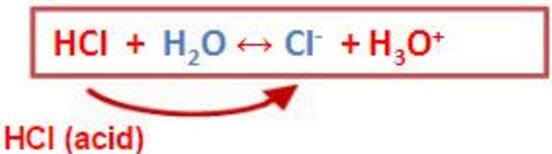
Which of the following is an Arrhenius Acid?
LiOH
CO32-
OH-
H3PO4
A bronsted lowry acid
produces hydroxide ions in a solution
is a proton donor
produces hydrogen ions in a solution
is a proton acceptor
An arrhenius acid
produces hydroxide ions in a solution
is a proton donor
produces hydrogen ions in a solution
is a proton acceptor
What is the [OH-] if the pH is 4.900?
7.94 x 10⁻¹⁰ M
1.00 x 10⁻⁴ M
7.94 x 10⁻¹⁴ M
4.90 x 10⁻¹⁰ M
In the following chemical equation, which compound is the Bronsted-Lowry base?
HCl + NH3 → NH4+ + Cl−
HCl
NH3
NH4+
Cl−
In the following chemical equation, which compound is the Bronsted-Lowry acid?
HCl + NH3 → NH4+ + Cl−
HCl
NH3
NH4+
Cl−
Identify the conjugate base in the following reaction: HNO₂ + H₂O ⇌ NO₂⁻ + H₃O⁺
HNO₂
H₂O
NO₂⁻
H₃O⁺
What happens when a strong acid is dissolved in water?
It partially ionizes into H3O+ and its conjugate base
It does not ionize at all
It completely ionizes into H3O+ and its conjugate base
It forms a precipitate.
NH3 + H2O --> NH4+ + OH-
What is H2O in this reaction?
acid
base
conjugate acid
conjugate base

